
Can you spot in Staithes...? Local Voices, Local Objects, Local Stories.

Updated: 1 day ago
This February half term, we set ourselves a simple but meaningful challenge: how can we help people see Staithes not just as a picturesque seaside village, but as a place layered with stories — stories that live in its cottages, ginnels, harbour walls, and in the objects carefully preserved in the museum?
This project was designed to connect local people with local history in a fresh and accessible way. By sharing selected objects from the museum’s collection alongside their wider village context, we wanted to show that our artefacts are not isolated behind glass cases — they are part of the fabric of Staithes. They belong to real people, real families, and real places that still shape the village today.
At the same time, we hoped to encourage visitors during half term to explore beyond the High Street. Staithes rewards curiosity. A turn down a narrow passage, a pause at the harbour, or a look up at an old cottage wall can reveal connections to fishing families, artists, sailors, shopkeepers and storytellers whose lives are reflected in our collection.
By sharing excerpts from the Facebook comments alongside the project, we are also celebrating something equally important: living heritage. The memories, corrections, additions and personal recollections shared by local people are part of Staithes’ ongoing story. They enrich the historical record and remind us that heritage is not static — it grows through conversation.
For us, this project has been about access in its widest sense. Not just physical access to objects, but access to meaning. It demonstrates how museum collections are strongest when they are rooted in community, and how local history becomes most powerful when it is recognised as belonging to everyone.
We hope this blog allows you to explore those connections — and perhaps to see Staithes, and the museum, a little differently next time you visit.
Can you spot in Staithes... The Lifeboat Station? ⚓️

Take a walk to the very mouth of the beck on the Cowbar side of the village. This historic building hasn't always been a place of rescue; in the 1700s, the land was home to a rugged alum store.
The first official RNLI station opened here in 1875, using that same converted warehouse to house the boat. For decades, this was the heart of village heroism, where crews of "iron men" launched heavy wooden rowing boats down the slipway into the teeth of violent North Sea storms. Though the station has closed and reopened over the years—and the building even served as a private home for a time—it remains a symbol of Staithes' seafaring soul.
Museum Challenge! 🔎 When you visit the Staithes Museum this half-term, can you find the photo of Joe Ben Verrill?
Joseph Benjamin Verrill (1839–1910), known to everyone as "Joe Ben," was a legendary local figure and the first coxswain of the Staithes Lifeboat. Look for a framed "head and shoulder" portrait of a sturdy, bearded fisherman wearing a traditional sou’wester. He represents generations of Verrills who have pitted their skills against the sea.
Come and discover the stories of sacrifice and survival that built our village! 🌊
From the comments:
I think Nellie Ericsson mentioned him in her book.
-NS
Nice Gansey - aka Knitfrock Jacket? - lots of working Ganseys were mainly plain apart from some shoulder decoration, in this case k2p2 rib.
-Propagansey
Proud to say a distant relative of mine
-P. Verrill
Also mine! My late Mum’s maiden name was Verrill. my mothers family lived in Loftus, just up the coast. But they said they were Staithes Verrill’s and at one point the family were the landlords of the Cod and Lobster!
-RL
My nan and grandad moved to loftus, coronation road
-P. Verrill
I believe your nan and Grandad were Ike and Ethel Who were my great aunt and uncle!
-RL
Richard Lennard Richard you are correct they were my nan and grandad what a very small world
-P. Verrill
Amazingly my grandparents also moved to coronation road from bluejacket house. Into a house called Guelma. There must have been an exodus when coronation road was first built
-H. Verrill
Can you spot in Staithes... the Grinkle Miner’s Hospital? 🏥

As you leave the old village and reach the junction where Staithes Lane meets the main road (Lane End), look for a building featuring a very distinctive lantern turret or roof-light.
This was the Grinkle Miner’s Hospital, established in 1915 by Dame Gertrude Palmer. It was a purpose-built 6-bed facility designed to treat those injured in the local ironstone industry. Mining was a "robber economy" and incredibly dangerous; in its first 40 years, at least 21 miners were killed at the Grinkle pit alone. While it is a private house today, it later served as a maternity unit—meaning many of the Staithes locals you meet today were actually born in this historic building!.
Museum Challenge! 🔎 When you visit the Staithes Museum this half-term, can you find the bogey sprag?.
Working in the narrow, lightless "drifts" of the ironstone mines was a "rough business". This simple but vital piece of equipment—sometimes also called a "burr"—was used to prop or jam the wheels of the heavy ore wagons (bogies) to prevent them from accidentally rolling backwards or runaway in the dark, cramped tunnels. It was a basic but essential lifesaver for the men working "in the bowels of the earth".
Come and see the tools that built the industrial North! ⚒️
From the comments:
Been in this building one year when the Staithes arts festival was on - beautiful building!
-JT
I was born there in 1943. My mother and I lived there until1945 while my father was in the Royal Navy. The house was the home of Nurse Hannah Prior and her husband it known as Ridgemount. She was the local district nurse. It was part of my chilldhood until Auntie Prior retired. The dome referred to was beautiful stained glass I can remember the glass reflecting in the hall below.
-DG
I remember the stained glass as well was only looking at it the other day and thinking it is a shame it was changed. When I was little and Gran and Grandad lived on Capt. Cooks Close I remember Grandad knowing two ladies that lived there. He had a rather funny nick name for them but I do not recall their real names ? This would have been in the mid to late 70’s. I am glad I now know it was a former hospital as always wondered what it was all about!
-ALC
As children, we always knew it as ‘the hospital house’ Also, the two ladies, Lizzy and Phyllis Shippey lived at the other bungalow, on the corner of Captain Cooks Close. They use to keep everything clean and tidy, including all the grass around the bus shelter and the bank side!
-CP
That makes sense now as Grandad used to cresote the long fence at the back of his and used to talk to them when they were out and about!
-ALC
Can you spot in Staithes... Captain Cook’s Cottage? 🧭

Head to the winding Church Street to find the house where a global legacy began. While the building you see today isn’t in its original location, they say it was reconstructed using the very same stones salvaged from William Sanderson’s general store after it was washed down by the sea in 1812. Look closely at the door—it still features the iron knocker that a young James Cook likely used every day at work in 1745.
Legend has it that Cook’s transition from a shop assistant to a world-renowned explorer was sparked by a simple dispute over a coin. He was fascinated by a bright new shilling, minted by the South Sea Company, and swapped it from the till for one of his own. When Sanderson accused him of stealing, the fallout prompted Cook to leave Staithes for Whitby to begin the formal apprenticeship that eventually led him across the Pacific.
Museum Challenge! 🔎 When you visit the Staithes Museum this half-term, can you find a real South Sea Shilling on display? You can also spot a full-sized copy of Sanderson’s original shop to see how it looked before the waves claimed the shore where it once stood.
Discover how a single coin changed Cook’s career from shopkeeper to sailor! 🌊
From the comments:
My Staithes ancestors name was Crooks. My grandma thought we were descended from Captain Cook but after researching our family history, we are descended from Captain John Crooks. I’ve found photos of my family in the museum.
-JH
That's great! At the museum, we've actually been donated loads of materials related to the Crooks family, documenting their lineage from the 18th century to the mid-20th century. The collection includes genealogical records, personal artifacts, and details of their involvement in Staithes' maritime history.
Genealogical and Personal Records
The museum holds several documents tracing the family's history and vital statistics:
* Family Trees: There are specific family trees for William Crooks, John Crooks (covering 1870–1930), and a joint Crooks/Thompson family tree.
* Certificates: The collection includes the 1847 marriage certificate for John Crooks and Mary Ann Thompson, the 1854 birth certificate for Thomas Johnson (father John Crooks), and the 1890 marriage certificate for Thomas Crooks and Hannah Totman .
* Longevity and Service: The museum has newspaper cuttings regarding Mary Ann Crooks, who set a longevity record by living to age 92, and Pilot Officer William Gray Crooks, a decorated grandson of Captain J. R. Crooks.
* Captain John Richard Crooks: There are multiple records for this "Hinderwell veteran," including articles on his death at age 90, his diamond and 65th wedding anniversaries with his wife Hannah (nee Gray), and a photograph of the couple taken around 1936 .
Maritime History and Tragedies
The family's deep connection to the sea is documented through memorial records and crew lists:
* Lifeboat Disaster: A remembrance card exists for John Crooks, husband of Mary, who was lost in the 1888 Staithes lifeboat disaster at age 41 .
* Losses at Sea: The collection records the death of Isaac Crooks, lost in 1895 aboard the *Dianah & Elizabeth* . It also notes that Thomas and Isaac Crooks were saved from the coble *Ellenor* in 1870 by Thomas Crooks Snr. .
* Napoleonic Prisoner: During the Napoleonic era, Thomas Crooks was recorded as a prisoner of war held at Valenciennes.
* Crew Lists: An 1864 crew list for the yawl *Bluejacket* includes 17-year-old John Crooks as a fisherman . Another William Crooks was part of the crew that launched the coble *Louise Beckett*.
Artifacts and Photographs
Physical items and visual records in the collection include:
* The "Crooks" Shop: A "blown up" photograph shows a man standing outside a Staithes shop with the name "Crooks" on the front [2].
* Family Bible: The museum has a Bible presented to George Crooks in 1895.
* Photographic Collection: There are numerous photographs of family members, including the three brothers William, Tom, and Coates Crooks; a family group from 1890–1895 featuring Mary Anne Crooks; and photos of individuals such as Rachel, George, Ethel, and Cissie Crooks.
* Daily Life: A photograph captures Mrs. Crooks getting water, a stark reminder of village life before modern plumbing.
Origins and Trade
The sources note that the family's presence in Staithes likely began with William Crooks, a cooper who moved to the village from Sunderland in the late 18th century. The name Coates Crooks appears in later records, such as an 1890s family group photograph. These materials collectively highlight the Crooks family as one of the few long-standing, interrelated families that defined the Staithes community.
-Staithes Museum
Wow thank you so much. I do have a book someone wrote about the family at Staithes, it has a lot of information in it. I’m due another museum visit. We stayed in the cottage next to the Royal George, one of the Crooks homes. Coates is on a photo, taken outside it, along with Mary Ann and Therese. Mary Ann list part of her leg whilst chopping wood. Gangrene set in and part of her leg was amputated
The family fascinate me.

Photo is Coates Crooks
-JH
the family outside the cottage

-JH
Can you spot in Staithes... the Wesleyan Chapel? ⛪️
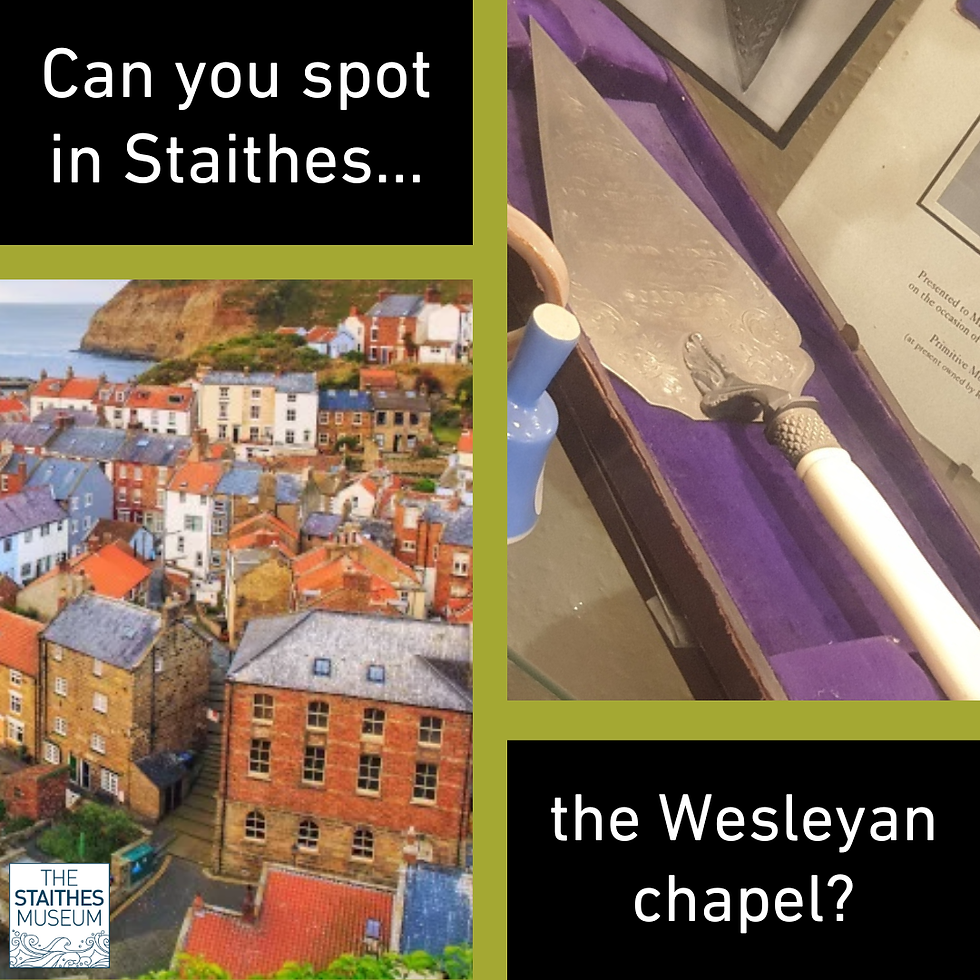
To find this historic building, look for the Chapel Yard opening off the High Street, or take in the best view of its impressive structure from the clifftops of Cowbar.
The chapel has a truly resilient history. When it was first opened for worship in January 1866, the building wasn’t even fully roofed yet! The congregation was so eager to start that they worshipped under a makeshift canopy of coble sails stretched over tree branches gathered from nearby woods.
Museum Challenge! 🔎 When you visit the Staithes Museum this half-term, can you find the ceremonial silver trowel? This exquisite object features a carved ivory handle and the Normanby coat of arms. It was used by the Marquis of Normanby to lay the chapel’s foundation stone on a cold, blustery day in February 1865.
Come and explore the "bricks and mortar" that served as an anchor for this community for over a century! ⚓️
From the comments:
I think I gave this trowel to Reg many years ago.
-NS
I was married there in 1977, my brother Colin Harrison married Marina Gaze in 1997. This is the commemorative teapot I have that my mother gave to me

-LS
Can you spot in Staithes... the Battle Stones? 🪨

Take a walk along the upper reaches of the beck, near where the massive pillars of the old railway viaduct still stand . In this part of the stream, you will find a set of stepping stones traditionally known as the “Battle Stones” (or “Battle steeans” in the local dialect) .
Before piped water arrived in the village in the 1890s, the beck was the primary source of drinking water for Staithes families . Villagers would venture to these stones where the water flowed most briskly to collect water from T'black watter streeam" . Women would carry this water home in wooden vessels called “skeels,” balanced perfectly on their heads.
Museum Challenge! 🔎 When you visit the Staithes Museum this half term, can you find a skeel in our collection?
These unique vessels were a source of great pride for Staithes families. They were typically made of oak with iron hoops and designed with a wider base than top to keep the water from splashing out. A single wooden stave was left longer than the rest to act as a handle.
To spot a true Staithes skeel, look for its distinctive bright green exterior and white interior, often finished with black hoops and the owner’s initials painted on the front by a local signwriter. You might even see the “roller”—a ring of plaited straw or cloth—that the women used to cushion the vessel on their heads!
Photo © Oliver Mills (cc-by-sa/2.0)
From the comments:
I remember when the battle stones were movable, so that the fishermen could take the boats up to Coble Gardens to work on them over-winter. They took them up on a spring (6 o'clock) tide, and brought them down on the same, months later. They were stored just round the first bend, on the village side of the beck, upside down (mostly) so they could be painted and repaired for the next season. The stones were sometimes a bit wobbly, but if you set off and didn't stop. you could make it over in one!
I used them everyday, going over to the gardens to feed the chickens and collect the eggs - and in the Spring to collect daffodils, to bunch and sell, and the Autumn to collect apples, pears, plums and brambles.
Once you got over the stones, and started walking up the bankside, the world went quiet, and you were in your own space - there could be dragons, monsters, nymphs, dryads - you were in your own little world...
-JRL
Jackie Roe-Lawton much more fun before these stones. the rocky ones were the best (years ago ) I used to go over up past the allotments and end up at top of Cowbar. Or turn left at end of stones we used to picnic. Happy days
-BMS
I walked over them 2-3 times a day in the 80s when I kept pigeons with Mrs Connie Calvert on the cowbar side right at the top where the railway bridge used to be
-JC
And when I was young we had dens up there in the old pigeon lofts!
-CP
I remember when they were actual stones, rather than concrete blocks - & yes, some were a bit shoogly! My dad used to go up the beck to fish, & my cousin Lynn & I to play when we took a nearby (Chapel Yard) cottage each Whit Week when I was wee 🙂
-LT
Three sets of battlies. Was up there most days as a kid
-SL
The first ones, then the second up near Coble Gardens, and the third when you got up near Hackets.. (now the caravan park)
-JRL
And there was always a little island up near Coble Gardens. Everything is overgrown now. We had a great time, with the twins, during lockdown (all very quiet) swimming and playing on their bodyboards up there.
-CP
Can you spot in Staithes... the path to Hinderwell Cemetery? 🪦

Take a walk up the winding Church Street and follow the old "Coffin Path" that leads over the fields to Hinderwell. For centuries, this was the route taken by grieving families to reach the parish churchyard, as Staithes had no cemetery of its own. When you arrive, look for the historic gravestones—many are adorned with moving symbols of the sea, such as anchors, ropes, and capstans, marking the resting places of dozens of drowned fishermen and sailors.
One of the many poignant stories in this graveyard is that of Francis Unthank, who was lost at sea in the 1899 Knight Commander disaster alongside his father and brother. Tragically, he was due to be married the very next Monday; the white tablecloth already spread for his wedding feast was instead used as his burial shroud.
Museum Challenge! 🔎 When you visit the Staithes Museum this half-term, can you find the poster of Harold Knight’s famous painting, "Grief"?
While many artists in the Staithes Group focused on the village’s "picturesque" charm, Harold Knight was known for his "uncompromising portrayal" of the community's darker realities. This powerful image depicts a widow in a traditional black Staithes bonnet—a garment strictly reserved for those in mourning. It serves as a devastating reminder of the "foreboding and anxiety" that was once a daily part of the seagoing life here.
Come and see the art that captured the true soul and struggle of our village! 🌊
From the comments:
I had many a walk that way with my aunt Vera when I was a kid. She delivered the post. My aunt Florrie delivered the papers.
-DP
Can you spot in Staithes... The Photographer’s House? 📸

Look up to the lane above the museum to find the distinctive bright yellow house known as "Photographer's House". This was once the residence and studio of Henry Charles Morley, a talented painter and photographer who, like Dame Laura Knight, moved to the village from Nottinghamshire in the late 1800s.
From this high vantage point, Morley captured the daily rhythms of the village, documenting the unique character of the Staithes Group of Artists and the local community through both his lens and his brush.
Museum Challenge! 🔎 Inside the Staithes Museum, can you find Morley’s large 1896 oil painting, "Early Morning, Beck Side"?.
This beautiful work depicts a woman wearing a traditional Staithes Bonnet walking along Beck Side, the area running adjacent to the High Street right opposite the museum. It is a perfect time capsule of village life from over a century ago, capturing the soft morning light on the very streets you are exploring today.
Come and see how the artists of the past saw our beautiful home! 🎨
From the comments:
It didn’t use to be called ‘The Photographers House’ that’s relatively new, name has changed. It was always called ‘The Studio’ or ‘Studio House’ I’ve also got lots of old family photographs that were taken there.
-CP
Can you spot in Staithes… The Staith?

Take a walk down to the very edge of the village to find The Staith, the robust sea wall and landing place that has served as the community's front line against the North Sea for centuries. Here, the women of the village would gather to wait for the fishing fleet or wade into the cold North Sea to help launch their husbands' wooden cobles. If you had been standing here a century ago, you would have noticed the women's incredibly graceful and upright carriage—this came from years of carrying heavy baskets of fish, sometimes weighing up to a hundredweight, balanced perfectly on their heads.
Museum Challenge! 🔎 When you visit the Staithes Museum this half-term, see if you can find the White Staithes Bonnet in our collection. While black bonnets were strictly for deep mourning and mauve was for the later stages of grief, white was the standard colour worn by village women for daily work.
These bonnets were ingeniously designed with a double crown to cushion those heavy loads and practical frills to prevent sea spray or water from running down the wearer's neck. Legend has it that a skilled Staithes seamstress could stitch one of these intricate, quilted bonnets in just one hour using a single yard of fabric. Staithes was the last place in England where women consistently wore these as daily working headwear, with the tradition surviving right into the 1990s.
Come and see the iconic headgear that became a symbol of our village’s strength and heritage!🌊
From the comments:
Black Staithes bonnet. My 3x gt grandmother Mary Ann Crooks nee Thompson wore one. Her husband Captain John Crooks died of malaria, after catching this on one of his travels. His grave is in Hinderwell churchyard, it has an anchor on it.
-JH
Can you spot in Staithes... The wreck of the Princess Clementine? 🚢

When the weather’s fine and the tide’s a long way out, take a walk out past the harbour towards the jagged rocks of Penny Nab and Penny Steel. This has always been a "notorious wrecking coast" in North Sea storms, and at low tide, the rocks can still reveal the skeletons of ships that didn't make it home. If you look closely among the tide pools near Penny Nab, you can still find rusted metal remnants from the wreck of the SS Princess Clementine.
For the hardy villagers, shipwrecks were a part of the "hidden economy"; whenever a vessel foundered, the community would rush to the shore to salvage driftwood for fuel or gather up "brash" (sea coal) washed out of the seams. It was a task for the whole family—in February 1886, the village schoolmaster recorded that his classroom was nearly empty because everyone was on the beach gathering the disgorged cargo of a wrecked coal ship!
Museum Challenge! 🔎 Inside the Staithes Museum, can you find the pair of bricks salvaged from the surf, which were salvaged from the Princess Clementine? They serve as a heavy, silent reminder of the many "pageants of the sea" that ended on our rocky shores. And as handy building materials for those who fetched them ashore after the wreck!
Come and touch the history that the waves left behind! 🌊⚓️
From the comments:
I remember going to long sands and seeing a wreck many years ago. Had to go as tide was turning
-BMS
1w
Those bricks which I'm told were bound for iron making furnaces in North East England can still be found in the rock pools and wedged between rocks on the scar. At low water during a spring tide, more of the Princess Clementine is visible.
-RP
Can you spot in Staithes... Dog Loup? 🐕🦺

Tucked away between the High Street and Gun Gutter, you’ll find Dog Loup (formerly known as Nanny Nick). Reputed to be the narrowest alleyway in the North of England, it measures a mere one foot nine inches wide—so narrow that you have to walk through it sideways if you are at all "wide or fat"!.
While it's a quirky photo spot today, it was once a vital part of village life. During violent North Sea storms, when waves crashed over the front of the Cod and Lobster, Dog Loup provided a safe, sheltered passage for villagers to move through the town. It also had a more mysterious reputation as a perfect escape route for smugglers looking to evade the portly "Revenue Men" in the village’s labyrinth of hidden passages.
Museum Challenge! 🔎 When you visit the Staithes Museum this half-term, can you find the Bols Genever bottles?.
This distinctive stone bottle once held Dutch Gin, a highly prized spirit often brought across the sea by sailors and alum workers. Staithes was a hub for the "fair trade," with contraband hidden in secret cellars and even a local spot known as "Gin Garth". Look for the bottle and imagine it being whisked through the narrow gap of Dog Loup under the cover of a dark, misty night!.
Come and see the hidden history of England’s most narrow escape! ⚓️🥃
From the comments:
My Mam used to shake her head with regret... "I used to be able t'walk thru that.. Then I had YOU lot!! Now I hatta gan through sidewards"
-JRL
Can you spot in Staithes... the Fishermen’s Institute? ⚓️

This historic building was a central hub for village life and the favourite haunt of one of Staithes' most legendary figures: Captain James Pinder (1840–1913).
Captain Pinder was a stocky, retired sea captain with a white pointed beard and a voice so powerful it was compared to a ship's siren. He was so respected that he was known to everyone as "T' King o' Steers". A man of intense discipline and fierce patriotism, he was famously known to get "worked up" during the Boer War, celebrating national victories with great passion from his home.
Museum Challenge! There’s been more than one king in Staithes! When you visit the Staithes Museum, can you find the photos of Prince Charles (now King Charles III) from his visit?
The museum’s collection includes 27 photographs of the then-Prince walking along the Staithes High Street on 1st June 1978. You can also find newspaper cuttings from the Whitby Gazette and Evening Gazette detailing his "tumultuous welcome," and even a commemorative mug made to mark the historic occasion!.
From the comments:
Martin Hopkinson & Keith Marsay looking on
-JH
My mum's aunt Anna handing over the cobble
-CA
Can you spot in Staithes... the Keel Lodges? 🏠

Perched high on the bank top overlooking the old village, these distinctive buildings have a history that stretches back over a century. Originally constructed as wooden barracks for housing troops during World War I, they were repurposed in the 1920s to become the Staithes Holiday Fellowship Camp.
Founded by Thomas Arthur Leonard, the Holiday Fellowship (now HF Holidays) was dedicated to providing "strenuous and simple" walking holidays for working-class families as an alternative to traditional seaside vacations. For decades, the camp was a place of transformation; for many children from cities like Manchester, it was their very first trip to the seaside. During the 1920s, it even hosted annual holiday trips for female workers from the Rowntree Cocoa Works in York.
Camp life was orderly and communal, with a rising bell at 7:00 a.m. and strictly timed meal shifts. While much of the camp has changed, Keel Cottages (and the area now known as Trig Point) still occupies three of the original World War I barracks, serving as a living link to the site's military and social history.
Museum Challenge! 🔎 When you visit the Staithes Museum, can you find the original Holiday Fellowship badge in our collection?
This small badge was once worn with pride by thousands of hikers and youth groups who journeyed to Staithes to explore the moors and the rugged cliffs. You can also look for our pictorial folding letter cards from the 1920s, which visitors would send home as a souvenir to tell their families about the "amazing" time they had at the camp.
From the comments:
Stayed there first time I visited with my school 50 years ago. Fell in love with the village and visit every year now
-AR
I used to stay in those huts when it was the annual St Judes choir boys holiday. Happy days.
-DR
Can you spot in Staithes... the Cod and Lobster? 🦞🐟

Perched at the very edge of the sea, this iconic pub has one of the most precarious positions in the village, being "buffeted by the waves on one side and motor vehicles on the other". Its location is so exposed that the building has actually been washed into the sea on four separate occasions, with the most recent destruction occurring during the devastating storm of 1953.
In the 19th century, the pub was the social heart for local fishing legends like "Jarge" Porritt. However, the sea was a constant and dangerous neighbor; during high tides and heavy gales, "tons of water" would crash over the bulwark, making it impossible to pass the corner without risk. One famous local tragedy tells of a man who left the inn at closing time on a wild night and was never seen again, having likely been swept into the sea just steps from the door.
Museum Challenge! 🔎 When you visit the Staithes Museum, can you find the old Cod and Lobster sign in our collection?
This sign is a remarkable survivor of the many battles the building has fought against the North Sea. The pub's name itself tells the story of the village's survival: the Cod represents the era of the great "five-man boats" and yawls that sought white fish on the Dogger Bank, while the Lobster represents the "potting" industry that sustained families after steam trawlers began to dominate the deep sea.
From the comments:
When it washed away in 1953, my grandad, John Thomas Roe (JonTom to his pals) worked for Willis's in Hinderwell. They were awarded the contract to re-build the cellars. The landlady was a notorious skinflint, and even though the cellars had been invaded by the water, the barrels were still there, full, and just covered with a cloth.
My great grandad had been an alcoholic, and my grandad (and my dad) didn't drink.
After a morning working in the pub, my nana could tell when my grandad was coming home for lunch - she could hear him slur-singing coming up the street!! The fumes from the beer, spewing out of the barrels was enough to make him, a man who to the best of my knowledge, NEVER touched a drop - roaring drunk!!
Before my husband replaced the dormer window at 3, Broomhill, where my grandad and nana used to live, the previous dormer was from the Cod - when it was washed away, there were still a few bits whole and unbroken - and the window was one of them. The Staithes ethos used to be "Ne'er let owt gan ti waste" - so the window was re-purposed as a dormer! Just like the old front door - it came off a German ship, wrecked during the war.
And the steps in the basement of Barber's Cottage - they were made of "target wood" - a specially prepared wood, steeped in chemicals that were designed to render it almost indestructible, as it was used as a target for the bombers and artillery to practice on, out at sea, and on the scaur.
When Aunty Nan (Hannah Harrison - nee Roe) died, we emptied the house. My dad cut up the steps, and gave them to me for the fire...As far as I remember, after a whole winter of TRYING to burn them, he remembered that they were target wood...Cheers dad!!
-JRL
Excellent service and food too
-JC
Can you spot in Staithes... the Royal George? ⚓

This historic pub on the High Street is one of the village's most enduring landmarks, with a name that echoes the dramatic "smuggling wars" of the 18th century.
In July 1777, a Revenue sloop named the Royal George was involved in a high-stakes naval chase to capture the notorious smuggling ship Kent. This was part of a long-running conflict; only a year earlier, the crew of the Kent had been involved in a violent battle with the Dragoons in Staithes, an affray that tragically left a soldier dead.
Museum Challenge! 🔎 When you visit the Staithes Museum, can you find the replica Harrison clock in our collection?
The pub is named after King George II, but it was King George III who was the reigning monarch during these smuggling battles. He was also a passionate patron of maritime science and exploration.
The museum's collection celebrates the genius of John Harrison, the man who invented the marine chronometer, finally allowing sailors to calculate their longitude and navigate the oceans safely. When the scientific establishment unfairly refused to give Harrison his rightful prize money for his invention, it was King George III who personally stepped in, famously declaring, "By God, Harrison, I will see you righted!". In our collection, look for the Congreve rolling ball clock and the Devon sea clock, which commemorate this incredible era of precision timekeeping.
From the comments:
The George was such a dive in the 70's. We were staying with my uncle on high street, family lived there from 1850's. Bumped into a half/quarter cousin there. Almost all Steers were related. So the conversation went like this. At we wondering how you couldn't know the fella 🤔 Sorry for blunt spelling, you can't spell Steers dialect.
"Do you knaw aud Billy?" "Nay dun knaw him" "Eye ya do, only got one eye" "Nay dun knaw him" "Stutters" "Nay!" "Lost his arm in Skinnygrove" "Nay!!" "Has a limp" "I dun knaw him!!! Why" "Aww he's deed." Us hastily leaving for bursting out laughing
-DP
My Crooks family cottage was next door. There are tales of smuggling from the pub to the cottage and vice versa.
-JH
What is the history of the pub?
-PT
The **Royal George** is one of the historic inns of Staithes, located on the High Street. Its history spans roughly two centuries, serving as a social hub, a place of business, and occasionally a site of " Wild-West" style brawls.
### Origins and Name
The pub is generally believed to have been named in honour of a famous ship, the **Royal George**, a 100-gun ship of the line that sank catastrophically at Spithead in 1782 with the loss of up to 1,200 lives. Staithes residents may have identified with this tragedy, as the opening stanza of William Cowper's poem on the loss is reproduced on the pub's menu.
Other possible connections to the name include:
* **William Sanderson Jnr.** (the son of Captain Cook’s employer in Staithes) served as a surgeon on a different, smaller warship also named the *Royal George* and died aboard her in 1767.
* The **Royal George** was also the name of a prominent seven-storey windmill in nearby Hinderwell.
### Notable Landlords and Characters
The pub has been home to several well-known local figures:
* **Thomas Seymour:** A landlord in the 1830s, Seymour was a pioneer in exploiting ironstone along the local cliffs.
* **Mrs. Walton:** In 1861, travel writer Walter White described her as a "portly, good-humoured dame" who could be heard laughing from across the street.
* **Thomas Spink:** A master mariner who ran the pub and brought his Russian wife, Natalia, back to Staithes to live there.
### Role in the Community
Historically, the Royal George was used for more than just serving beer:
* **Shipwreck Auctions:** It served as a venue for the auctioning of goods recovered from shipwrecks.
* **Inquests:** Official inquests were held on the premises. In 1878, for example, the body of an unemployed ironstone miner who had fallen from the Cowbar cliffs was brought back to the pub for such proceedings .
### Atmosphere and Reputation
In 1861, the pub was described as having a "low-ceilenged, subterranean feel," with the tap room and parlour sunk about three feet below the level of the roadway. While it was a "warm refuge" for some, others, like the Victorian lady Henrietta Crompton, complained that the "stench was beyond endurance" .
The pub also had a reputation for rowdiness:
* **Nineteenth-century brawls:** Cases in the Whitby police court recorded incidents like three miners kicking a police officer in the Royal George until he became insensible.
* **Modern incidents:** In 2009, a large fight involving thirty youths from Loftus broke out in the street outside the pub during Lifeboat Weekend.
Despite its rougher moments, it remains a central landmark in the village, with a large clock and barometer memorial located on the wall just outside.
-Staithes Museum
The first pub I went into with my parents while on a holiday in Staithes around 1962. Very happy memories.
-IC
Can you spot in Staithes... the Captain Cook Inn? 🍺

Located at the top of the bank, this well-known pub has a hidden history as a hub for 19th-century travellers. Before it took its current name, it was known as the Station Hotel, built to serve the passengers and workers of the Staithes railway station which sat just behind it. The arrival of the railway in 1883 was a landmark moment for the village, allowing local fishermen to transport their catch to distant markets much faster than the old carrier carts ever could.
Museum Challenge! 🔎 When you visit the Staithes Museum, can you find our photo of the old railway bridge?
This spectacular viaduct was once the most striking landmark in Staithes, spanning the deep valley with slender, graceful supports. It was a marvel of engineering, featuring tubular columns filled with cement, but crossing it could be a terrifying experience. Because the bridge was so high and exposed, special warning bells were installed to alert train drivers when the wind reached a dangerous velocity. On one famous occasion, a driver who couldn't hear the bell in a gale drove so fast over the viaduct that he overshot the station and had to reverse a very long way back!
Look for the photo in the museum and see if you can imagine the white-knuckle ride of crossing that deep valley in a North Sea gale!
Can you spot in Staithes... The Museum’s most unusual treasures? 🥫

Tucked inside the beautiful, converted Primitive Methodist Chapel on the High Street is a collection unlike any other. While many museums are formal and grand, the Staithes Heritage Centre is famously charming and quirky, thanks to the lifelong passion of its original creator, Reg Firth.
Reg was "mad about Cook" and spent decades hunting down everything from original 18th-century voyage accounts and receipted bills from the Sanderson shop to the most eccentric modern memorabilia,. He scoured auctions and eBay to find items ranging from a replica of Captain Cook’s sword to a taxidermy Hawksbill sea turtle (a favorite meal for Cook's crew!),. It is this mix of high-end history and fun, everyday objects that makes the collection so unique.
Museum Challenge! 🔎 When you visit the Staithes Museum this half-term, can you find the jar of smoked salmon with Captain Cook’s face on it?
Look closely at the display cases for a small brass badge or one of the vintage tins of sardines featuring the great navigator’s portrait,. Reg believed that if it had Cook’s face on it, it belonged in Staithes! It’s a perfect example of the "trove of treasures" you’ll find inside—from miniature Toby jugs and Commemorative mugs to a tiny ship in a bottle,,,.
Come and see how one man’s obsession turned a village chapel into a world-famous tribute to the "Seaman's Seaman"! 🌊⚓️
From the comments:
You see something different every time you visit
-JC
Last one
That’s the end of Can you spot in Staithes, but the archive (and our volunteers’ heads) are still full of fascinating stories about the village and the people who made it.. If I’ve missed you out this time, I’m sorry, and I’ll make some more next school holidays. I still have lots of stories to tell, for example…
• The 1888 lifeboat disaster, when the village spent a night in grief believing the entire crew had drowned, only to have them return by train the next morning after being rescued by a passing steamer.
• The Staithes Bonnets, which were more than just fashion; their colours told a story, with black worn for mourning and lilac or mauve signaling that a widow had reached "half-mourning".
• The secret smuggling tunnels and attic hatches that connected cottages along the beckside, allowing locals to evade the Customs and Excise men.
• How "Tange" Verrill got his famous nickname after he was caught as a young boy stuffing a whole box of mouldy tangerines down his jumper.
• The "Parliament" of retired fishermen who used to hold court on the benches by the sea, sharing tall tales and "deadpan" village humour.
Come and discover these stories and a thousand more at the Staithes Museum! 🌊⚓️


Comments