
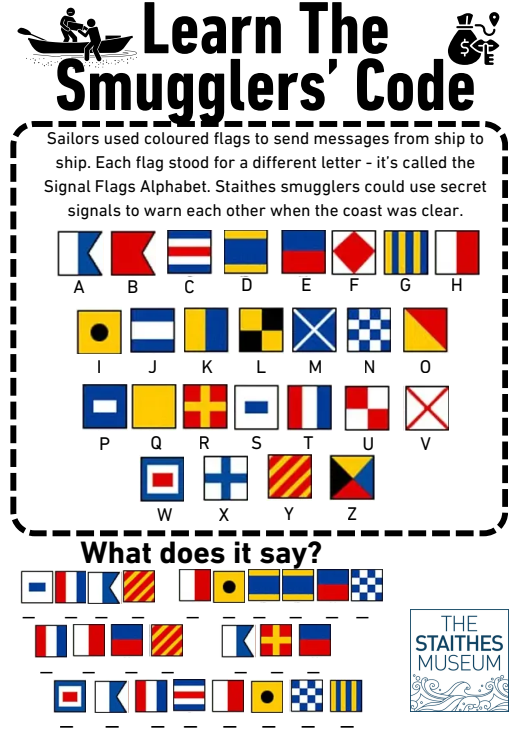
Learn the Smuggler's code with our latest educational worksheet!

For over a century after 1720, the village of Staithes was a major hub for the "Free Trade" - better known as smuggling. While official industries like fishing and ironstone production were important, smuggling formed a vital "hidden economy" that supplemented the income of almost every resident. The unique architecture of the town, with its labyrinthine network of passages, attic hatches, and hidden cellars, made it the perfect haunt for evading the law.
Smuggling was a true community effort; the sources reveal that everyone from fishermen and miners to local farmers and gentry was often in league with the smugglers. This illicit business was so successful that it allowed villagers to prosper, build new homes, and even purchase their own fishing vessels.
The people of Staithes used a sophisticated system of secret signals to communicate with smuggling ships like the Grey Dove or the Goedhoop. On washing days, women would hang sheets on the seaward-facing side of the Old Stubble hill; when arranged in a specific order, these acted as a code that could be read from vessels out at sea. At night, lookouts on Cowbar Nab (originally called Colburn or "Coal-burn" Nab) would light fires to warn the men in the beck if a Customs Officer was approaching. One of the most famous local code phrases was "Andrews' cow has calved," which signaled that a new cargo of contraband had been safely landed.
Hiding the goods—which included brandy, gin, tobacco, lace, and tea—required great ingenuity. Secret chambers were built into walls and floors; one such hole on Slippery Hill was discovered beneath a paving stone marked with the word "GIN". There is even a legendary story of a fisherman who tried to hide a bag of gold sovereigns from a searching officer by hanging it out of his window, only for the tide to wash his fortune away forever.
To help local families explore this exciting part of our heritage, we’ve created a "Smuggler’s Code" educational worksheet for the half-term holidays! Kids can step into the shoes of a "Smuggler’s Apprentice" and practice decoding secret ship-to-ship messages using maritime signal flags. They’ll also learn the difference between an "Owler" (who smuggled wool out of the country) and a "Hoverer" (who smuggled goods in) while hunting for hidden items in our smuggling word search.
Once you’ve mastered the code, why not visit the museum to see real artifacts from the smuggling days? You can see an original "gin" barrel, marlin spikes used by the sailors, and learn more about "Notorious Rascals" like John Wastell and Thomas Crispin. Can you crack the code and help "Andrews' cow calve" one more time?
P.S. a big thank you to David Tindale, who lent me the book, Owlers, Hoverers and Revenue Men by John Tindale, which I used to discover all of these facts!


This educational worksheet sounds like a bit of a fun and creative thing, to nudge learning through puzzles, codes, and those problem- solving moments. Honestly, as a student I find interactive resources more engaging, because they make learning feel less like work and more like something worth sticking with. And yeah, Ghostwriting kind of also leans on creativity, plus communication, showing how ideas can get shaped into content that holds attention. In other words it’s not just information, it’s more like a way to keep an audience interested, even when you’re doing it step by step.