
Staithes Museum Newsletter May 2026


Hello, all!
Please find linked here the latest Staithes Museum newsletter. A text-only version is below this message.
This month's edition includes updates on our rolling ball clock, a new family activity sheet inspired by Staithes smugglers, reflections from a museum symposium in Plymouth, an update on our social media experiments, and news of a rather unusual upcoming visit from some ghost hunters. There's also a look at what we're tentatively calling "The Bill Hinchley Effect" and the impact of our new film space.
All of our volunteers are very welcome to the next trustees' meeting on Thursday, June 18th at 18:00 - in the usual room above the art gallery - the Smugglers (Thank you, Dave and Al!)
As always, thank you for your interest in Staithes Museum, and for helping to support the museum and the stories of our village.
Best wishes,
Rosie
Hello!
I’ve just had an email from Accreditation, saying that a visit (and a final result) is not very far away. Meanwhile, my apprenticeship course is just getting more and more useful, and we’ve decided to invite some ghost hunters to the museum, to see if that’s a new and feasible way of making money in the cold winter months…

Supporting independent visits
This month, we welcomed two groups who chose to explore the museum through independent visits.
Pupils from Wellfield Middle School visited Staithes as part of a trip organised by their school, while a walking group from HF Holidays called in during their journey along the Yorkshire coast.
Independent visits give groups the flexibility to shape their day around the weather and other activities, while still allowing us to prepare for their arrival and make sure they have a great experience. We're always pleased when groups let us know they're coming, and it was a pleasure to welcome both parties to the museum!

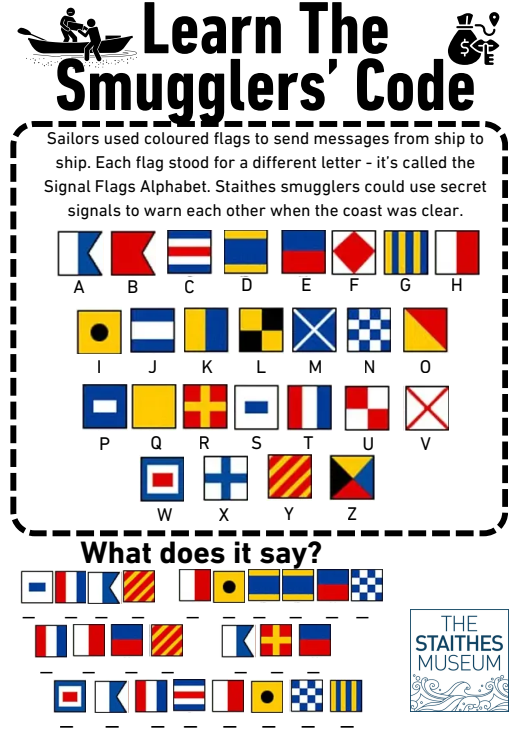
New Family Activity: Staithes Smuggler's Secret Code
Just a few days too late for half term, we've created a brand-new family activity sheet inspired by Staithes' smuggling past.
Young visitors can learn how sailors used signal flags to send messages, crack a real smuggler's code, discover secret words used by local smugglers, and hunt for hidden smuggled goods in a word search. They'll even have the chance to create their own coded message to send from Cowbar!
The activity is free and suitable for a range of ages. Printed copies are available to pick up from the Welcome Desk at the front of the museum, or can be downloaded from our website to enjoy at home.
Can you work out what the mysterious messages really mean?

End of Semester Reflections
As part of my apprenticeship, I've just completed a university module called Global Critical Context (and got 78% - as good as a distinction! Hooray!). . The course explored some surprisingly difficult questions about museums, and rather than leaving with answers, I mostly seem to have come away with better questions.
One idea that stuck with me was the suggestion that museums can sometimes become "freakshows of objects" – places full of fascinating things but not enough context to help us understand why they matter. It made me think about the balance between preserving mystery and telling meaningful stories.
I also found myself wondering whether museums are primarily for the dead or the living. Are we here mainly to preserve the past, or to serve the communities of today? And what happens when those two goals pull in different directions?
Another memorable discussion was about accessibility. We often think of access as opening the door, but perhaps real accessibility means actively helping people find their way in. It reminded me how much unseen work goes on behind the scenes to make museums welcoming places.
Perhaps the biggest surprise was discovering that the more you learn about museums, the more complicated they can seem. But I've come to think that good museum work isn't about having perfect answers – it's about continuing to ask thoughtful questions while still having the confidence to get on and do the work.
I'm sure I'll still be thinking about these ideas into the new semester starting this month - and hopefully by putting them in the newsletter, I can keep on thinking about them, even as new ideas start crowding in!

The Rolling Ball Clock Has Gone Up the Bank Again
Visitors to the museum may have noticed a small but very noticeable gap in one of our displays recently. Our rolling ball clock has temporarily disappeared from its usual spot — but don’t worry, it hasn’t gone far.
In fact, it’s gone on a familiar journey.
When the museum first acquired the collection years ago, the pair of clocks weren’t running at all. These clocks are famously delicate, temperamental things, and ours had fallen silent. A handy volunteer, Ken, agreed to have a look at it, carefully lifted it into the boot of his car, drove it up the bank to his workshop, worked some behind-the-scenes magic, and eventually brought it back ticking and rolling once more.
After all that effort, he apparently warned:“If you break it again, I’m not fixing it again.”
Well… never say never.
This week, the rolling ball clock has once again made the journey up the bank, this time with help from the Staithes Men’s shed, to give it a more thorough overhaul. The aim is not just to get it running again, but to make sure it keeps running reliably for many years to come.
And it deserves the care — because the rolling ball clock is one of the museum’s most fascinating objects.
What Is a Rolling Ball Clock?
The design is known as a “Congreve clock”, named after Sir William Congreve, who patented the mechanism in 1808. Instead of using a pendulum like a traditional clock, a Congreve clock measures time using a small metal ball rolling down a zig-zag track.
As the ball slowly rolls from one side to the other, it eventually reaches the end of the track and triggers the mechanism to tilt the whole tray in the opposite direction. The ball then rolls back the other way, and the process repeats over and over again. Each journey advances the clock hands, 15 seconds at a time.
They are mesmerising to watch — visitors often stand in front of ours far longer than they planned to, waiting for the ball to reach the end and flip the mechanism.
Brilliant… but Not Very Accurate
There is one small problem with Congreve clocks.
They are terrible timekeepers.
Even in the early 1800s, people realised that tiny changes — dust on the track, changes in temperature, wear on the ball, even the slightest unevenness — could affect how fast the ball rolled.
Modern collectors still joke about how difficult they are to keep running properly. One clock owner online described spending “4 hours a day for 6 weeks” adjusting his after years out of use.
But perhaps accuracy was never really the point.
Congreve clocks sit somewhere between scientific instrument, engineering experiment, and kinetic sculpture. They belong to a period when inventors were fascinated by unusual mechanical solutions and extravagant displays of ingenuity. Sir William Congreve himself was better known for developing military rockets than for making clocks.
Today, surviving examples are collected by museums and horology enthusiasts not because they are practical, but because they are wonderfully strange.
And ours has become one of the objects visitors remember most.
So if you notice the empty space in the gallery for now, don’t worry. The rolling ball clock is simply taking another trip up the bank — hopefully returning soon, polished up, properly repaired, and ready to keep rolling for many years to come.
Ghost Hunters at the Museum!
This winter, Staithes Museum will be welcoming some very unusual overnight visitors…
We are pleased (and perhaps just slightly nervous) to announce that paranormal investigation group Kindred Spirit Investigations will be visiting the museum for an overnight ghost hunt inside our historic 1880 Primitive Methodist Chapel.
Now, whether you believe in ghosts or not, Staithes certainly has enough stories to keep even the most sceptical visitor awake at night.
The village has always been rich in folklore, superstition, and tales from the sea. Generations of Staithes people lived with the dangers of storms, shipwrecks, illness, and sudden tragedy, and over time those experiences became woven into local legend.
One of the most famous stories is that of Hannah Grundy, a young girl tragically killed in 1808 by a falling splinter of rock while sitting on the scaur. According to local tradition, her ghost still wanders the cliffs and shoreline. Some say she appears transparent and floating above the sea where the cliff edge has long since collapsed away. Others insist she carries her severed head beneath her arm.
Then there is the eerie tale of Jack Robinson’s Beck, where a murdered man is said to haunt a lonely gorge outside the village. Local people claimed that on moonlit nights the water ran red with blood, while his “death groans” echoed on the wind.
Even the roads around Staithes had their haunted reputations. Older villagers spoke of the footpath past Hinderwell Cemetery with genuine fear. Some people were reportedly so frightened of walking past the graveyard after dark that they preferred to spend the night at Port Mulgrave rather than brave the route home.
And, of course, no Staithes ghost story collection would be complete without the Mermaid’s Curse — the legend that captured mermaids cursed the village with the prophecy: “The sea shall flow to Jackdaw’s Well.” After violent storms destroyed homes at Seaton Garth, many believed the curse was slowly coming true.
Kindred Spirit Investigations will have access not only to the old chapel building itself, but also to the museum’s collection of thousands of historic objects — including the original tools, clothing and household objects connected to life in Staithes.
The visit is also an exciting opportunity for the museum to reach new audiences during the quieter winter months. Paranormal events at historic buildings have become increasingly popular across the country, and we hope the evening will introduce a whole new group of people to the extraordinary history, folklore, and atmosphere of Staithes.
We can’t promise ghosts… but the museum certainly has stories to tell.

Social Media, Hashtags, and the Mystery of 90,000 Views
One of the big things we’ve been experimenting with recently at Staithes Museum is social media.
At the moment, our approach is quite simple:post something every day, see what people respond to, and slowly work out what makes people curious enough to stop scrolling and engage with a small independent museum.
Some days this means serious local history.Some days it means obscure fishing objects.Some days it means making memes about visitors touching the taxidermied turtle.
Surprisingly, all of these have their audience.
This month alone, our posts reached around 90,000 views — which, for a museum of our size, feels slightly surreal. A year ago, many of our posts struggled to reach a few hundred people. Looking at the graph of our growth over the past three years feels a bit like watching somebody walk along the high street, and then suddenly get to Staithes Bank.
But the interesting part is what people actually respond to.
After analysing hashtags and post performance, some patterns started emerging.
Posts connected to a strong sense of place do particularly well:
all performed very strongly for reach and engagement.
Meanwhile, our most consistently successful content of all has been the “Can you spot in Staithes…?” series. These posts invite people to identify tiny details hidden in old photographs or paintings of the village — and people absolutely love them.
I think part of the reason is that they transform visitors from passive readers into active participants. Instead of simply being told about heritage, people get the satisfaction of noticing things for themselves.
It also turns out people enjoy feeling clever online.
One unexpected finding is that very broad museum hashtags like #museum or #MuseumLife often perform worse than very local or specific ones. The internet seems to reward personality and specificity more than generic “museum content”. People are not necessarily searching for a museum. They are searching for Staithes.
In a strange way, the more local we become, the more global our reach seems to get.
If 90,000 people are viewing our content online… why hasn’t that translated directly into huge increases in physical visitors? Am I just spending five hours a week writing social media stuff when I could be doing something more useful for the museum? Is this free advertising and great community engagement? Then why haven’t our visitor numbers gone up?
Part of the answer is probably practical: many people discovering us online live nowhere near Staithes. Social media also encourages quick curiosity rather than long-term commitment. A person might watch three videos about the old village while sitting in Australia at midnight and never realistically visit the museum.
But it also raises a more interesting possibility: perhaps online engagement is valuable in itself.
Historically, museums often measured success through physical footfall alone. But social media allows museums to exist in people’s lives differently — as entertainment, education, conversation, memory, local pride, or even just a pleasant distraction during somebody’s lunch break.
Of course, there is still the eternal museum question:how do we transform online attention into meaningful long-term support?
We do not fully know the answer yet.
At the moment, we are still experimenting :trying different hashtags, different tones of voice, different types of photographs, shorter videos, quizzes, behind-the-scenes posts, and stories from the collection.
Some things fail completely. Some unexpectedly take off. And occasionally, the internet decides that a tiny fishing village museum should suddenly appear on 30,000 people’s phones for reasons nobody entirely understands. Which, honestly, feels quite fitting for Staithes.
Hashtag | Times used | AVERAGE of Reach | AVERAGE of Views | AVERAGE of Engagement | AVERAGE of Engagement Rate |
5 | 4,842.80 | 7,305.00 | 233.40 | 4.48 | |
4 | 4,572.00 | 6,984.50 | 221.00 | 4.85 | |
4 | 2,851.00 | 4,443.00 | 184.25 | 8.59 | |
7 | 2,272.14 | 3,486.43 | 114.57 | 7.23 | |
4 | 2,509.25 | 3,110.75 | 84.00 | 3.37 | |
20 | 2,018.05 | 3,076.25 | 111.85 | 6.52 | |
4 | 1,645.75 | 3,060.25 | 143.50 | 53.21 | |
5 | 1,874.20 | 2,682.20 | 96.60 | 5.37 | |
8 | 1,607.00 | 2,517.63 | 76.88 | 18.37 | |
9 | 1,669.89 | 2,400.67 | 72.89 | 5.79 | |
4 | 1,437.00 | 2,207.25 | 70.25 | 4.99 | |
17 | 1,486.29 | 2,189.06 | 90.47 | 12.98 | |
8 | 1,075.13 | 1,957.38 | 82.50 | 52.87 | |
22 | 1,260.00 | 1,798.41 | 64.00 | 10.90 | |
4 | 1,260.75 | 1,718.25 | 68.00 | 29.10 | |
9 | 1,126.67 | 1,602.00 | 61.78 | 18.15 | |
39 | 1,010.28 | 1,534.85 | 58.15 | 21.04 | |
9 | 911.89 | 1,390.00 | 55.00 | 7.94 | |
5 | 938.20 | 1,360.40 | 61.80 | 6.01 | |
147 | 892.85 | 1,332.42 | 56.33 | 30.69 | |
4 | 843.75 | 1,203.00 | 49.00 | 5.36 | |
4 | 851.00 | 1,200.25 | 47.50 | 5.11 | |
22 | 731.32 | 1,037.32 | 42.18 | 15.30 | |
4 | 927.00 | 1,030.50 | 35.75 | 29.49 | |
76 | 656.89 | 1,003.58 | 38.14 | 39.50 | |
5 | 637.40 | 939.80 | 57.40 | 10.27 | |
5 | 616.60 | 888.60 | 49.20 | 8.45 | |
8 | 602.38 | 829.75 | 48.00 | 8.08 | |
12 | 550.75 | 773.92 | 44.67 | 8.17 | |
6 | 496.50 | 765.67 | 44.67 | 9.26 | |
5 | 385.40 | 731.60 | 18.40 | 42.19 | |
7 | 399.71 | 695.43 | 20.86 | 31.97 | |
4 | 498.75 | 642.50 | 38.25 | 75.81 | |
5 | 441.20 | 637.80 | 36.20 | 26.49 | |
12 | 466.08 | 637.08 | 34.17 | 68.89 | |
5 | 412.60 | 604.40 | 30.60 | 7.38 | |
4 | 290.50 | 417.50 | 28.50 | 53.39 | |
5 | 246.00 | 369.00 | 21.00 | 7.70 | |
5 | 228.80 | 350.60 | 26.60 | 65.56 | |
7 | 127.00 | 193.43 | 13.43 | 73.41 | |
5 | 98.40 | 172.00 | 7.60 | 43.40 | |
6 | 61.67 | 121.67 | 11.00 | 85.44 | |
4 | 25.50 | 44.75 | 25.50 | 100.00 | |
Grand Total | 1217 | 921.5957272 | 1372.408381 | 53.35004108 | 26.1910458 |

Shall We Call It... the Bill Hinchley Effect?
When we decided to transform the second shop into a small film space, it felt like a bit of a gamble. Would visitors miss the extra retail space? Would anyone actually sit down and watch a film while visiting the museum?
The verdict is in: everyone seems to love it.
Visitors have described the film as funny, heartwarming, and packed with surprising stories. Even local people who know Staithes inside out have been coming out saying, “I'd never heard that before!”
The film, featuring the wonderful Bill Hinchley, has quickly become one of the highlights of a museum visit. It gives people a chance to sit down, rest their feet, and spend a little longer exploring the village's history and character.
And perhaps there's evidence that people appreciate it. Since the film space opened, we've seen a noticeable increase in visitor donations. While we can't prove that it's all down to Bill, we're starting to wonder whether we might be seeing the beginnings of the "Bill Hinchley Effect"!
We're incredibly grateful to the North York Moors National Park for creating the film, and to Bill for sharing his stories! As well as enriching the museum experience, we hope it will help encourage walking tourism, give visitors another reason to spend time in the village, and provide an enjoyable attraction throughout the year, helping to extend the visitor season beyond the summer months.
If you haven't seen it yet, make sure you call in and watch it next time you're at the museum. Just don't be surprised if you leave having learned something new about Staithes!


Comments