
A Very Stern Captain Cook Returns Home

From the Staithes Museum Newsletter, June 2026
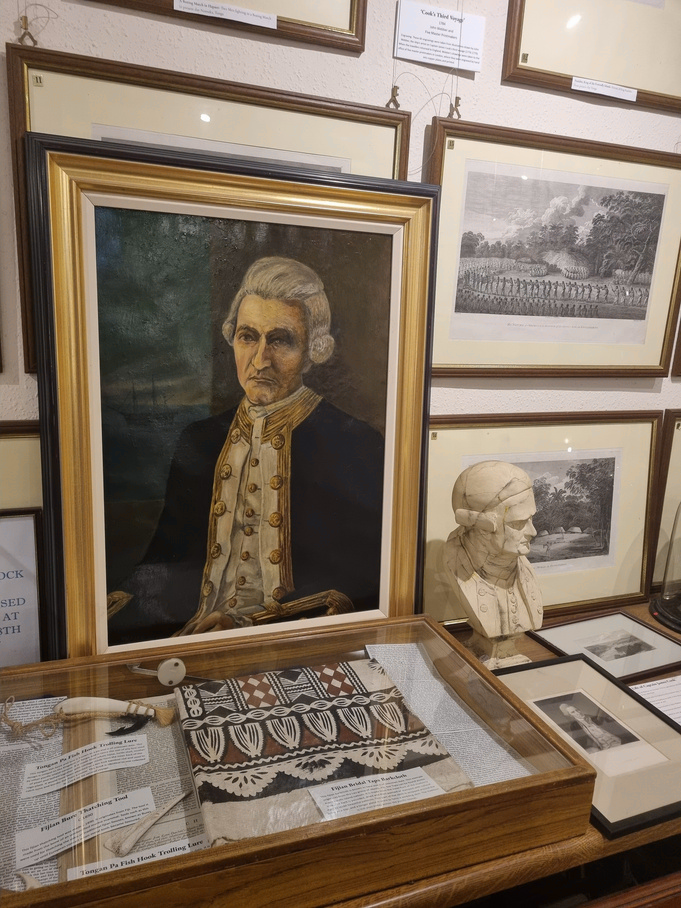
For over two centuries, the face of Captain James Cook has been an fixture of global history, appearing on everything from coins and stamps to commemorative plaques and statues. In the museum he appears everywhere - from statuettes to sardine tins. However, for those who seek to find the "real" man behind the navigator, the history of his portraits offers a series of competing and often contradictory identities. As the noted Cook scholar J.C. Beaglehole once admitted, after gazing with intensity at these portraits for years, he felt he had learned remarkably little about the man himself.
The Stern "Poster Boy": Nathaniel Dance (1776)
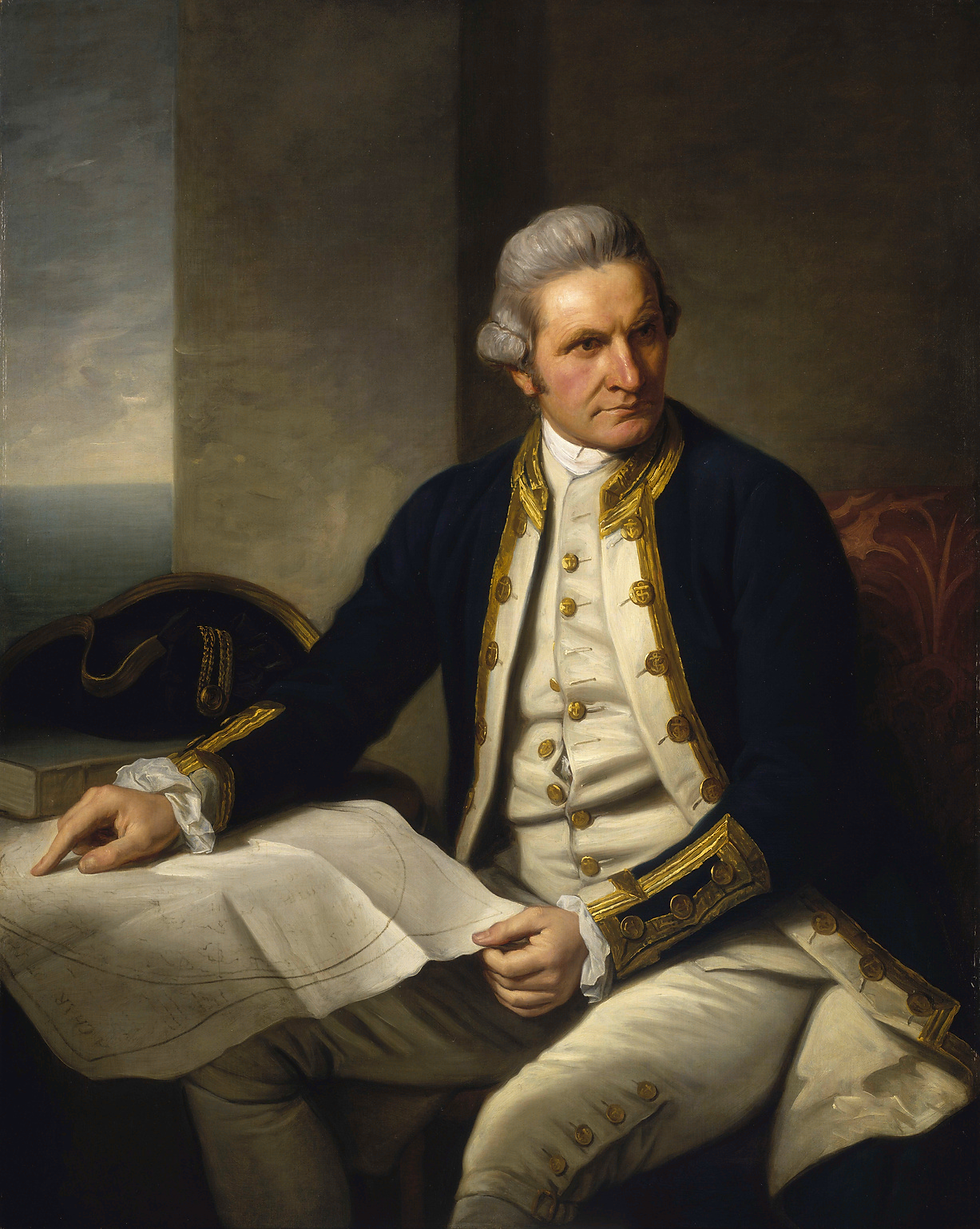
The most iconic image of Cook is the society painting by Nathaniel Dance, commissioned between his second and third voyages. This portrait presents Cook at the height of his fame, study-bound and studious, STUDYING a chart of the Southern Ocean. Interestingly, his wife, Elizabeth Cook, disliked the painting, finding his expression much too stern, though she admitted it was a reasonable likeness. Despite her reservations, Cook’s contemporary David Samwell claimed it was the only portrait he ever saw that bore a true resemblance to the captain. The painting serves as a theoretical statement on Enlightenment authority, with Cook's hand resting on a map that identifies and "collects" the nations of the Pacific into the European book of knowledge.
The Rugged Introvert: William Hodges (c. 1775–1776)
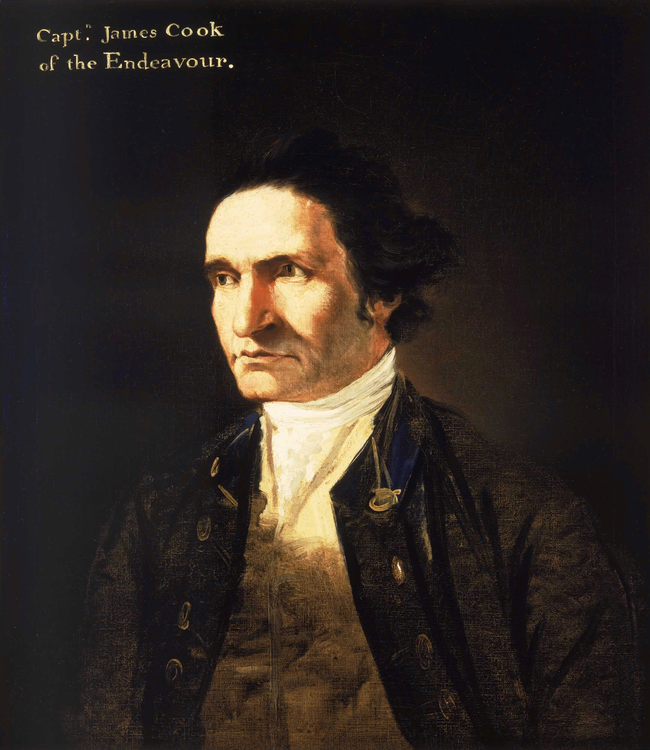
For over two hundred years, one of the most revealing portraits of Cook was thought to be lost. It was finally rediscovered at a country house auction in Ireland in 1986, where it was identified and eventually purchased by the National Maritime Museum for £700,000. Painted by William Hodges after Cook’s promotion to captain in 1775, this version is notably more modern in its treatment. It strips away the official naval trappings to focus on a rugged, powerful face marked by a distinct hint of introspection and even sadness, quite unlike the "machine-like" competence often attributed to him.
The Professional Scribe: John Webber (Third Voyage)

By the third voyage, John Webber was the official artist on board, tasked with supplying the "unavoidable imperfections of written accounts" through his drawings. Webber was a prolific worker who captured everything from plants and animals to the ceremonies of Indigenous peoples. He painted at least four portraits of Cook, including one at Cape Town in late 1776. Webber's work went far beyond mere likeness; his portraits were intended to be both "faithful and entertaining" for a massive public back in Britain.
Portrait as a Sacred Relic

One of the quirkiest chapters in the history of these images involves a portrait Webber painted of Cook in 1777 and left with the chiefs of Tahiti. In 1790, thirteen years after Cook departed, the Tahitians held a ritual ceremony for the picture. They uncovered their shoulders as a mark of respect, made a long speech acknowledging Cook as the "Chief of Matavai," and presented the image with a young plantain tree and a sucking pig. To the islanders, the portrait was not just a picture, but a manifestation of sacred power.
The Martyr Myth: The Death of Cook

The most widely reproduced image of the captain is Webber’s "The Death of Captain Cook," a studio reconstruction of the 1779 events at Kealakekua Bay. Although Webber did not witness the tragedy, his painting cemented the myth of the "martyred humanist". It depicts Cook in a self-sacrificial gesture, waving his hand to stop his marines from firing on the Hawaiians—a detail added to portray him as a "victim to his own humanity". This ennoblement reached its peak in the engraving The Apotheosis of Captain Cook, which shows him being drawn up to heaven by Britannia and Fame, notably clutching a sextant instead of a sword.
Today, these portraits are being viewed through a new lens. While they once represented a "noble project" of exploration, they are now often re-evaluated today as a symbol of "the fatal impact" that brought pathogens, guns, and dispossession to the Pacific. Whether seen as a "peerless navigator" or an "emblematic invader," Cook’s many faces continue to frame our understanding of the complicated legacy of empire.
2026 update
Catalogue reference: SSESM.2026.5
The portrait is by John White (RBA RI) 1851-1933. Restored by Paul Carr of Art of Oak, Wakefield. We are especially grateful that he generously donated not only his expertise, but also his time and materials. As a small independent museum, acts of kindness like this that make an enormous difference. His generosity has enabled us to preserve an important piece of our collection for future generations without diverting precious resources from other areas of the museum.
His craftsmanship, care and respect for the painting are evident in every detail. We know that countless visitors over the coming years will enjoy this portrait without ever realising the skill that went into bringing it back to life, but we certainly won't forget it.
Thank you once again for your generosity and for helping us preserve and share the heritage of Staithes. We are incredibly grateful for Paul's support, and we hope he will visit many times again to see his work being appreciated by our visitors.


Comments