
Laura Knight in Staithes: Fisherfolk, Shipwrecks and the People She Remembered

An artist’s memories of a Yorkshire fishing village, its extraordinary characters, its tragedies, and the people who helped her find her way as a painter.

Today, Staithes is admired for its colourful cottages, steep winding streets and beautiful coastline. But when the young artist Laura Johnson arrived in the village in the late nineteenth century, it was a very different place from the one we know today. Fishing was a dangerous and uncertain livelihood, storms could bring disaster within minutes, and the lives of the people who lived here were shaped by the North Sea in ways that visitors could scarcely imagine.
Laura, who would become Dame Laura Knight, arrived with her future husband, Harold Knight, and became fascinated by the world she found. She painted the fishermen, their wives and children, the boats and the beach. But she did much more than observe them from a distance. She was welcomed into their kitchens, attended their celebrations and funerals, listened to their stories, learned their customs and became caught up in the daily life of the village.
Her autobiography, Oil Paint and Grease Paint, contains a remarkable record of these years. It is full of wonderful characters, extraordinary episodes, sharp observations and moments of unexpected comedy. There are red-hot coals thrown at a passing steamboat, a shopkeeper who could sell almost anything, a retired sea-captain who became king of Staithes, and a terrible shipwreck that left an entire family waiting for their dead.
There are also children sitting for paintings in return for a few pennies, painters struggling to make a living, women carrying enormous weights of bait and nets, and the constant, uncomfortable knowledge that a fisherman who left home in the morning might never come back.
Knight's years in Staithes were among the most important of her artistic life - between the late 1890s and her departure for Cornwall in 1907. The autobiography itself shows that her time here was interrupted by periods away, including trips to Holland. But her heart remained here.
What follows is the story of Staithes as Laura remembered it: a place of enormous beauty, relentless work, dreadful loss and, above all, people whose names and personalities deserve to be remembered.

1. Arriving in Staithes: blown hats and a very unwelcome surprise

Laura's first visit to Staithes came after a difficult period of her life. She had studied art, worked in Nottingham and spent time in France, but she was struggling to develop her own approach to painting. Her sister Sissie had been unwell, and the arrival of their Aunt West from France brought an opportunity to escape the constraints of their everyday lives.
An art master, Thomas “Thor” Barratt, had recommended Staithes as a place to paint. He told Laura that there was nowhere better on the coast for an artist. The suggestion was enough to set the plan in motion. Aunt West took Laura and Sissie to the village with proper railway tickets, an extravagance compared with the complicated journeys Laura's mother had previously arranged when money was scarce.

Their arrival made an impression. Laura remembered the wind blowing fiercely through the carriage window and striking the outside of the train. On the platform, their skirts were blown over their heads, their hats flew away, and the air seemed to sweep through them. They walked to their lodgings at Mrs Crooks's in Church Street.
For Laura, this was the real thing: an unspoilt fishing village, not a fashionable seaside resort. It was a place where the work of ordinary life went on regardless of visitors, weather or appearances. Aunt West, however, was rather less well equipped for the experience. Dressed in her black French town clothes, she looked distinctly out of place. She could not understand the Yorkshire dialect, nor could the fishermen make much sense of her French-accented English.
Mrs Crooks of Staithes's black-and-white cat followed its mistress everywhere, even when she was washing dishes, laying the table or making beds. It was apparently an essential part of the household staff. They ate freshly caught fish, kippers smoked with oak chips, homemade bread and Yorkshire cakes. Mrs Crooks herself supplied an early taste of the local mixture of superstition and dark humour. She warned the young women that seeing two lice walking across one's forehead at the same time meant that something dreadful was about to happen. She had experienced it herself, she said, on the day her husband was lost in the lifeboat.
There were so many people in the party that not everyone could be accommodated at Mrs Crooks's. Harold slept at Tom Porritt's, in an old four-poster bed. He developed a rash and became so uncomfortable that the doctor was called. The doctor's diagnosis was wonderfully unromantic: Harold should get up immediately. The problem, he explained, was fleas.
Harold was transferred to an iron bedstead and suffered no more. It was a practical introduction to a place where the picturesque and the uncomfortable were rarely far apart.
2. A village unlike any other
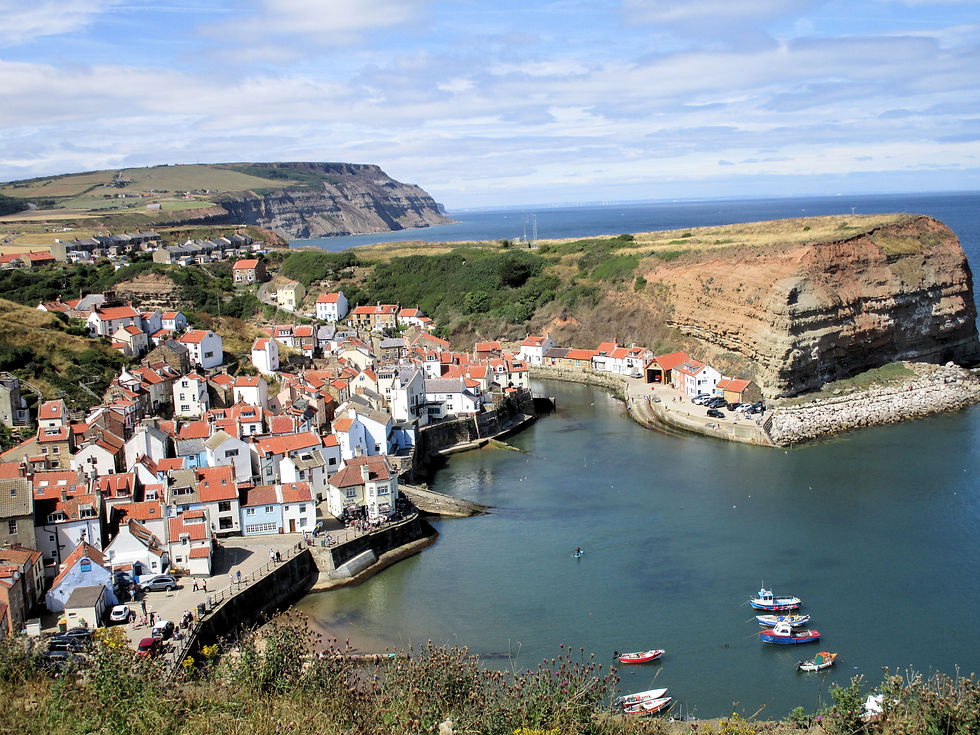
Laura tried to explain why Staithes had such a profound effect on her. She could describe its physical appearance, but the village's character was harder to capture. The houses seemed almost to have tumbled down the steep hillside between the cliffs. They jostled against each other as if they might push their neighbours into the sea. She compared the village to “a giant child's box of bricks thrown from the top.”
There were red-tiled and thatched roofs, brownish-yellow ironstone walls and occasional whitewashed cottages with green shutters. The wooden quay, known as the Staithe, stretched across the beach, offering some protection from the north-easterly storms. The Beck ran down from springs on the moor and into the sea.
Staithes was hemmed in by cliffs, but it never felt small to Laura. Its inhabitants, their work and their stories made it seem like a place containing an entire world. She described loving the freedom, austerity, wildness and savagery of the place. The people could appear stern and forbidding to outsiders, but she found warmth and generosity beneath that exterior. Life could move quickly from joy to tragedy, sometimes within the same household.
She felt that the village had everything an artist could wish for: every kind of light and shadow, colour and movement, beauty and ugliness. It was not only a place to paint landscapes or seascapes. It was a place to paint people.
She regretted that Staithes, as she had known it, could not be preserved. By the time she wrote her autobiography, the old bridge had gone, a new pier had been built and visitors came to bathe in the shelter of the harbour. Many of the people she remembered were dead. Her affection for the village was inseparable from her affection for its inhabitants.
When Aunt West decided she must return to France to see whether her husband, Arthur, was managing without her, Laura was devastated at the prospect of going back to Nottingham. She compared the experience to being given one lick of salt and then having the lump snatched away.
Harold stayed on in Staithes, hoping his father would lend him enough money to continue painting there until Christmas. Laura nervously approached Mr Knight on his behalf and was relieved when the older man agreed. Harold's letters described dramatic storms, ships driven ashore and fishermen escaping from wrecked vessels. These accounts only strengthened Laura's desire to return. The following year, she and Rosie Good went back for six months. This time, there was no mistaking Staithes for a holiday destination. It was somewhere they wanted to work.
3. The village at work: cobles, fish and the North Sea
One of the most striking things about Knight's account is how thoroughly she observed the everyday business of fishing. She watched men haul their cobles up and down the beach, women gut fish, buyers gather at the fish sales, and lobsters and crabs being laid out on the shore. She studied the baskets, barrels, nets, ropes, oars, sails and heavy clothes that made up the material world of the fishing community. She even recorded the appearance of the children carrying strings of coloured bladders used to buoy up the nets. To her, they resembled enormous bunches of grapes.
In the summer, she watched the last boats return in the evening, their sails catching the dying sunlight. Women carried men's meals down to the shore in tins, while others brought coals for the fires used to prepare bait. During the herring season, the whole village seemed to move at once. Nets had to be prepared, boats readied and crews organised. A good catch could make the difference between having money for the coming year and having to struggle through another winter.
Knight understood that the apparent romance of fishing concealed a great deal of labour. Women and older men did much of the work ashore. Women carried bait, gutted fish, mended nets and hauled heavy loads. The fishermen's children were frequently wet, barefoot and covered in sand.
The work could be physically punishing. Women travelled over the rocks at low tide to gather mussels, returning with enormous loads balanced on their heads. Knight described one woman carrying what she estimated to be about a hundredweight of mussels, walking with such ease that she seemed hardly to notice the weight. She was fascinated by the skill and strength involved.
She was also fascinated by the risks.
A gale at the quay

One afternoon, the weather turned so bad that the fishermen began rushing home. Mrs Crooks warned them that it was becoming “wildified” and that the boats were returning. A spring tide and the gale behind it threatened to flood the village. The slipways became jammed, so boats were dragged up wherever there was space. One coble hung on its ropes over the edge of the quay, balanced awkwardly across the timbers. The men feared it would break its back.
Then another boat appeared beyond Penny Steel. It was struggling through the breakers, its oars waving uselessly as the crew tried to bring it home. The entire quay watched. Shopkeepers left their shops, men shouted encouragement, and people who had been terrified for the crew began cheering as the boat reached safer water.
When it finally came ashore, men threw their arms around one another in relief. Within minutes, however, the embraces had become arguments and curses. The reaction after a frightening ordeal was almost as sudden as the relief itself.
Knight and Rosie had helped haul the boats in, adding their weight to the ropes. This was no distant spectacle for them. It was a world they were entering, and the people who inhabited it were gradually becoming their friends.
The dangers were not over when the boats came ashore
Knight and Harold owned a small, leaky pilot boat of their own. It was badly suited to the coast, with a rounded bottom that made it unsafe in rough water. On one occasion, while they were changing seats, they allowed it to drift towards the swell over the reefs at Cawbor (Cowbar) Steel. The boat suddenly rose in front of an enormous green wall of water. Harold managed to turn it towards the wave in time, and they rode over it before it broke.
After another dangerous outing, the fishermen decided they had seen enough of the young artists taking unnecessary risks. They contrived to wedge the pilot boat behind their own cobles at the top of the beach so that it could no longer be taken out.
Knight and Harold also gave up climbing the cliffs after being caught on a shifting shale bank above a precipice. Staithes was a place where the sea offered endless inspiration, but it did not forgive mistakes.
4. The Argys: politics, chapel singing and red-hot coals

Among the fishermen with whom Laura became friendly, several were called “Argy”. She explains that this was short for Isaac. The three men she mentions were Argy Verrill, Argy Theaker and Argy Porritt. The three were very different characters, but all became part of the world in which Laura and Rosie found themselves.
Argy Porritt lived near Mrs Crooks and regularly called to discuss politics with Mr Spence, a lay preacher who lodged in the young women's kitchen. Argy was a passionate radical, and conversations between the two men could quickly become heated. Laura remembered hearing Argy roar, “I'll tell you what, mister,” followed by what sounded like a terrible threat. Mrs Crooks reassured the frightened young women that the men were not about to fight. This was simply what a lively conversation sounded like.
Argy Verrill was a particularly important figure in Laura's life. Tall and broad-shouldered, with pink whiskers, a freckled face and pale blue eyes, he was a formidable presence. He also had a talent that Laura described with admiration: he could spit with astonishing accuracy without changing his expression. He led the singing at the Primitive Methodist chapel, known locally as the “Ranter Chapil”. At first, there was no musical instrument. Argy stood in the aisle, cupped his hand round his ear to help him find the pitch, and launched the hymn in his own key.
Eventually, a harmonium was purchased. The trouble was that Argy had no intention of surrendering his position as the chapel's principal singer. On the first Sunday, Argy and the harmonium started together. Some of the congregation followed him; others followed the instrument. It must have been quite a performance.
Yet Knight found the singing deeply moving, especially when the congregation sang “For those in peril on the sea” while a gale was blowing outside. She painted that subject and submitted it to the Royal Institute of Oil Painters, although the picture did not sell and she believed it was probably destroyed later.
Religion was a powerful part of life in Staithes. Knight attended the Ranters with her friends and was drawn into the emotional intensity of the Love Feasts, where people confessed their sins and sometimes declared that they would never drink again. The chapels and public houses, she observed, were in perpetual conflict.
Argy Verrill also took Laura and Rosie out in his boat and taught them to row. His idea of a suitable painting expedition was to take them to sea to haul up crab-pots. The experience was miserable. The boat smelled of fish, everything was wet, rain fell, and the crabs pinched their ankles. The tea they had drunk that morning had been made the previous night and left stewing on the hob. Laura was relieved to return to shore.
Argy Theaker had a different sort of reputation. One night he told the others how a steamboat had passed through his fishing nets, tearing them apart despite the riding lights. Furious, he threw red-hot cinders from his bogie fire at the man on the bridge, burning his own hands in the process. He was not the sort of man to let an injury to his livelihood pass unnoticed.
The Argys brought Laura into contact with the intimate, noisy world of the village. They were companions, storytellers, fishermen and characters whose personalities seemed almost as dramatic as the weather.
5. Argy Verrill's kitchen: herring, gossip and an unidentified sailor
When the sea was too rough for fishing, Argy Verrill's cottage became a gathering place. Laura described his kitchen as a regular salon. The fishermen sat around the fire, spat their chewing tobacco into a rag mat, and watched the herring grilling between a pair of twisted metal tongs. Argy insisted that this was the only proper way to cook herring. The oil ran from the fish, leaving the flesh dry and sweet. His red-haired daughter Ellen helped prepare supper and entertained the company.
The kitchen was filled with domestic details: a black cat rubbing against everyone's legs, dogs staring down from above, brass spittoons on the mantelpiece and the lamplight catching Argy's hair and whiskers. It was here that Laura heard stories of danger, loss and strange happenings along the coast.
One fisherman described finding a man lying face down over a boulder at the water's edge early one morning. The stranger had golden hair and appeared to be alive at first, but he was dead by the time he was carried home. He was buried at Hinderwell, but nobody knew his name. The man who told the story thought he might have been Swedish. It is a tiny story, but an intriguing one. Somewhere behind it was a real person, perhaps a sailor or a traveller, whose life ended on the Yorkshire coast and whose identity was never discovered.
Another tale concerned a man who found a large piece of jet exposed in the cliff. He sold it in Whitby for £500, a very considerable sum, but later returned to the spot while drunk to show his friends where he had found it. He fell from the cliff into the sea. Neither he nor the money was ever recovered. Laura heard stories like these while people gathered in Argy's warm kitchen. They were part of the village's memory: accounts of sudden wealth, foolishness, violent weather and lives ended without warning.
There were also more horrible tragedies. One fisherman and his nephew were returning from sea when the older man's coble was caught by a breaker. The nephew was thrown overboard. His uncle reached for him and caught only a thumb before losing his grip. The boy drowned.
The older man was haunted by the moment, always gripping his hand in a fist, imagining that he was still holding the boy's thumb. Eventually he had to go to hospital, where it was said that a blood clot had formed on his brain. The people of Staithes believed he died of a broken heart. His name is not recorded in Laura’s book, but it is in the museum’s archives - Isaac Porritt who lost his son Nelson in 1901.
6. Mrs George Porritt, Sally Hicks and the business of getting by

Not all of Knight's memories are tragic. Some of the people she describes seem to have existed chiefly to make other people's lives more cheerful.
Mrs George Porritt was one of the kindest and jolliest women in Staithes. She and her husband, George, welcomed Laura and Rosie into their kitchen and were always ready to offer them something to eat. If Mrs Porritt saw the young women in the street, she might call them in for a crab or two. George was popular too, although he sometimes returned home late from the Cod and Lobster. His wife would greet him by telling him he was “all stackery”; George naturally denied it.
Mrs Porritt had plenty of stories. She told the young women about a ship that had come ashore carrying coal. The cargo was thrown overboard in an attempt to refloat the vessel, whereupon the people of Staithes gathered up enough fuel to last them through the year. The Porritts filled every available space, including the area beneath their bed. She also described the old practice of “wrecking”, when people travelled along the coast with lanterns looking for useful goods from wrecked vessels.
Mrs Porritt was called upon when someone was ill or when a body needed to be prepared for burial. Laura remembered a particularly grim incident involving two elderly sisters who had not spoken to one another for twenty years. When one sister died, the surviving sister came to say goodbye. Mrs Porritt described how the woman began slapping the corpse's face and then dragged it around the room. Eventually, she decided that enough was enough, and put her to bed.
It is not difficult to imagine why people trusted Mrs Porritt with the practical work of caring for the sick and dead. She seems to have combined a sturdy sense of humour with considerable compassion.
Sally Hicks and the four fingers in the cart
Sally Hicks, a fish-buyer and friend of Mrs Porritt, was another of Knight's unforgettable characters. She was big, strong and red-faced, and drove her cart at an alarming pace, standing with her legs braced to keep it balanced over the cobbles.
One night, Sally was returning along the cliff road with the proceeds of her fish sales in her pocket when two men sprang out of a hedge. One grabbed the horse's head, while the other seized the back of the cart. Sally fought back with the tools of her trade. She used her whip against the man at the horse's head and then turned on the other with her fish-gutting knife.
She escaped. When she went to clean her cart the next morning, she found four fingers lying inside.
It is one of the most extraordinary little stories in the autobiography. Sally Hicks was clearly not someone to be intimidated easily.
Mrs Porritt and Sally also enjoyed travelling to Middlesbrough for a day out. On one occasion, the two women sat down in a public park to rest and were asked to pay a penny for their seats. Mrs Porritt refused indignantly. Sally, on the other hand, was happy to spend money when she was out enjoying herself. The incident gives us another glimpse of two women who had little intention of allowing anyone else to dictate how they should spend their time.
Frankie Seymour's shop
Frankie Seymour was the village shopkeeper, and Knight gives him one of her most affectionate portraits. His shop sold an astonishing range of goods, from cheese and paraffin to rusty tin-tacks and wedding dresses. People went in to buy a packet of pins and came out with a bundle of things they had never intended to purchase.
Frankie was an enthusiast. He could persuade customers that a length of poor-quality cloth was the finest material in the world, or that an indifferent piece of bacon would make a wonderful breakfast. His eyes seemed to look in different directions, and his false teeth had a habit of slipping down while he talked. His favourite expression of approval was a delighted exclamation about the dripping on a piece of bacon. Even years later, when Laura encountered Frankie and his wife in their best black clothes, he was still talking about it. Frankie eventually retired with a comfortable fortune.
The story is funny, but it also tells us something important about the village. The shop was a place of conversation and gossip as well as commerce. It was where people met, caught up with the latest news and perhaps bought a few things they did not need.
7. Fair time: black cakes, new clothes and the art of hospitality
The annual Fair was another important event in Staithes life. It took place every June, and preparations began weeks beforehand. Houses were cleaned and whitewashed, kitchen walls were covered with new wallpaper, and women carried tins of dough to the bakehouse to have their great black sweet-cakes cooked. A cake could cost as much as a pound in ingredients, an enormous expenditure for a family on a tight budget.
During Fair week, people entertained friends to tea. Invitations were issued in the direct village style: Mrs Crooks said you had to go to somebody's house that afternoon. The tables were spread with jams, gingerbread, spice-loaf, curd cakes and black cake. Guests were expected to sample everything. The warmth of the welcome was as important as the food. Knight remembered the heat of the kitchens, the smell of melting butter and the flowers growing in pots on the windowsills.
After the meal, a host might push back his chair and announce, with great satisfaction, that he was so full he could practically feel the food inside his mouth. Another favourite expression declared that someone was so thirsty that a flea could be crushed on their belly. Fair time mattered because it offered a break from the relentless labour of the year. Even families who had struggled to afford the ingredients for their cakes would find a way to take part.
Knight also remembered the Fishermen's Institute, where the men gathered to play bagatelle and smoke. She used a large room there as a studio, and the Institute later hosted an exhibition of the artists' work. Visitors paid threepence to see the pictures, and occasionally bought one.
The village was not indifferent to art. It had its own painters and its own audience, even if the Royal Academy proved more difficult to impress. At one exhibition, Laura and the other artists invited people from across the country to a grand private view. Tea was served and a sizeable reception attended. Unfortunately, not one of the pictures was accepted for exhibition at Burlington House.
There were concerts in aid of the Institute too. Once the official programme ended, the audience would call for “Jarge”, who would eventually rise to sing “Green Broom”, a song with a great many verses and a rather coarse ending. Staithes knew how to enjoy itself.
8. Captain Pinder, King o'Steers
A prominent figure in the village was Captain Pinder, a retired sea-captain who lived opposite Laura's cottage. He had a telescope and a lookout on a ledge outside his house. He could scan the coastline in every direction, and he had a flagpole on which he raised a Union Jack when there was a special occasion. His cottage was immaculate. He repeatedly whitewashed the walls and varnished the woodwork. Inside were pictures and models of ships, as well as glass bottles containing impossibly elaborate model vessels. Every evening he went to the Fishermen's Institute, where he held court while the men played bagatelle. He was known throughout Staithes as “King o'Steers”.
His greatest moment came during the Boer War. Captain Pinder became so excited by British military news that people feared for his reason. When Mafeking and Ladysmith were relieved, he organised public celebrations. The villagers crowned him king, placed him on a throne lashed to a lorry and paraded him through the countryside. His courtiers wore an assortment of colourful clothes found in their drawers, including an embroidered coat brought home by a sailor many years earlier. The streets were filled with bunting and paper flowers, while Captain Pinder waved his Union Jack like a sceptre.
The procession stopped at the public houses as the singing, shouting and noise became increasingly enthusiastic. Laura and Harold followed the celebrations as far as Runswick before Harold decided that things were becoming too rough.
The story has a wonderfully comic ending. Captain Pinder, who drank only water during the festivities, was nevertheless so exhausted and overcome by the excitement that he had to be lifted from the lorry and put to bed almost unconscious.
9. White Water: the Unthank family tragedy
The chapter of Knight's autobiography entitled “White Water” contains one of the most devastating accounts of life in Staithes.
The Unthanks were a fishing family, and the village was anxiously following the fortunes of their boat during the herring season. The crew consisted of a father and his two sons. They had been unlucky for a long time, but on this occasion they had achieved a particularly good catch. Their fish were sold at Middlesbrough for thirty pounds. The other boats had finished their work and left, but the Unthanks' boat was still unloading. Nobody expected them to attempt to return that night. They had little time to finish their work, let alone make another fishing trip.
Yet the family had every reason to want to get home. An adopted daughter was due to marry the eldest son the next day. The boat went out, and the weather turned dangerous.
Knight describes waking before dawn to hear a woman screaming in the street. The cries rose and fell in long, piercing notes. This was the “Death Wail”, the sound by which disaster was announced to the village.
The Unthanks' boat was missing.
By the time Laura and the others reached the shore, the sea had become a mass of white water stretching from the beach to the horizon. Among the foam and the reefs at Cawbor Steel, they could see fishing gear and net bladders bobbing on the water. As the tide went down, pieces of the boat's equipment appeared along the coast. Laura picked up a broken thole-pin. Burnt into it were the initials I. U.
Eventually, the searchers reached Sandy Wyke, where they found the coble itself, upright on its keel and almost entirely stripped of gear. Knight's description is chilling. The boat appeared whole and undamaged, yet it had been emptied of everything that made it a working vessel. It was as if its life had been taken away. Later that day, a procession of men approached the village carrying a long ladder. A body was lashed to it horizontally: the father, whose remains had been washed up farther along the coast. They carried him through the village to his cottage.
Inside, everything was ready for a wedding feast. The tablecloth had been laid, teacups and saucers were arranged, and the family had prepared to celebrate the marriage that should have taken place that day. The body was carried in. The crockery was pushed aside, and the white tablecloth was pulled away to cover the dead man. The wedding had become a funeral. The two sons were still missing.
Knight remembered the extraordinary stillness that came over Staithes. The children were kept indoors, the streets emptied, and the men no longer paced up and down the quay as they usually did when ashore. People who had lived in the village for years seemed to emerge from their houses to attend the funeral. The crowd was enormous.
Women dressed in black carried trays of wine and little cakes. A wreath was placed on the coffin, which was borne through the village and up towards the churchyard at Hinderwell. The crowd sang hymns as they walked.
But the tragedy was not over. The two boys had not been recovered, and their families continued to wait. For three weeks, the two young women in the household scarcely went to bed or removed their clothes. Friends remained with them, trying to help them endure the uncertainty.
Some three months later, it was whispered that a leg had been found. The initials on the stocking showed that it belonged to one of the boys. The men who discovered it buried it at the foot of the cliff, away from the reach of the sea. They did not want the family to know. But the news reached Aud Margaret Ann Verrill.
Knight calls her a strikingly beautiful old woman with a fierce temperament. Related to the Unthanks, she went straight to their cottage, burst into the kitchen and demanded to know why the remains had been buried without Christian burial. Her anger was not directed at the sea, which had already taken so much, but at the thought that a member of the family had been laid in the earth without the religious rites she considered proper.
The episode gives a glimpse of the intense communal obligations that held Staithes together. People who might argue, gossip or fight were still bound by family ties, faith and a shared understanding of what was owed to the dead.
After the funeral of the father, Mrs Crooks returned home ahead of the others, lit the fire and prepared tea. When the mourners came back, she was pleased that the funeral had been well attended. Her comment was that there had been a “grand comp'ny at t'funeral”. It is an almost startling example of the way humour, hospitality and grief could exist side by side.
10. “Aud Jarge”: George Longster and the lost brother
Another of Knight's memorable characters was George Longster, known as “Aud Jarge”. He lived in a small, whitewashed cottage on the quay and was a fisherman. His back was bent, his hands hung down towards his knees, and his face was surrounded by grey whiskers. Although he looked very old, he remained active. Knight admired him greatly. He was kind and gentle, and the villagers considered him one of the best men in Staithes. He was deeply religious and knew the Bible by heart.
His great sorrow was his younger brother, who drank heavily. One wild night, the brother left the “Cod and Lobster” at closing time and was never seen again. His body was washed up on the beach the following day. When the men carried the corpse up from the shore, Aud Jarge came out of his cottage and told them to put it down on the quay.
There, standing over his brother's body, he delivered an impassioned sermon. He prayed for forgiveness for the dead man, then warned the assembled crowd to turn away from sin before it was too late. The experience haunted him. Knight believed he never recovered from the thought that his brother might be condemned to eternal punishment.
Soon afterwards, Aud Jarge suffered a stroke. His sickroom became the centre of village life, filled with people who came to sit beside him, bring medicine and keep him company. He could no longer speak, but he was conscious of those around him. Knight describes him propped up in a four-poster bed, waving a peacock-feather fan, while visitors paid their respects. The bed had become almost a throne. A poor fisherman, whose life had been spent facing the elements to earn food for others, was now treated with the dignity of a king. When Aud Jarge died, there was another “big comp'ny” at his funeral, and he was carried to Hinderwell by his old friends.
A few days later, an elderly woman who had cleaned his house stopped Knight in the street. She had rarely spoken to the young artist before, but now she had something important to say: if Aud Jarge did not get to heaven, then there were plenty of other people in Staithes who would need to mend their manners. It is difficult not to like this woman, whoever she was.
Aud Jarge's faith could not save his brother from the sea, and it could not protect him from grief. But his neighbours gave him the affection and attention that he had spent his life giving to others.
For family historians, the name to look for is George Longster, indexed in the autobiography under “Longster, Aud Jarge”.
11. Children on the beach: Laura learns to see
If the sea and the fishermen supplied drama, the children supplied Laura with an endless variety of subjects. She spent long summer days on the beach, rocks and quay, recording the gestures and movements of children at play. She watched them paddle in rock-pools, run across the sand and climb over the stones. She began to understand that a child was not simply a smaller version of an adult. Children had their own proportions, their own ways of balancing, running, sitting and moving.
Her studies were often made under difficult conditions. She could not afford much to pay her models, and even a few pennies mattered to families who had very little money. She remembered once having only halfpennies to offer. A child who had been sitting for an hour complained loudly as she ran along the Staithe that the woman painting her had paid her only a halfpenny. Laura was ashamed, but it was all she had.
Sometimes she became so absorbed in her work that she forgot to tell the children when they could stop posing. On one occasion, a girl had been sitting so long that her backside had become stuck to the sand. Another child was summoned to help her. The girl's name was Meggie Verrill.
It is a small episode, but it is exactly the sort of detail that makes Knight's account so valuable. We can see the painter's concentration, the impatience of the children, and the ordinary chaos that accompanied making art in an outdoor studio.
The children were everywhere, and their lives were inseparable from the fishing community. They were wet for much of the summer, often barefoot and dressed in simple cotton garments. Their mothers joked that they went to bed wet and got up wet. The boys swam whenever they had the chance, despite their fathers' warnings that fishermen never learned how to swim - “It only took you longer to drown.” Knight was fascinated by the relationship between their bodies and the landscape: bare feet gripping rounded stones, dresses blown tight by the wind, small figures against the sea.
She later painted pictures in Cornwall that drew on what she had learned in Staithes. She was clear that the work was based on her observations of the village, even when the finished paintings were made elsewhere. She also noticed the beauty of the objects and gestures that might have seemed too ordinary for an artist. A child sucking a homemade dummy, a group of girls playing, a boy standing in shallow water: all became subjects worth recording.
She wanted to make pictures of the lives she saw, not scenes invented to please a customer. It was here that she began to find her own way of looking.
12. The old bridge, the herring boats and the picture that went into the fire
Staithes provided Laura with an education that no art school could easily have supplied. She made innumerable drawings and colour notes, learning how sunlight worked on the sea, the beach and the figures moving through it. She came to understand how the colour of a shadow could change depending on its surroundings. She also learned the importance of observing rather than copying other painters' techniques.
Charles Mackie, a painter she met through a hockey match, became an important mentor. Laura and Harold visited him and his wife at Mrs Redmond's farm at Roxby, and afterwards Mackie came to Laura's studio in Staithes each week. He insisted that she should paint directly and simply, rather than try to avoid difficult passages through clever tricks. She had to prepare diagrams exploring the effect of one colour on another. He taught her how to arrange her palette, use fewer colours and think about how a painting held together. Laura later wrote with gratitude about his influence, saying that the lessons were of incalculable benefit. But the most important teacher was Staithes itself.
The painters could leave their easels on the quay without worrying that someone would steal them. The local people were accustomed to artists and would pose when they had time and when the artist could afford to pay them. Knight admired the old trestle bridge where the fishermen crossed to reach their boats. At the height of the herring season, people carrying their gear streamed across it against the sky. Sydney Lee, another artist, made a colour print of the bridge, while Harold painted a picture that Laura particularly admired. Unfortunately, Harold's painting was stolen from a train.
The old bridge itself was eventually removed after repeated arguments about the wear caused by fishermen tying their cobles to it. A new iron bridge took its place, but Laura felt that something essential had gone with the old structure.
The first really big picture she attempted was called Off to the Herring Fishing. It showed people and boats rushing down the beach. She worked on it year after year, submitting it repeatedly to the Royal Academy. Each time it was rejected. Eventually, she cut it up and used the canvas to make a fire in her studio stove.
This was not the only work she destroyed. She burned many drawings and paintings that failed to satisfy her. Looking back, she did not regret the experiments: Staithes had taught her how to remember movement, observe colour and build a composition from life.
There was another picture, Mother and Child, painted at Staithes, that was to bring her a rather different sort of luck. In 1903 she received a letter telling her that the Royal Academy had sold the picture to Edward Stott, R.A., for £20. Laura could scarcely believe it. She had assumed there must be some mistake, or that Stott wanted the frame rather than the painting. The money was a tremendous encouragement to a young artist who had spent years struggling to sell her work.
13. The cottage at Cawbor Hill: Antony, Mary Ann, Anna Margaret and Elizabeth Alice
One of the most important groups of people in Knight's memoir appears in her account of a cottage at the top of Cawbor (Cowbar) Hill.
After her marriage to Harold in 1903, the couple returned to the Yorkshire coast. They lived at Roxby with Mrs Bowman and walked down to Staithes every day to work in their studios, which were in a converted stable and loft behind the Post Office. Later, after a period away in Holland, Laura arranged to paint in a cottage at the top of Cawbor Hill. She rented it by the week and used the mother and children who lived there as models.
This family lived in terrible poverty. The father worked in a mine, but his wages could not cover the cost of rent, food and clothes for the family. There were four children: Antony, Mary Ann, Anna Margaret and Elizabeth Alice, with another baby on the way.
The children had almost no shoes. Antony could not read or write because he could not attend school without footwear. The cottage had very little furniture. The children slept on a bundle of rags, and the parents shared a poor iron bedstead with each new baby. Dry homemade bread and tea made up their food.
Laura found the conditions difficult to bear. She was well fed and reasonably healthy, while the family around her struggled simply to survive. She was particularly troubled by the father's exhaustion and ill health. Working in the mine meant spending long periods in wet conditions; when the winter frost came, his clothes could freeze stiff.
The children, meanwhile, were energetic and affectionate. Little Elizabeth Alice, Laura's principal model, would hold on to the painter's dress and admire it, calling it “Bonny skets, bonny skets”. Laura was deeply moved by her. She described Elizabeth Alice as one of the most beautiful and wholesome-looking children she had ever seen.
Years later, when the Duchess of Devonshire showed Laura one of her paintings hanging in her bedroom at Chatsworth, Laura recognised the child immediately. “It’s Elizabeth Alice,” she exclaimed. The Duchess was struck by the name and said she must write it down.
Laura had painted Dressing the Children in the cottage. In her autobiography, she identifies it as a work held at Hull Art Gallery. It became one of the strongest pictures she produced during this period. The painting was not made in comfortable circumstances. While Laura worked, the father sometimes lay groaning on a hard wooden settle behind her. His illness became so serious that the doctor warned he would die if he returned to the mine. The artist felt guilty working while the family suffered, but the money she paid for the sittings was essential to them.
When Laura and Harold finally left, they lent the parents £5 to start a fish-hawking business. The couple bought a horse and cart and did well enough to repay part of the loan. Laura told them to keep the rest as a gift. She ended the story with the hope that they had become millionaires by the time she wrote about them.
14. The final return: “I thout tho' was deead”

Laura and Harold's time in Staithes was not uninterrupted. They travelled to Holland, where they studied the Dutch masters and met other painters, but they repeatedly returned to Yorkshire. In the autumn of 1907, after another period away, they came back to work in the village.
They stayed at Featherstones, above the Post Office, and worked in their old studios. Laura found the beach familiar and welcoming. For a while, she felt the freedom and growing power she had been searching for in her painting.
But the weather and the dangers of the sea were wearing them down. There were more storms, more anxious nights on the beach, and more occasions when a missing boat left the village waiting for news. One night, the crew of a boat failed to return. In the morning, the women of the village were gathered in a kitchen, wailing for the missing men. Suddenly the door opened and one of the supposed dead fishermen walked in. His boat had landed at Port Mulgrave. There had been no telegraph office there, and the men had been too frightened of ghosts to pass Hinderwell Cemetery in the dark. The man's wife, who had believed him dead, tore off the apron she had been wearing over her head and shouted at him in rage. The words Knight remembered were:
“I thout tho' was deead.”
The incident was funny in its sudden reversal of grief, but it also showed how close the village lived to real disaster. The woman had not been foolish to fear the worst. Other families had received precisely the news she thought she was receiving.
The couple had now endured too many storms, too much cold and too many tragedies. They missed the companionship they had found among painters in Holland, and they longed for warmer weather. They began to prepare to leave. Laura was deeply reluctant to abandon the place that had given her so much. In her account of the move to Cornwall, she described Staithes as one of the most vital influences in her life. It was there, she said, that she had found what she might do.
15. What Staithes gave Laura Knight
Staithes gave Laura Knight far more than a collection of subjects for paintings. It gave her an understanding of ordinary life in all its variety. She watched work and leisure, tenderness and cruelty, religious fervour, drunkenness, generosity, grief and the strange humour that could emerge from even the saddest circumstances.
She encountered people who had never thought of themselves as subjects for art, yet whose lives were full of drama. A fisherman mending a net, a woman carrying bait, a child standing in a rock-pool or a family preparing for a wedding could each become the centre of a painting.
The village also taught her to see colour and form for herself. The sea, the rocks, the boats and the children were not simply things to be copied. They were the raw material from which she could build her own understanding of painting.
Her memories can be uncomfortable. Some of her descriptions reflect the attitudes and language of her time, and the poverty she witnessed is not softened by nostalgia. Her Staithes was beautiful, but it was not an easy place to live.
That is one reason these stories are so important. They help us look beyond the picturesque cottages and imagine the village as a community of individual lives, each with its own history.
Knight remembered Staithes with extraordinary affection. She also remembered its people by name: Mrs Crooks, the Porritts, the Argys, Captain Pinder, Aud Jarge Longster, Sally Hicks, Frankie Seymour and many others.
Some of those names may be familiar to local families. Others may be the beginning of a discovery for someone researching a great-grandparent, a fishing family or a relative who lived in the village at the turn of the twentieth century.
The autobiography cannot answer every question. It leaves many people unnamed and records some stories only as they were told to Knight. But it preserves a remarkably vivid record of a community that might otherwise be remembered only through paintings and old photographs.
The people of Staithes were not merely the background to Laura Knight's artistic development. They were the reason she found so much to paint.
Names in Laura Knight's Staithes stories
The following index is intended to help anyone searching for a person or family mentioned in Oil Paint and Grease Paint. Page numbers refer to the pagination printed in the book, not the PDF viewer. The spelling is retained as it appears in the autobiography's index and text wherever possible.
Artists, family members and visitors
Laura Johnson / Laura Knight — The artist herself. She was Laura Johnson before marrying Harold Knight in 1903.
Harold Knight — Laura's husband and fellow painter. He worked in Staithes, painted the fishing boats and old bridge, and shared Laura's dangerous outings on the water and cliffs.
Sissie / Sis — Laura's sister, who accompanied her to Staithes and helped establish their cottage.
Aunt West — Laura's aunt, who paid for the first trip to Staithes and encouraged the young women to spend time by the sea.
Rosie Good — Laura's friend and fellow artist, who shared a studio with her and accompanied her on walks and painting expeditions.
Thor Barratt — The art master who recommended Staithes as an exceptional place for painting (mentioned before the Staithes chapter, around p.70).
Harrington Mann — An artist lodging with his wife and two children near the house associated in Knight's account with Captain Cook (p.74). Knight says one of the children later became the Marchioness of Queensberry, but she does not name her there.
Fred Mayor — Another painter working in Staithes, whose watercolours and methods Knight discusses (pp.79, 96, 101).
Arthur Friedenson — A painter lodging at the Porritts' who passed on a commission for a show-card design to Laura (p.96).
Charles Mackie — The painter who helped Laura develop her understanding of colour and painting technique (pp.87–88, 116, 158).
Mrs Mackie — Charles Mackie's wife, who appears in the account of their visits to Roxby.
Bagshawe — A painter who helped Harold pull boats up the beach during a storm (p.109).
Sydney Lee — An artist who made a colour print of Staithes's old trestle bridge (p.107).
Frank Mason — A painter from Scarborough who took part in a concert at the Fishermen's Institute (p.92).
Edward Stott, R.A. — The artist who purchased Laura's painting Mother and Child for £20 (p.121).
Ethel Knight — Harold's sister, who stayed with Laura and Sissie on the moor (p.114).
Mr Knight — Harold's father, who agreed to lend Harold money to remain in Staithes.
Jimmy James — The fish auctioneer. His youngest daughter later wrote to Laura from Canada, remembering Laura and Harold walking down the hill in their white mackintoshes (pp.80, 124, 163).
Captain Cook — Mentioned in Knight's description of an old house near the bottom of Church Street that she identified as his former home.
Captain Pinder — A retired sea-captain known as “King o'Steers” (pp.91–93).
Staithes residents and fishing families
Mrs Crooks — Laura and Sissie's landlady in Church Street. She told stories, repeated local superstitions and made sure the young women were looked after (from p.73 onwards).
Tom Porritt — A local resident with whom Harold initially lodged (p.74).
George Porritt and Mrs George Porritt — A much-loved couple. Mrs Porritt was known for her kindness, her hospitality and her stories about wrecking and village life (pp.95–96, 108).
Argy Porritt — One of the men known as Argy; described as a passionate radical who argued with Mr Spence.
Argy Verrill — A fisherman who led chapel singing, took Laura and Rosie out in a boat and welcomed people into his kitchen (pp.83–86).
Ellen Verrill — Argy Verrill's red-haired daughter, who helped prepare food and entertained the company in the family kitchen (p.86).
Meggie Verrill — A child who sat for Laura and became stuck to the sand after sitting too long (p.104).
Aud Margaret Ann Verrill — A formidable older woman who intervened in the aftermath of the Unthank family's tragedy (p.113).
Argy Theaker — A fisherman remembered for a story about throwing red-hot cinders at a steamboat that destroyed his nets (p.86).
Isaac Unthank and the Unthanks family — The family at the centre of the “White Water” tragedy, in which a father and his two sons were lost at sea (pp.94, 109–113).
Susie, called “Aud Laudny” — One of two elderly sisters in a story told by Mrs Porritt (p.96).
Sally Hicks — A strong and resourceful fish-buyer who fought off two men who attempted to rob her on the cliff road (p.97).
Frankie Seymour — The charismatic shopkeeper whose shop sold an astonishing range of goods and became a centre for village conversation (pp.81, 104–105, 116).
Bobbie Atkinson — The proprietor of a pub mentioned in the description of Gun Gutter (p.96).
Mr Spence — A lay preacher who lodged in the same kitchen as Laura and Sissie and argued with Argy Porritt (p.83).
Mrs Brotchie — Connected with the family at Hinderwell who formed a hockey team that played against Laura and Harold's circle (p.87).
Mr Redmond and Mrs Redmond — Mr Redmond was a stonemason; his wife ran the farm at Roxby where the Mackies stayed. Laura and Sissie also stayed with her and painted in the surrounding landscape (pp.87, 116, 131–132).
Mrs Bowman — The landlady at Roxby, who took in Laura, Harold and other lodgers and allowed the couple to continue living with her when they were short of money (from p.114).
Billy Fanny — A fisherman remembered as particularly fortunate during the herring season (p.82).
“Pore Tom” — A local man with a speech impairment and limited mobility, remembered by Laura for his cheerful nature and a comic incident involving a saucepan and a pair of oilskins (pp.98–99). The book does not give his surname in this story. He is a different person from Tom Porritt.
Jarge Longster / “Aud Jarge” — George Longster, the deeply religious fisherman whose younger brother drowned after leaving the “Cod and Lobster” (pp.117–120).
The Cawbor Hill family
Knight gives the following first names for the children of the very poor family she painted while working in a cottage at Cawbor Hill (pp.145–147):
Antony — The eldest child, who caught a wild cat for Laura's painting.
Mary Ann
Anna Margaret
Elizabeth Alice — Laura's principal model, remembered as a particularly beautiful child. Years later, Laura recognised her in Dressing the Children.
The children's mother and father — Both are described in considerable detail, but Knight does not give their surname.
The expected baby — The mother was pregnant while Laura was painting the family; the autobiography does not name the baby.


Comments