
A lifetime of Staithes stories: Edward Hugill remembers the village and his Dad

From homemade remedies and cliffside rescues to the great storm of 1953, Edward Hugill’s memories offer a remarkable glimpse into life in Staithes during the 1930s, 1940s and 1950s.

What was it like growing up in Staithes when fishing and ironstone mining shaped everyday life, neighbours looked after one another, and a man with a first-aid kit could find himself treating anything from a broken arm to an injured cow?
Edward Hugill was born at Wavecrest, on Seaton Garth, on 27 September 1936. Both his parents were born in Staithes, and his father, George Hugill, became well known throughout the village for his medical knowledge and willingness to help anyone in need.
When Edward visited Staithes Museum to record his memories, he brought photographs and a lifetime of stories. Some were dramatic, some funny, and others recalled a way of life that has changed almost beyond recognition. Together, they reveal a village where the sea could be both livelihood and danger, where resourcefulness was essential, and where people often repaid kindness in whatever way they could.
George Hugill: the village's unofficial doctor

Edward's father, George, was a busy man. He worked at the ironstone mines, including Kilton, near Lingdale, but his working day did not end when he came home.
He would leave early in the morning to catch the bus to the mine, sometimes travelling in dreadful winter weather. Once home, he might have barely finished his dinner before setting off again to visit somebody who needed his help. People also came directly to the family home, which could feel more like a surgery than a private house.
George was known locally as an unofficial doctor. He had first-aid experience through his work at the mines and a reputation for treating injuries and ailments. He also made his own remedies, lotions and potions.
Edward particularly remembered one preparation, which he called, “Embrication”. As a schoolboy, he helped his father obtain the ingredients. On Saturdays, he would travel to Whitby, queue at Johnson's the butchers because meat was still scarce after the war, and then visit a chemist in Baxtergate with a list from his father.
The ingredients included methylated spirits and other substances. George would take them home and set about preparing the mixture. Edward remembered its powerful smell, which could make travelling on the bus rather unpleasant!
The remedy was not simply for the doctor’s use. People in Staithes asked George to make bottles for them, including Dick Longster and his wife, who sold crabs and lobsters and travelled to Stockton Market. Football clubs in the surrounding area also obtained bottles for their players.
George did not run a business or charge people for his work. As Edward explained, he simply liked helping people.
Improvised medicine
George's patients included people with serious injuries. One of Edward's most memorable stories concerned Freddy Longster, a young man who fell down the cliffs and badly broke his arm.
George had been working so hard that he had gone upstairs to sleep, asking not to be disturbed. But when Freddy was brought into the house, pale and badly injured, Edward knew his father had to be woken.
George examined the arm and decided that Freddy needed to go to hospital. Before he could be moved safely, however, the arm needed to be supported. There was a problem: George had used up all his splints.
He went outside onto the seafront, where deckchairs were being hired out to visitors. Approaching a man who was sitting in one, George politely asked him to get up. He then took the canvas from the chair, removed the awkward parts and carried it back inside.
Edward remembered his father making a joke about the man's seat being less important than Freddy's injury. The improvised material was wrapped around the broken arm to support it before Freddy was taken to hospital.
It was a practical solution born of necessity. In George's world, waiting until the perfect equipment became available was not always an option.
Treating animals as well as people
George's first-aid skills were also useful to the farming community around Staithes.
Edward described how cattle sometimes escaped into the fields near Quarry Bank and fell down towards the rocks below. The animals could break their legs, leaving farmers with the difficult task of getting them off the shore and back to the farm.
Depending on the tide, the animals might have to be left until the water went down or moved into shelter. Eventually, they would be hauled back up and transported to the farm, where a vet could assess the injuries.
Sometimes George was called to help. Edward remembered going with him on a couple of occasions to support injured cattle while his father applied splints to broken legs.
It was a laborious process, but Edward remembered the animals recovering.
Payment did not necessarily involve money. A farmer might give George a bag of potatoes or a couple of turnips. Fishermen also repaid help with their produce.
This was a world in which people helped one another and settled obligations in practical ways. A bag of vegetables could be a perfectly reasonable thank-you for an afternoon spent treating an injured animal.
An emergency bell between houses
People sometimes needed George in the middle of the night. There were no convenient mobile phones, and a telephone was not available to everyone.
A neighbour, Jeff Walker, who was an electrician, came up with a solution. He ran a cable between the Walker home and the Hugill family's bedroom and fitted a bell at his end. If someone needed George urgently, the bell could be pulled. Jeff would then come and summon Edward's father.
It was a simple arrangement, but it gave people a way of reaching the person they trusted when something went wrong.
Life underground: the ironstone mines
George's work at the mines exposed him to dangerous conditions and serious accidents. Edward remembered hearing about the long journey to work, particularly during winter.
The miners were paid according to the amount of ironstone they produced. If they could not get enough work done, they did not earn the expected amount. Snow could make an already exhausting day even harder.
When buses could not get through the drifts, the men sometimes followed the railway line towards East Loftus. They would continue their journey by bus where possible, then walk again through the snow to reach the mine. After descending in a cage, there was still another walk to the working face.
It was a long way to go before the actual mining began.
One particularly terrible accident involved Edward's maternal uncle, Joe Verrill, who worked near George. During a break, Joe had his hand resting on a truck when a piece of stone fell and severed his hand.
George acted immediately. Using a tourniquet, he managed to stop the bleeding and help save his brother-in-law's life.
Joe survived, although his injury meant that he could no longer do the same work. He was able to return to lighter duties, and Edward remembered the kindness of a local landowner who allowed Joe to use a piece of ground to grow vegetables.
George's first-aid work extended to the mine's animals, too. Edward recalled a pony that was bleeding badly. Fortunately, there were bandages available at the first-aid centre. George worked to stop the bleeding, and when he succeeded, he called out that they had won.
These stories show why George's medical work was so important to the community. His knowledge was useful not just in the home or on the streets of Staithes, but in the dangerous environment where so many local people earned their living.
The great storm of 1953

One of Edward's most vivid memories was the storm of 31 January 1953.
He was sixteen and playing football for Whitby Grammar School. That morning, he caught the bus to Whitby, even though the weather was already alarming. As the bus travelled along the coast, waves were lashing against the hotels at Sandsend. Edward suspected they might struggle to return by the same route.
Despite the conditions, the football match went ahead.
Edward was playing in goal when an opposing player shot towards him. Just as he prepared to make his save, a tremendous gust of wind caught the ball and carried it away. The players and spectators could only stand and watch.
The match was abandoned, and everyone was told to get home as quickly as possible.
The bus could not return by the normal coastal road, so it had to take the route over the moors. When Edward finally arrived back, the local policeman told him that his mother had been brought out of the house, but his father was still inside.
Getting home was not straightforward. Edward made his way around the back of the village and managed to reach the family house from the seafront.
The sea had battered Staithes. Water had actually entered his parents' house through the chimney. Edward and George worked to bail it out, trying to remove the water that had forced its way inside.
Eventually, father and son sat on the kitchen table, waiting for the worst of the storm to pass.
Edward never forgot the experience. It was a frightening demonstration of the power of the sea, and a reminder that the village's closeness to the water could become dangerous in a matter of hours.
Uncle Nels: fishing with one leg

Fishing was woven into Edward's family life. His maternal uncle Nelson Verrill, known as Uncle Nels, was a fisherman who continued working despite losing part of his leg.
Edward remembered going out to sea with him and helping to haul crab pots. The work was physical and demanding, but Nels carried on.
There was a practical side to life with an artificial leg, too. Edward recalled a child discovering it, a moment that became one of those family stories that is retold because it is both surprising and rather funny.
The sea provided work, food and independence, but it also demanded considerable skill. Fishing families knew the tides, the boats and the dangers of the coast. Children grew up around the equipment and the routines of the harbour, learning through watching and helping.
The rules of the fishing community could be strict. One that Edward remembered particularly clearly was the tradition that boats did not go out on Sundays.
He sometimes wanted to borrow Uncle Nels's boat to go fishing with a friend. Nels refused: the boat did not go out on a Sunday.
The rule could be inconvenient. On one occasion, Edward had to get up at three o'clock in the morning to move a boat into the harbour at the right state of the tide, so it would be ready to go out later.
Edward remembered arguing with his uncle about the restriction, but it was a firmly held custom. The working week had its own rhythms, shaped by the tide, the weather and the community's religious traditions.
Pigs, superstitions and village life
Edward's memories reveal how much village life was shaped by habits and customs that might seem unusual today.
One was the superstition about saying the word “pig” at sea. It was considered unlucky, and alternative names were used instead.
Pigs were also part of everyday domestic life. Edward remembered the family keeping Berkshire pigs at the Shoulder of Mutton. On one occasion, the family got into trouble for moving pigs within twenty-four hours without the appropriate licence. They pleaded ignorance and, as Edward remembered it, were effectively let off.
Pigs could provide food for the household, but preparing one was a communal task. Edward remembered people coming together to help with pig-killing and the preparation of the meat, which was then shared. Food was not always something bought in a shop; it could be the result of a family's own labour, helped along by neighbours.
Gardens mattered, too. Mining families might have a plot of ground for growing vegetables, and people made use of whatever space they could. Fishing and mining were the main occupations for many families, but growing food, keeping animals and exchanging produce helped households manage.
The Shoulder of Mutton: sailors, stories and a night on straw

The Shoulder of Mutton pub featured in Edward's family history. His father had been born there, and Edward remembered hearing stories about its earlier days.
When sailors came ashore after shipwrecks, or were brought into the village from vessels in difficulty, they needed somewhere to stay. The Shoulder of Mutton could accommodate large numbers of men, with perhaps a dozen or more sleeping upstairs on straw.
Edward's recollections suggest how important local buildings could become in an emergency. A pub was not just somewhere to drink: it could provide shelter for people who had lost their ship or found themselves unexpectedly on shore.
The building also had its share of trouble. Edward remembered a story about a football team renting an upstairs room in 1904. Alcohol was not permitted, but a disturbance broke out. Edward's grandfather became involved, was assaulted, and the incident led to a prosecution and fines.
There were other stories about Edward's grandfather, including a night when he and Edward's father went rabbiting on the hillside. They came across men they suspected of poaching. The two hid in the grass as the men approached. Then Edward's grandfather stood up and calmly asked what he could do for them.
The suspected poachers fled into the dark.
Wartime Staithes
Edward was a young child during the Second World War, so his memories of the conflict are often small, vivid details rather than a continuous account.
His father served as an Air Raid Precautions (ARP) warden. When the sirens sounded, George would return home, lift Edward onto his shoulders and carry him up Church Street towards a cliffside shelter.
Edward remembered the hard benches and candles inside. Later, neighbours arranged for an iron frame to be fitted beneath their dining table, providing a place to shelter at home instead.
He also remembered mines washing ashore after the war. On one occasion, somebody went to investigate a mine, which exploded and damaged the rendering on the Hugill house. Even after the fighting had ended, the sea could bring dangerous remnants of the war to the coast.
The family also hosted the Coltons, a family from Sheffield who had come away from the Blitz. Edward remembered Mr Colton helping local fishermen who were struggling to get ashore, even breaking through wire barriers to reach them.
After the war, soldiers stationed nearby sometimes came to the coast to swim. Edward had a small rowing boat called Wavelet, licensed to carry six passengers. Although he was only about twelve, he would take soldiers out towards the swimming area, steering while they did the rowing. They returned in groups, and the men could walk back once the tide had fallen.
He was told off for operating the boat while underage. His grandfather and others spoke up for him, arguing that he had been brought up around boats and knew what he was doing.
A village of characters

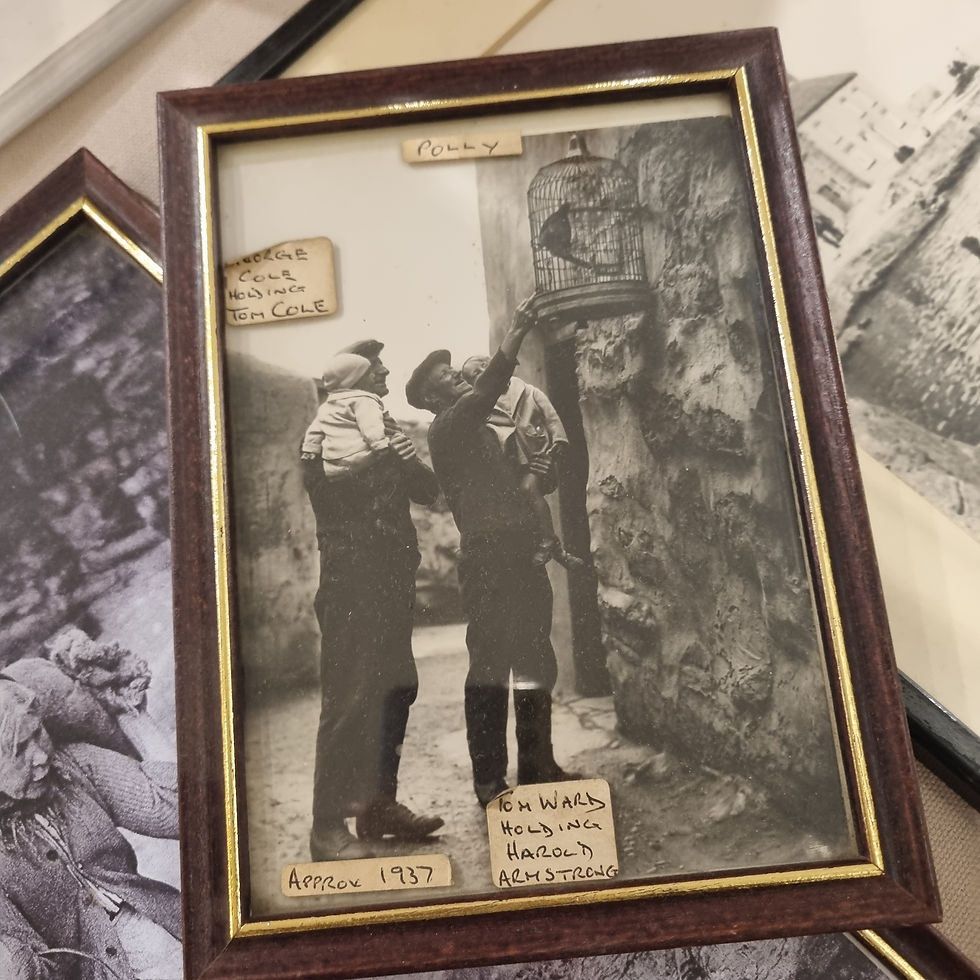
When asked about the characters of old Staithes, Edward remembered Harold Armstrong, a very tall man who lived nearby, and Willie Wright, who looked after people around the village.
Willie was particularly kind to Edward's parents, regularly calling in to see how they were doing. He looked after others in the same way. Edward remembered his funeral as one of the biggest he had attended at Hinderwell.
These recollections were tinged with a sense that the village had changed. Edward remembered the old characters, the fishermen gathered by the lobster pots, and the distinctive clothing and routines of the working community.
The population was smaller, and people often knew one another's families and histories. The same names appeared in stories about fishing, mining, family life and emergencies. A person might be a fisherman, a neighbour, a relative and the person who came to help when something went wrong.
The parrot that shouted at Edward
Not every memory involved danger or hard work. Some of the best are simply funny.
Edward remembered Nelly and Jack Beaton, who were associated with a village gift shop. Jack had a parrot in a tall cage, which he would put outside during the day. Visitors and passers-by could talk to it, and the parrot would shout back.
Edward's mother was often calling out to him when he was little. The parrot apparently picked up the words and began repeating, “Edward, thou’s wet again!”
It became a familiar feature of village life. The bird also copied nursery rhymes, and, perhaps unfortunately, some of Jack's language. Eventually it began swearing at visitors, so it had to be brought indoors.
The parrot lived to the remarkable age of 61.
George Hugill and the rescue of Colin Harrison

Among all the stories about George, the one Edward thought might have meant most to his father was the rescue of Colin Harrison.
Colin got into serious difficulty in the water after his father's boat capsized. Harold and Nigel Hinchley pulled him out and brought him part of the way up the rocks. He was unconscious.
George came to help. Women brought blankets, and George continued performing artificial respiration until Colin began to breathe. Edward remembered the moment when his father realised they had succeeded: Colin was breathing again.
An ambulance took Colin away, and he survived.
George received a Royal Humane Society certificate for his part in the rescue. Edward remembered the certificate and the pride his father took in it. The award recognised a moment when his knowledge and determination had helped save a life.
It was not the only occasion on which George's first-aid skills had mattered. Edward also remembered his father stopping the bleeding when Joe Verrill was badly injured in the mine. Both incidents reveal the same quality: George was prepared to act when someone needed help.
The last hymn
One of Edward's most moving memories concerned his grandfather's death.
Edward was still young when his grandfather became seriously ill. The family brought him downstairs and placed him in a bed beside the kitchen. Edward was called in, along with other family members, to gather around him.
His mother told him that his grandfather was dying.
Then, as the family stood beside the bed, his grandfather began reciting a hymn from memory: “Son of My Soul, Thou Saviour Dear.”
He continued through the verses without a hymn book. Edward could still recall parts of the words decades later, including the final verse, which speaks of being accompanied through life's journey and finally finding peace in heaven.
When the hymn was finished, his grandfather closed his eyes and died.
It was Edward's first experience of someone dying in this way, and he never forgot it. The memory has stayed with him not just because of the death itself, but because of the calmness of the moment and the words his grandfather chose to speak.
Remembering Captain Cook
Edward's interest in local history did not begin with this interview. He had helped organise a Captain Cook exhibition and village pageant, drawing on material he encountered during a trip to London with the Boys' Brigade.
While passing Australia House, he saw an exhibition about Captain Cook. He went inside and explained that he hoped to organise an exhibition back home. The staff told him they were nearly finished with it and offered to send the material to him.
They did, and the resulting exhibition brought schoolchildren into Staithes to learn about Cook.
Edward also organised a pageant with a series of floats showing episodes from Cook's life, from his early years through to his death in Hawaii. It was an ambitious community undertaking, and a reminder that local history has long depended on people who take the initiative to collect stories and share them with others.
A lifetime of stories
Edward's interview ranges across almost every aspect of life in Staithes: work in the mines, fishing, family traditions, wartime memories, dangerous storms, medical emergencies, village characters and moments of quiet family life.
Some stories describe extraordinary events. Others concern everyday routines: catching a bus to Whitby, queueing for meat during rationing, moving a boat according to the tide, or receiving a bag of potatoes in return for helping a neighbour.
What links them is the way people relied on one another. George Hugill might be called to treat a broken arm or an injured cow. A neighbour might rig up a bell to summon him in the night. Fishermen and farmers exchanged produce, while relatives and friends helped one another through accidents, storms and the ordinary difficulties of life.
Edward's memories also remind us that history is not made up only of major events and famous names. It lives in the details: the smell of Embrication on a bus, the canvas taken from a deckchair, the sound of a parrot calling out a child's name, or a grandfather reciting his final hymn.
We are very grateful to Edward for sharing these memories and photographs with Staithes Museum. Each recollection adds another piece to the story of the village and the people who made it what it was.
Do you remember any of the people, places or stories mentioned here? We would love to hear from you. Memories, family photographs and small details can all help us build a fuller picture of Staithes' past.

Comments