
Polly the Parrot of Staithes: A Voice from the Village Past

From the September 2025 newsletter.

For over six decades, a distinctive voice with a pronounced Staithes accent was a familiar part of village life. It belonged not to a fisherman or a shopkeeper in the traditional sense, but to Polly, an Amazon green parrot who became one of the village's best-known characters. Polly's story is one of an unexpected journey, a long life spent at the heart of the community, and a quirky personality that left a lasting impression on residents and visitors alike.
A Perilous Journey to Staithes
Polly's arrival in Staithes in 1923 was anything but ordinary. She was brought from overseas by Mr Joe Armstrong, a merchant seaman who lived in Church Street. Her transport was a simple orange box, which she unfortunately had to share with two armadillos. During the journey, her travelling companions ate their way through to her section of the box and pulled out her feathers, marking a rather undignified start to her new life in Yorkshire.
Upon arrival, Mr Armstrong gave Polly to Mr Jack Beighton and his wife Nellie, who ran a barber's and sweet shop on the Staith. It was here that Polly truly found her voice and her role in the community.
The 'Alarm Bird' of the Staith
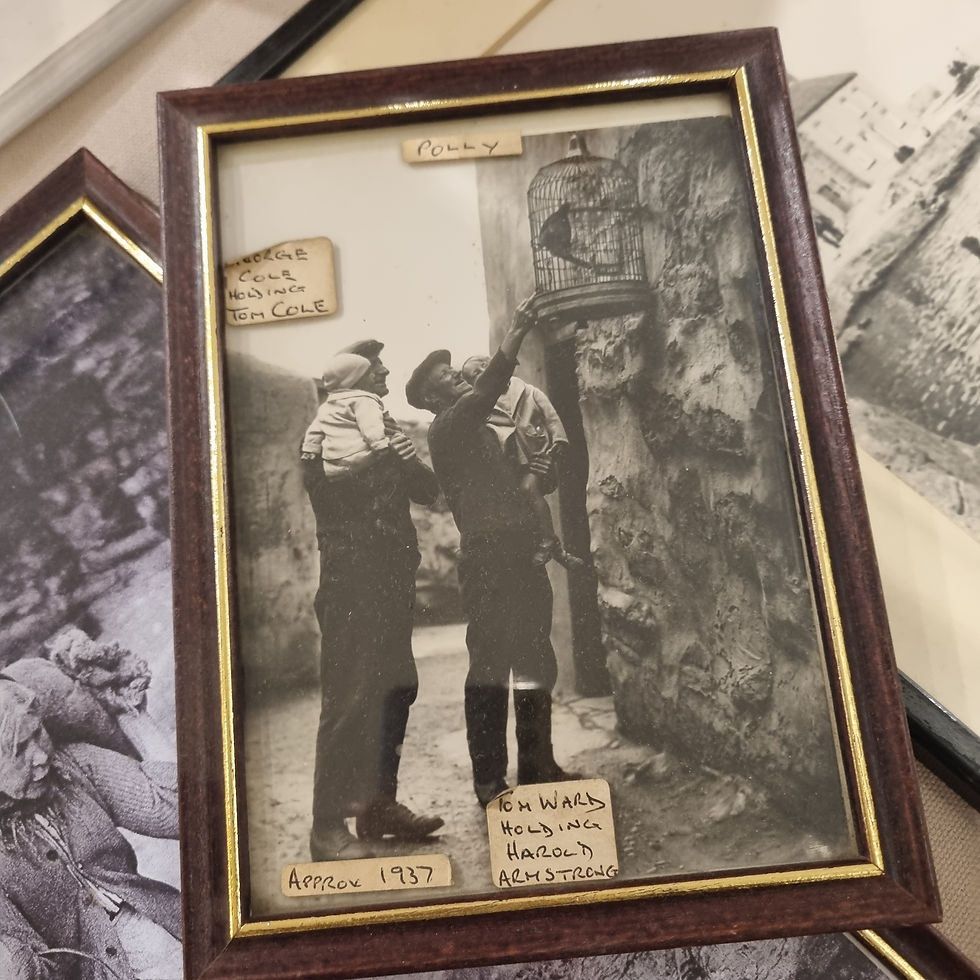
Living in the Beightons' shop, Polly quickly became a local celebrity and a great favourite with everyone. She was a prolific talker and developed an effective, if unofficial, security system that earned her the nickname the 'alarm bird'.
Customer Alert: When anyone entered the shop, Polly would call out to the owner to alert them.
Sweet Thief Deterrent: Most famously, if children tried to sneak sweets from the counter, she would shout, "Jack, they're at it again," foiling their attempts.
Her sharp eyes and even sharper tongue made her an integral part of the shop's daily operations. A photograph in the museum collection captures a moment in her life, showing Tom Ward, Harold Armstrong, and George and Tom Cole looking at Polly in her cage, placing her firmly among the familiar faces of the village.
Later Life and Lasting Mysteries
After her time with the Beightons, Polly's next owner was Mrs Lena Calvert. When Mrs Calvert became ill, Polly was cared for by Mr John Jemmerson and his wife Freda for ten years, before they officially owned her for a further fourteen. At the Jemmersons' home on Staithes Lane, from which Mrs Jemmerson ran a news agency, Polly continued her role as a greeter, welcoming customers at the door.
Polly had some very particular tastes. She had a special liking for Yorkshire pudding, but would only eat it if it was dipped in gravy. The smell of it cooking would send her into a state of excitement, jumping up and down in her cage in anticipation.
When Polly died in 1984, she left behind two enduring mysteries:
1. Her Age: Although she had lived in the village for 61 years, no one knew how old she was when she first arrived in 1923.
2. Her Sex: Despite being called Polly her entire life, her sex was never actually known. As the newspaper clipping marking her passing noted, she may well have been a "Peter or Paul".
Polly the parrot was more than just a pet; she was a village institution whose story is woven into the social history of Staithes for much of the 20th century
2026 Addendum: Polly the Parrot

Since publishing our original story of Polly the parrot, we have found two more pieces of evidence which add to our picture of this extraordinary Staithes character.
Polly in living memory
In an oral history interview recorded by Staithes Museum, Mr Hugill remembered visiting the shop run by Nelly and Jack Beighton when he was a child. His recollections give us a wonderfully vivid picture of Polly's daily life.
Jack Beighton was by then well retired and, according to Mr Hugill, would sit in an armchair with Polly in one of the large cages used for parrots. During the day he would take the cage outside, where passers-by could stop and talk to her. Polly would shout back.
She also knew the names of local children. Mr Hugill remembered that his mother was often shouting at him for coming home in a mess. One day he was told by Frieda that Polly had been shouting his name:
“Edward! Thou's wet again. Edward! Thou's wet again.”
He remembered that Polly would repeat the phrase for years, and that she could also perform nursery rhymes.
There was, however, a downside to having such a vocal resident. Jack Beighton apparently had a colourful vocabulary of his own, and Mr Hugill remembered that Polly eventually picked up some of it. When she began swearing at visitors, the cage had to be brought back inside.
This adds another dimension to the story of Polly as the village's unofficial “alarm bird”. She wasn't simply sitting behind the counter waiting for someone to try to steal a sweet. She was taken outside into the street, where she became an attraction in her own right — talking to passers-by, calling out to local children and, eventually, giving visitors rather more of Jack's vocabulary than they had perhaps bargained for.
Mr Hugill also remembered that Polly lived to the remarkable age of 61, and that after her time at the shop she was taken to the house further up the village, where she continued to live for many years.
Polly returns to television
There is another, rather unexpected chapter in Polly's story.
In 2017, the BBC children's programme Old Jack's Boat, starring Bernard Cribbins, featured Polly in an episode of Rockpool Tales called “The Treasure Chest”. (listen here: https://www.bbc.co.uk/cbeebies/radio/old-jacks-boat-rockpool-tales-the-treasure-chest )
The episode begins with Old Jack finding a parrot feather and remembering a parrot who once lived in Staithes. His story describes Polly as the pet of the lady who ran the sweet shop. Children would visit the shop to see her, and he remembers saying hello to her before running back down to the beach.
The programme also preserves one of the details which appears in our own records: Polly's enthusiasm for Yorkshire pudding and gravy. In the television story, this becomes part of the memories of the parrot who was once a familiar sight in Staithes, Old Jack says that he still has one of Polly's feathers.
The programme is, of course, a children's drama rather than a documentary, so we cannot assume that every detail is a verbatim historical account. But its appearance is another indication of how firmly Polly had lodged herself in the remembered history of Staithes. More than thirty years after her death, she was still sufficiently well known to form part of a story about the village's past.
Taken together with Mr Hugill's oral history and the photographs and newspaper cutting in the museum collection, these newer sources help us to see Polly rather differently. She wasn't simply a long-lived pet belonging to a local shopkeeper. She was one of those characters who became part of the fabric of village life: something children knew, visitors encountered, and local people remembered decades later.
`937 photo catalogue reference: SSESM.2019.RED.798


Comments