
Out of the Old Earth at Staithes: Harold Heslop’s Childhood at Boulby

The ironstone mines, the great cliffs, a mysterious fossil, a very peculiar toilet and a heartbreaking family tragedy: in his autobiography Out of the Old Earth, writer Harold Heslop recalls the extraordinary years he spent as a boy at Boulby, looking out over the sea beyond Staithes.

Staithes has always been a place best understood through the people who have lived here, worked here and watched the sea from its shores. Their stories are not confined to the narrow streets of the fishing village itself. They reach out along the coast, up to the clifftops and across the fields, connecting Staithes with the people and places that have shared its fortunes.
One of the most remarkable accounts of life in this wider landscape appears in Out of the Old Earth, the autobiography of Harold Heslop, published by Bloodaxe Books in 1994. Heslop was a working-class writer from County Durham whose childhood was shaped by the coal industry, trade unionism and the politics of the early twentieth century. But for a brief and eventful period in 1913, his family’s life was transplanted to the North Yorkshire coast.
His father had been appointed manager of Boulby Ironstone Mine, near Staithes. The family moved into Boulby Grange, a large house perched above the cliffs, and young Harold found himself living in a landscape of extraordinary beauty, alongside an ironstone industry that was anything but gentle.
What follows is Heslop’s story of those months: a boy’s introduction to a very different world, a mining community on the edge of the sea, the fishermen of Staithes, and a family tragedy that left an indelible mark on his memory.
A new home on the edge of the world

Before coming to Boulby, the Heslops had lived in the Durham coalfield. Harold had attended Bishop Auckland Grammar School, but his father’s new appointment was to change everything.
Heslop tells us that his father received the offer after meeting William Walker, a well-known mining engineer from Hinderwell, in the first-class waiting room at Middlesbrough railway station. There was tremendous excitement in the family. His father was to manage Boulby Ironstone Mine, whose employers were the Skinningrove Iron Company Limited.
The move took place at the beginning of January 1913. Harold’s schooldays were coming to an end, although nobody seems to have explained this to him in quite the way he might have wished.
The journey to their new home was memorable. After travelling by train, Harold and his family continued on foot through the Cleveland countryside. They passed through Grinkle, where the church stood high above the village, and made their way towards Boulby.
The weather had been kind. There had been a light snowfall, whitening the earth and giving the landscape what Harold remembered as a happy radiance. They climbed through the village and continued along the road, which gradually brought them onto higher ground.
Then the view opened out.
The road ran along an escarpment, with the countryside dropping away towards the coast. Heslop describes how the eye travelled across the land towards the distant moors, before reaching the cliffs and the sea.
The sea was not quite visible at every point along their route, but it was there in the shape of the land, in the immense cliffs ahead and in the sense that the ground was about to give way to something much larger.
At last, they came to a turn in the road.
“This is it,” said his father.
For Harold, the arrival would become one of those moments that remain permanently lodged in the memory. For his mother, however, the prospect of their new home was far less welcome.
She had looked at the landscape and understood, perhaps before the others, how isolated their new life might be. The house stood in a remote place, far from the familiar world she had left behind. The open countryside and the sea, which might have delighted a poet, offered her little comfort.
Heslop remembers her clinging to his father’s arm and asking him to promise something that must have sounded strange at the time:
“Promise me you won’t bury me up there, Bill.”
It is a haunting moment. His mother could not have known how closely that request would come to the events of the next few months.
Boulby Grange and the mystery of the toilet
Their new home was Boulby Grange, an imposing house standing some distance from the cliff edge on a sheltered escarpment. Heslop admired the building, despite its remoteness and the rather uncomfortable reality of living there.
The house had once belonged to a more prosperous world. It was large, handsome and surrounded by a deep garden, but its grandeur was accompanied by a curious lack of practical amenities.
Heslop, whose eye for the ridiculous remained sharp even when describing difficult circumstances, devotes some memorable attention to the subject of plumbing.
The house had a beautiful staircase, and on its first landing was a water closet fitted with a fixed mahogany seat and a handle at the side.
Unfortunately, nobody seems to have given much thought to what happened before or after anyone used it.
“They knew nothing about plumbing, for they attempted none.”
The source of the water and the destination of the contents remained mysteries. Heslop remarks that the little corrugated-iron cottages provided for the miners had considerably better facilities than the house in which the manager lived.
It is a wonderfully deflating detail. Boulby Grange might have looked impressive from a distance, but its inhabitants were not necessarily enjoying the comforts one might expect from such a substantial residence.
The house was divided into two dwellings. Another family, the Rowlands, occupied the other part, while the Heslops had their own garden and a grand entrance approached by a winding path.
That path had its own story. It followed the contours of what Heslop describes as a fossilised, snake-like monster, quarried from the alum shale above the house and brought down more or less intact.

The fossil had once been a remarkable object, with smaller fossils embedded in the surrounding shale. By the time Harold saw it, however, it had been broken into sections. Some pieces were impressive in size, but much of the material had simply been thrown aside.
He could not help wondering how a palaeontologist might have viewed the discarded remains. The people living at Boulby had other things to concern themselves with, and the ancient creatures preserved in the shale were apparently of little practical value.
For a boy whose curiosity was already developing, the landscape offered a thousand such mysteries: fossils from another age, an extraordinary house, the workings of an industrial mine and, beyond everything, the sea.
The little tin houses and the ironstone mine
Boulby was not simply a grand house overlooking an empty stretch of coast. The mine had brought an industrial community into this seemingly remote landscape.
Heslop describes the area around Boulby as windswept and sparsely inhabited before the opening of the mine. The company had installed its workings near the cliffs, and a substantial number of workers were needed to extract the ironstone and transport it to the works.
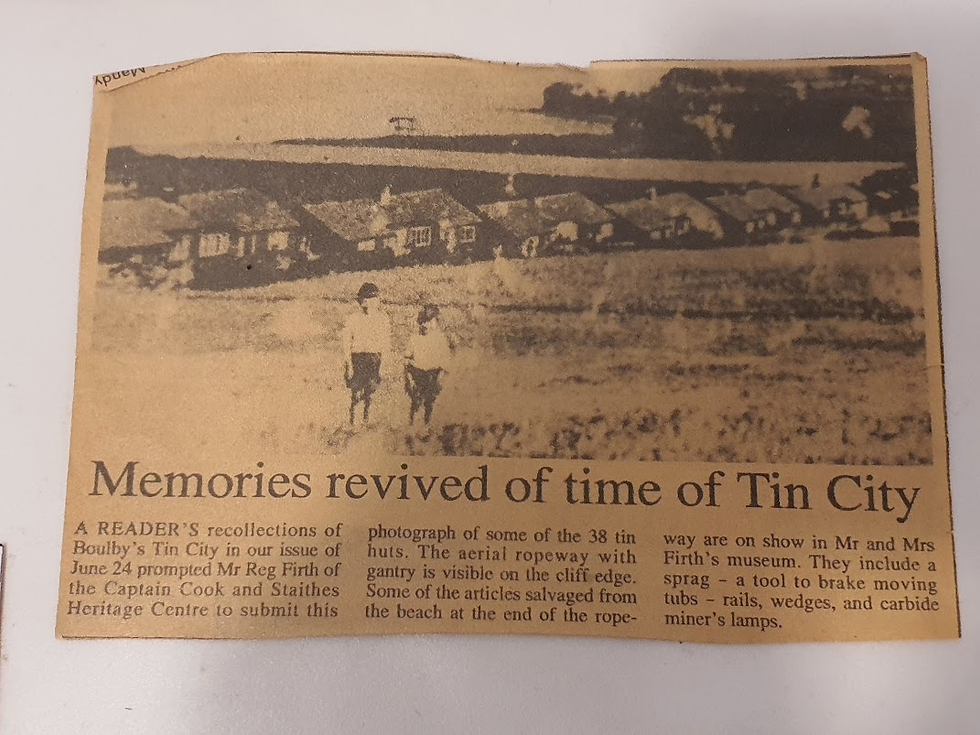
For these men, the company erected rows of small, semi-detached cottages made from corrugated iron. They were known locally as the “tin huts”.

Heslop’s description suggests that the huts were not universally admired for their appearance, but they served their purpose. More tellingly, the workforce was not drawn entirely from other mining districts.
Some of the men employed at Boulby were the sons of fishermen from Staithes.
This is one of the details that makes the book particularly valuable to anyone interested in the history of the area. The mining industry and the fishing community were not separate worlds, each confined to its own landscape and traditions. Here, the mine drew in young men from a village whose economy had long depended upon the sea.
The mine itself belonged to the Skinningrove Iron and Steel Company Limited. Its industrial works stood beyond Boulby Head, alongside the edge of a large valley. Ore blasted from the mine was sent directly to the works for processing.
It was an industry on a considerable scale, even if the village around it remained small. The houses were crowded close to the workings, and the atmosphere could be noisy, hot and unpleasant. Conditions were especially disagreeable in winter, when noise and heat were trapped around the industrial buildings, and in summer, when the workers’ accommodation could become stifling.
The contrast between the beauty of the surrounding countryside and the realities of industrial life is one of the recurring themes of Heslop’s account.
It was a beautiful place to look at, but beauty did not guarantee comfort, safety or a decent standard of living.
The cliffs beyond Staithes
If Boulby Grange was uncomfortable, its setting was magnificent.
Heslop’s descriptions of the cliffs are among the most striking passages in this part of the book. Boulby Head rises dramatically above the sea, and the cliffs stretch along the coast, enclosing the landscape that shelters Staithes.
He describes the cliffs as a kind of natural wall, standing between the land and the restless sea. The waves, winds and storms seemed small against them, even when the weather was at its most violent.
The fishing boats gave the landscape a different character.
Heslop remembers the cobles carrying their brown sails, the fishermen trailing baited lines and the boats moving across the water in a way that seemed almost effortless. There was something timeless about the scene: the massive cliffs, the open sea and the small boats that had to work within it.
He wrote of the sea with a sense of awe that is quite different from his descriptions of machinery and mining.
The landscape, he felt, had a grandeur that could not easily be compared with anything else he had seen. It was not merely picturesque. It was immense and indifferent, a place in which human activity seemed very small.
From the front windows of Boulby Grange, the view stretched across the countryside towards the west, with the moors lying beneath the wide skies. The land was largely free of industry, and Heslop describes it as possessing a kind of primeval peace.
Looking east, the cliffs extended beyond Staithes, while the sea filled the horizon.
For his mother, these views were a source of distress. For Harold, they became one of the defining memories of his childhood.
He could not forget the beauty of the place, even when recalling the sadness that surrounded it.
A little mystery on the beach: Staithes fishermen and jet

The connection between Boulby and Staithes was not only industrial. Heslop also records a small detail about local fishermen that hints at an older relationship between the coastal landscape and the people who knew it best.
The cliffs and surrounding countryside contained deposits of alum shale, and jet could be found among the material left behind.
Jet had long been valued as a material for jewellery and ornamental objects. In Heslop’s recollection, elderly fishermen from Staithes sometimes made the journey over the fields and across the countryside to search the old quarry for pieces that might have been overlooked.
These were not grand expeditions. They were simply part of the resourcefulness of people who knew the landscape and understood that it might still yield something useful.
Heslop recalls how the fishermen would search among the discarded material for black fragments of jet. If they found a sizeable piece, they returned home in a particularly happy frame of mind.
What happened to their discoveries was another matter.
He ends the recollection by observing that what they did with their findings was not “bruited abroad”.
It is a small phrase, but it tells us something about the character of these fishermen as Heslop remembered them. Here were men who knew the coast, its geology and its hidden possibilities. They were not simply passive observers of the landscape; they made use of what it offered.
It also gives the reader a glimpse of the informal economy that could exist alongside fishing and industrial work. A journey that might otherwise have been simply a walk across the cliffs could become worthwhile if it produced a piece of jet.
Harold goes underground

Although the sea and cliffs left a powerful impression on him, Harold’s everyday life was soon to be shaped by a very different world.
His father had been appointed manager of the mine, and the family’s move made it impossible for Harold to continue attending his former grammar school. The nearest alternative was at Guisborough, too far away to travel each day.
Education, it seems, was no longer an option.
Heslop describes his father as a practical man who believed that his son should learn how to make his way in the world. One morning, Harold was told to get up. He dressed in his school clothes and followed his father to the mine.
At the entrance to the underground workings, he was given a lamp.
He followed his father down the wet travelling drift, into a world that was entirely unfamiliar to him.
Heslop later described this as the beginning of his “servitude in the underworld”, a period that would ultimately last until 1928, when he and thousands of other miners were made unemployed.

His first experience at Boulby was not the same as the work undertaken by the miners’ sons, who sat in the quiet dark for hours, waiting for the next load to arrive. Because his father was the manager, he was not immediately subjected to the full demands of underground labour. Instead, he was given an opportunity to learn about the workings of the mine.
That did not mean the experience was easy.
The first thing that struck him was the whiteness of the underground world. The roof, the timber supports and the ironstone behind them were all marked by the pale material and whitewash used in the workings. The mine had a strange, unfamiliar appearance, with its high roof and the heavy timbers that supported it.
Harold followed his father along the underground railway, watching the movement of the wagons and learning how the different parts of the system worked.
He was fascinated by the way the mine had been constructed. Rails, junctions and haulage systems had to be arranged with great precision. Lines were marked along the roof to indicate where the miners should work and how far they should extend their excavations.
It was not simply a matter of digging into the earth. Every operation had to be carefully planned, and an apparently minor mistake could have serious consequences.
Heslop was particularly struck by the importance of precision in an ironstone mine. The roof conditions differed from those he had seen described in coal mines, and the absence of timber in some of the workings made the question of safety especially important.
He learned that the mine’s layout was intended to conserve expensive materials while keeping the workings within safe limits. The miners had to know exactly where they were, how far they could go and what might happen if they moved beyond the boundaries set for them.
For a boy still adjusting to the loss of his schooldays, it was an extraordinary education of a different kind.
Explosions, horses and the wisdom of miners

Heslop’s observations of underground work reveal both his fascination with the mine and his growing awareness of its dangers.
At Boulby, the ironstone was extracted by blasting. Holes were drilled into the rock, filled with explosives and fired to break up the stone. The resulting fumes had to be dealt with, and the ventilation system was a constant concern.
His father was particularly troubled by the conditions underground. Each face worker carried a substantial quantity of cordite, and blasting could produce thick, unpleasant fumes that made the air difficult to breathe.
Heslop remembers his father criticising the ventilating arrangements, although he acknowledges that the structure of the mine made improvements difficult.
The ironstone workings lacked the timber supports that would have provided the necessary framework for some conventional ventilation methods. The problem was not simply a failure to recognise what needed to be done; the physical conditions of the mine imposed limits on what could practically be achieved.
Yet the world underground was not governed by technical knowledge alone. The people who worked there developed their own practical understanding of danger.
Heslop recounts a conversation with an older miner who explained that coal miners were not ‘straying from right to left’ because of being ‘slap-happy’ - it was because explosions travelled in straight lines, and would be flattened if they encountered a curve. Ironstone mines didn't explode.
The man was explaining something that Harold had not yet understood, and the boy listened as the miner patiently set out the problem in his own terms.
Heslop sums up the lesson with an admiring exclamation:
“The pragmatism of those whom nature schools!”
In his text, he can be very critical and serious, but he was also capable of recognising the intelligence that came from experience, particularly when that experience involved having to survive dangerous conditions.
The mine horses fascinated him too.
These animals were essential to the movement of the wagons, hauling heavy loads through the underground workings. Heslop remembered their strength, their intelligence and their ability to anticipate what was happening around them.
He describes one particularly impressive pony that would signal the approach of another by pawing at the rail long before the approaching animal could be seen. Coming head-to-head with the oncoming obstacle, its “I told you so” was almost audible.
The pony was not simply a machine for moving coal or ironstone. It appeared to have a distinct personality, and Heslop was alert to the ways in which the animals responded to their surroundings.
The men and boys who worked underground relied upon such animals, and the animals relied upon the people who handled them. Their lives were bound together in the harsh conditions of the mine.
For Harold, the experience of following his father underground was a first encounter with this relationship between human beings, animals and industry.
It was also a world he would remember long after leaving Boulby.
He describes the excitement of moving through the workings and finding himself beneath the cliffs, where the land above was separated from the sea by layers of rock and earth.
At certain points, it was possible to emerge from the underground world and look out towards the coast.
For a moment, the two landscapes came together: the dark workings of the mine and the shining water beyond.
Heslop concludes this part of his recollection with a sentence that carries the full force of hindsight:
“It was an experience I was not to know again after we left Boulby.”
A mother who could not be consoled

While Harold was exploring the mine, his mother was struggling to adapt to their new life.
The house was isolated, the landscape unfamiliar, and the sea that seemed so magnificent to her son had a very different effect on her. She had left behind the surroundings in which she had lived for years, and she could not find comfort in her new home.
Heslop’s descriptions of his mother are especially affecting because they are so closely connected to the landscape. He understood, looking back, that she was lonely and apprehensive. Her distress was not simply a dislike of the house or the location; it was the feeling of being cut off from the life she had known.
In his memory, she would sit looking out across the sea while ships passed along the horizon.
The passing vessels seemed to represent a world beyond her reach. They could travel freely across the water, while she remained in the house, unable to escape the loneliness that had settled over her.
Heslop writes of her watching the cliffs and the sea, and of the tears that the landscape seemed unable to soothe.
“How lonely she must have been. How apprehensive. How sad.”
It is one of the most moving moments in the account. The same landscape that gave Harold a lasting sense of wonder became, for his mother, a reminder of her isolation.
Her feelings were compounded by the fact that she was pregnant. She was approaching the final stages of her pregnancy when the family settled into life at Boulby, and her health became a growing concern.
A doctor from Hinderwell visited her, and a woman named Mrs Pearson was brought in to assist with the confinement. Mrs Pearson lived at Dale House, a hamlet set among the woods some distance from Staithes.
Harold did not particularly like her.
One evening, his mother asked whether he liked Mrs Pearson. He answered that he did not. His mother then told him that Mrs Pearson would be his next mother, adding that she would soon be gone.
Harold was surprised, and the words stayed with him.
His mother seems to have felt that her life was approaching its end, although there is no indication that she had any precise knowledge of what was to happen.
Her fears were made more acute by the distance from the rest of the family. Her own mother, whom Harold knew as Grandma Whitfield, was living at Quarry Burn, and the family eventually arranged for her to come to Boulby.
Grandma Whitfield was an experienced midwife, and her arrival would prove crucial.
“Down the pit?!”: a grandmother arrives
Harold’s account of his grandmother’s arrival provides one of the most memorable passages in the book.
He had been sent to meet her, and he accompanied her on the journey to Boulby. She was an imposing woman, still recognisably the grandmother he remembered, and she was not slow to express her opinions.
When she asked Harold about his schooling, he had to admit that he had not attended school since leaving High Grange. He had been working underground instead.
His grandmother was horrified.
“Down the pit!” she exclaimed.
She could not understand how a family that talked so much about education could allow a boy who had won a scholarship to be sent into the mine. Her indignation spilled over into a denunciation of the family’s priorities.
“Shame! Shame, I call it. A great shame.”
It is a wonderful moment of family dialogue: Harold’s grandmother, with her own unmistakable voice, saying exactly what she thinks.
It also reveals something important about Harold’s experience. His father saw his move into the mine as a practical necessity, but his grandmother regarded it as a terrible waste of an educational opportunity.
Both responses belonged to the world in which Harold grew up, where mining was often regarded as the inevitable future for boys from mining families, even when they showed other abilities.
For Harold, the journey into the mine was already underway. But the story was about to become far more serious than the loss of his schooldays.
A night in May 1913
Friday, 3 May 1913, brought a change to the household at Boulby Grange.
The weather had been fine, and Harold had been working in the garden when his mother came to the door. She was heavily pregnant and appeared to be in considerable pain. He remembers the way she stood, with her hands resting on her belly, before turning and walking slowly back into the house.
When Harold came inside later, his mother had gone upstairs.
Grandma Whitfield began to prepare for the birth, and the house settled into an anxious silence. The doctor still had to be summoned, and the journey to fetch him was a long one. Harold describes how his father set out on foot to seek medical assistance, a journey made more difficult by the absence of modern communications.
The doctor would not arrive until after the twins had been born.
Grandma Whitfield had to manage the delivery alone. She was an experienced midwife, and her confidence in her own abilities was unmistakable. She had seen many children born and understood what needed to be done.
But these twins were tiny, and their survival was uncertain.
Heslop describes his grandmother washing and preparing the babies, using the skills she had acquired over a lifetime of work. One was wrapped and placed near the fire; then she turned her attention to the other.
There was no comforting cry from either child.
His grandmother was convinced that the babies would not survive. She spoke of how small they were and how difficult it would be for them to live.
“Both’ll dee,” she declared.
It is a moment in which the book’s warmth and humour coexist with genuine distress. Grandma Whitfield's confidence and experience could not overcome the uncertainty of the situation, and her words were as much an expression of fear as of judgement.
Harold remained in the house, trying to understand what was happening around him. He could hear his mother in the bedroom, and the sounds of her suffering stayed with him for the rest of his life.
At last, the doctor arrived.
By then, the worst had happened. His mother had died.
Heslop remembered his grandmother’s grief, and the way she stood beside the bed, trying to console the woman who had lost her daughter.
His father eventually came into the room. He was overwhelmed by the situation, and Grandma Whitfield had to be led away.
The doctor covered the dead woman's face.
Harold was left with a memory that he would carry for decades. His mother had arrived at Boulby full of apprehension, unable to settle into her new home, and now she would never leave it alive.
There was, however, a detail that makes the story of the twins especially poignant.
Grandma Whitfield believed that both children would die. In fact, both girls survived. Harold's sisters later took them away to be raised elsewhere, and the twins went on to have children of their own.
His grandmother's prediction was wrong, although nobody could have blamed her for fearing the worst that night.
The survival of the girls was one small point of hope in a family whose life had been shattered.
The funeral and the fair at Staithes

The death of Harold’s mother caused a profound reaction in the surrounding district. The family was not well known in Boulby, but the loss was felt by people from the nearby villages, particularly Staithes.
Heslop writes that the sensation caused by his mother’s death was immense, and he remembers the sympathy shown by people who had lived with the sea and understood the hardships of life.
One of the most affecting details concerns an elderly fisherman named Isaac Theaker, whom Harold remembered as a fine, well-bearded man. Theaker later told him that he often sat in his house and cried over the death. Heslop never witnessed that grief.
In a community where work could be dangerous and death was never very far away, the death of a young mother was not simply a private family tragedy. It was something that affected people who knew her, or who had come to know the family through their lives in the area.
The funeral itself brought together an extraordinary collection of local people.
Heslop records that, at the time, Staithes was celebrating its annual fair. One of the features of the fair was a group of men who arrived with horse-drawn, open landaus, offering people rides into the countryside.
As Harold wryly observes, these rides amounted to little more than journeys between Staithes railway station and Hinderwell churchyard and back.
When the funeral took place, the people of Staithes hired practically all the landaus at the fair so that they could attend.
The result was an immense procession. The fishermen wore their best blue jerseys, the women dressed in their finest funeral clothes, and the cortege extended to an impressive length along the road.
It is a striking image: the fair, ordinarily a time for entertainment and sociability, becoming the occasion for a collective act of mourning.
The landaus that had arrived to carry people out into the countryside instead carried mourners to the churchyard. The village’s resources were turned to the practical business of accompanying a family in grief.
The procession made its way to Hinderwell, where Harold’s mother was buried. A local preacher led the service, and the coffin was carried into the hearse.
Heslop remembers that the hymn sung at the funeral was accompanied by a fisherman who provided the note for the congregation. The people gathered outside the house sang together before the hearse set off.
For Harold, the ceremony was both overwhelming and bewildering. He was still a boy, trying to understand the death of his mother and the circumstances that had led them to Boulby in the first place.
Yet he never forgot the scale of the community’s response.
The people of Staithes had taken part in the funeral in a way that went beyond attendance. They had helped make it an occasion of collective remembrance.
Their sympathy was practical as well as emotional. They had hired the landaus, dressed in their best clothes and travelled together to the churchyard. The annual fair had been interrupted by a death, and the village had responded by turning the day into a funeral procession.
In a few short paragraphs, Heslop captures something that can be difficult to convey in a conventional historical account: how grief was experienced and expressed by a close-knit community.
A family scattered

After the funeral, Harold’s life at Boulby began to change again.
His father had been deeply affected by his wife’s death, but he remained the same man Harold had known before. He was a devout Methodist, a preacher and a mining engineer whose practical ability was accompanied by a strong sense of religious conviction.
Heslop was often critical of his father, particularly the way in which his religious activities could conflict with his professional responsibilities. In the mining industry, the interests of workers and employers were often sharply opposed, and the political or religious commitments of a manager could be viewed with suspicion.
Harold believed that his father’s religious activities had contributed to his difficulties with the company, and that he was ultimately cast aside with his motherless children.
The Boulby mine belonged to the Skinningrove Iron and Steel Company Limited, and the workings were closely tied to the prosperity of the industrial district. It was not a world in which sentiment necessarily counted for much.
By October 1913, Harold’s father had received another appointment, this time in Northumberland. The family began to disperse.
Before leaving, his father married Mrs Pearson, the woman who had helped during his mother’s confinement. Harold learned of the marriage in a letter and travelled to see his father, apparently hoping to express his disapproval.
When he arrived, he realised that he would be better advised to keep his opinions to himself.
The next morning, he watched the couple leave for Grinkle Church, where they were married by the rector who had officiated at his mother’s burial some five months earlier.
It was an uncomfortable end to a difficult period.
Within a fortnight, Harold and his family had left Cleveland. The years at Boulby had come to an end, and the family was eventually reunited at Wylam-on-Tyne.
For Harold, however, the place remained unforgettable.
He had arrived at Boulby as a boy whose education had been interrupted by the demands of his father’s new job. He had learned about the ironstone mine, discovered the intelligence of the miners and their ponies, and seen something of the dangers faced by the men who worked underground.
He had also encountered a landscape that seemed almost beyond the reach of human industry: the cliffs, the sea and the great sweep of country beyond Staithes.
Most of all, he had experienced the death of his mother and the way in which a small community rallied around a family in distress.
Remembering Boulby, remembering Staithes

Harold Heslop’s account of Boulby is not a simple exercise in nostalgia. His memories include moments of humour, curiosity and wonder, but they are also shaped by loss, anger and the knowledge of what would come later.
His descriptions of the sea and cliffs show a deep appreciation of the landscape, but he never separates that beauty from the lives of the people who inhabited it. The same coast that offered him a sense of grandeur was also the setting for his mother’s loneliness and death.
His observations of the mine reveal the practical intelligence of working people, but also the danger and hardship of industrial labour. His memories of the fishermen from Staithes show a resourceful community whose lives were shaped by both land and sea.
And the story of the funeral brings those different worlds together. The people who knew Harold’s family, along with those who came from Staithes, turned an ordinary day into an act of collective mourning. Their procession along the road to Hinderwell was a reminder that communities are not defined only by their industries or geography, but by the relationships between the people who live there.
Heslop’s book preserves a world that would otherwise be difficult to reconstruct: the houses, the mine workings, the people who worked underground, the fishermen searching for jet and the families whose lives were shaped by the demands of industry.
It is also a reminder that Staithes has always been connected to the places around it. Its history reaches beyond the harbour and the narrow streets, into the surrounding countryside and the lives of people who may never have considered themselves part of the village itself.
Harold Heslop spent only a short period at Boulby, but it was a period that remained with him. His memories are full of the landscape, the mine and the people who lived within them.
The result is a story that is at once local and universal: a boy’s account of a strange new home, a family’s grief and a community’s response to a death.
And, in the background of it all, the sea continues to shine beyond the cliffs.


Comments