
The Clock That Helped Sailors Find Their Way Around the World


Meet the remarkable mechanism at Staithes Museum that celebrates John Harrison’s quest to solve one of the great challenges of seafaring: how do you know exactly where you are when all you can see is sea?
There is something wonderfully satisfying about the Devon Sea Clock at Staithes Museum. With its brass gears, swinging arms, intricate framework and three separate dials, it looks as though somebody has taken a clock apart and then decided to leave all the interesting bits on the outside.
But this is no ordinary clock. It is a modern timepiece inspired by the work of John Harrison, the eighteenth-century English clockmaker who helped transform maritime navigation. And the story behind it involves ingenious engineering, freezing temperatures, rolling ships, scientific rivalries and a problem that could mean the difference between finding your destination and crashing into land.
Most importantly, the clock's purpose was about much more than telling the time. It was about finding your way around the world.
The great mystery of longitude

Imagine that you are a sailor in the eighteenth century. You have been at sea for weeks. The coastline has disappeared, there is no GPS, and your maps are only as good as the information available to the people who drew them.
You need to know where you are.
Fortunately, sailors had ways of calculating latitude: how far north or south they were. By observing the Sun and stars, they could estimate their position in relation to the equator.
Longitude was a different problem. This tells you how far east or west you are, and working it out accurately was much harder.
The solution depends on time.
The Earth takes approximately 24 hours to rotate through 360 degrees. That means it turns through 15 degrees of longitude every hour, or one degree every four minutes.
As the Earth turns, the Sun appears to travel across the sky. When it reaches its highest point, it is local solar noon. But the Sun reaches this point at different times in different places. Places farther east reach solar noon earlier; places farther west reach it later.
Imagine you could keep an accurate record of the time in Greenwich, even while travelling thousands of miles away. You could then compare that time with the local time determined by observing the Sun.
Suppose your clock, still keeping Greenwich time, reads four o'clock in the afternoon when the Sun tells you it is local noon. Greenwich is four hours ahead of your local solar time. Four hours multiplied by 15 degrees gives you 60 degrees.
Your ship is approximately 60 degrees west of Greenwich.
This is the basic principle behind finding longitude using a clock.
And the accuracy matters enormously. At the equator, one degree of longitude is roughly 111 kilometres. An error of just four minutes in your timekeeping could therefore mean an error of around 111 kilometres in your estimated east–west position.
That is a considerable distance when your next encounter with land might be a rocky coastline in the middle of the night.
Why couldn't sailors just take an ordinary clock?

Today, we take reliable timekeeping for granted. But making a clock that could keep accurate time through a long sea voyage was a formidable engineering challenge.
The first difficulty was movement. A clock designed to sit on a stable table or hang against a wall behaved very differently aboard a ship that rolled from side to side and pitched up and down. A conventional pendulum could be disturbed by the movement of the vessel, making it unsuitable for this purpose.
Then there was temperature. A mechanism that behaved reliably in one environment might behave differently in another. Metals expand and contract as temperatures change, while the oils used to lubricate moving parts could become thick or sticky in cold conditions. Extra friction could interfere with the clock's timing.
Finally, there was maintenance. An elaborate mechanism that needed constant adjustment or cleaning was hardly ideal when the nearest clockmaker might be thousands of miles away.
A clock for navigation needed to be accurate, robust and capable of continuing to work in difficult conditions.


The British government recognised how important this problem was. In 1714, the Longitude Act established a system of rewards for anyone who could devise a practical method of finding longitude at sea. The largest reward was £20,000 — an enormous sum at the time.
Mathematicians, astronomers and inventors investigated different approaches. John Harrison devoted much of his life to developing a mechanical timekeeper that could withstand the challenges of a sea voyage.
His work produced a series of remarkable designs, each exploring new ways of maintaining accuracy.
You can find out more about the history of Harrison's timekeepers in Royal Museums Greenwich's account of the longitude problem.
Meet the clock at Staithes Museum

Our Devon Sea Clock celebrates Harrison's ingenuity. It is a modern clock inspired by his work, rather than one of Harrison's original eighteenth-century timekeepers.
Its exposed brass mechanism makes it particularly useful for exploring the engineering ideas involved. Instead of hiding everything inside a case, the design allows us to follow the movement of the different components and see how they work together.
Let's follow the energy through the mechanism.
1. The mainspring: where the energy begins
A mechanical clock needs a source of energy. In this clock, that comes from a mainspring.
When the spring is wound, energy is stored in it. As the spring gradually unwinds, it releases that energy into the mechanism, turning the gears.
The Devon Sea Clock at Staithes Museum is normally wound about twice a week. Without winding, the spring would eventually run down and the clock would stop.
It helps to think of the spring as the clock's power supply. But supplying energy is not the same as controlling time. For that, the clock needs several other components working together.
2. The gear train: making the different speeds possible
The gear train consists of interlocking wheels with teeth. As one wheel turns, it drives another, transferring movement through the mechanism.
The interesting part is that the wheels do not all turn at the same speed.
Imagine a gear with 100 teeth driving a gear with 25 teeth. For every complete turn of the large gear, the smaller gear turns four times.
By carefully choosing the number of teeth on different wheels, a clockmaker can create different rates of rotation.
This is how a clock can display seconds, minutes and hours, even though those units pass at very different rates. Sometimes several gears are needed to bridge the difference between a fast-moving wheel and a much slower one.
The mechanism at Staithes Museum makes these relationships visible rather than concealing them behind a dial.
3. The escape wheel and grasshopper escapement: controlling the release
Here is where things become particularly clever.
The mainspring provides the energy, but the clock cannot simply allow that energy to turn the gears as quickly as possible. It needs to release it in a controlled way.
This is the job of the escapement.
The escape wheel has a series of teeth. The grasshopper escapement uses two moving arms, called pallets, to catch and release those teeth. Instead of allowing the wheel to turn freely, the escapement releases its movement in controlled steps.
The distinctive shape and motion of the arms inspired the name: they move with a kicking action reminiscent of a grasshopper's legs.
Harrison's grasshopper escapement was important because its pallets could engage with the escape wheel without the usual sliding friction found in many other escapements. It required little or no oil at these contact points.
Why was this so useful at sea? Because the oils available to eighteenth-century clockmakers could become thick or sticky in cold weather, and friction could affect the clock's accuracy. Reducing friction also reduced the need for cleaning and maintenance.
It is a good example of engineering that solves several problems at once: improving the mechanism's reliability while making it more practical to use on a long voyage.
4. The twin balance arms: a clock that can cope with a moving ship
One of the most ingenious ideas explored in Harrison's early marine timekeepers was the use of linked balances.
A conventional pendulum swings back and forth under the influence of gravity. On a rolling ship, however, the movement of the vessel can disturb that motion.
Harrison developed arrangements using weighted balance arms linked together by gears. As one arm moves in one direction, the other moves in the opposite direction. This helps counteract some of the effects of the ship's movement.
The idea can be understood by thinking about balance. When two linked components move in opposing directions, their relationship can make the overall mechanism less sensitive to external disturbance.
This was not a simple matter of making the arms heavier or building a sturdier case. Harrison was rethinking how a timekeeper could regulate its motion without relying on an ordinary pendulum.
The twin balance arms on our Devon Sea Clock demonstrate this approach, which was used in Harrison's first marine timekeeper, H1, completed in the 1730s.
5. Adjustable brass weights: fine-tuning the timing
Look closely at the weighted arms and you will notice that the brass weights can be moved along them.
Their position affects how the arms move. Think of a seesaw: moving a weight closer to the pivot changes the effort needed to move it. In a balance mechanism, changing the position of a weight also changes the way the arm oscillates.
This gives the clockmaker a way to adjust its rate.
If the clock is losing time or gaining time, adjusting the weights can help bring the mechanism back towards the desired rate. Moving a weight closer to the pivot generally allows a faster oscillation; moving it farther away generally slows the oscillation.
It is a small adjustment with a significant purpose. When a clock is being relied upon to calculate a ship's position, the ability to fine-tune its timing is essential.
6. Three dials: seconds, minutes and hours
Our clock has three separate dials. The top dial shows seconds, the middle dial shows minutes, and the bottom dial shows hours.
Each dial displays a different timescale, driven by the gear train.
There is something satisfying about seeing these different measurements displayed side by side. Time is a single continuous process, but our clocks divide it into different units to make it easier to understand and use.
The separate dials also leave much of the mechanism visible, allowing visitors to see how the clock's different functions relate to one another.
So, when you next visit the museum, have a look at the three dials. Can you work out what time the clock is showing?
The invention that isn't in the clock

There is one more Harrison innovation worth knowing about, even though it is not physically present in our Devon Sea Clock: the bimetallic strip.
Different metals expand by different amounts when they become warmer. Harrison used two metals joined together to form a strip that bends as the temperature changes.
That movement could be used to compensate for temperature-related changes in a clock's timing.
It is a beautifully simple principle, and one that has found uses far beyond historical timekeeping. The same basic idea appears in everyday temperature-sensitive devices, including the mechanisms used in kettles and circuit breakers.
It is also a reminder that the quest for a reliable sea clock was not solved by one ingenious component. It required clockmakers to think about friction, temperature, movement, energy and precision as parts of the same problem.
From Harrison's great sea clocks to a pocket-watch-sized breakthrough

Harrison did not solve the longitude problem overnight. Over several decades, he developed four major marine timekeepers, known as H1, H2, H3 and H4.
The first three explored large mechanical designs, including linked balances and other ways of reducing the effect of a ship's movement. Each was an attempt to improve the performance of a clock in conditions very different from those on land.
H4, completed in 1759, looked quite different from its predecessors. Instead of the large, elaborate framework of the earlier designs, it resembled a large pocket watch.
Its high-frequency balance offered a promising way to maintain accuracy at sea. This was a crucial breakthrough: a compact timekeeper could, in principle, provide a dependable reference time throughout a voyage.
But it was important to show that the success could be repeated. If reliable navigation depended on a single complicated machine that nobody else could make, the practical problem would not be fully solved.
Clockmaker Larcum Kendall was commissioned to make a copy of H4. He completed K1 in 1769.
Captain James Cook took K1 aboard HMS Resolution on his second and third voyages to the South Seas. It performed so reliably that Cook came to trust it as an important navigational aid.
Accurate timekeeping helped the crew calculate longitude more reliably and produce better charts of distant coastlines. The story of the clock is therefore also part of the wider history of maritime exploration, mapping and the encounters between European voyagers and the peoples whose lands they visited.
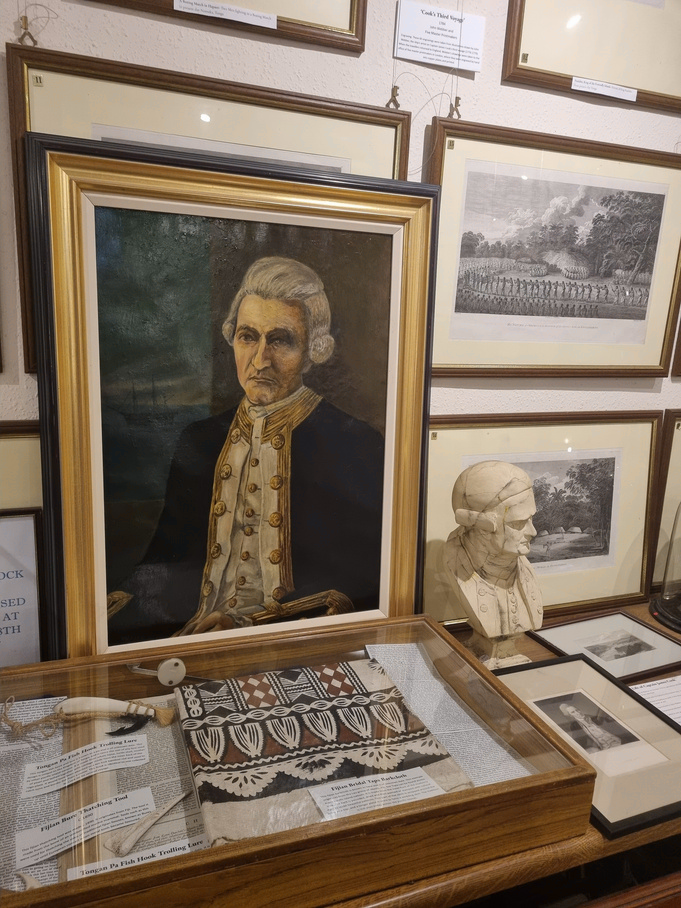
The connection with Cook gives the subject a particular resonance at Staithes Museum. Captain Cook's voyages are part of the history of our collection, and the technology that supported them reveals just how much ingenuity lay behind the navigation of the eighteenth-century world.
Why is the clock's mechanism left exposed?
Most clocks hide their workings inside a case. A skeleton clock does the opposite, leaving the moving parts on display.
That makes our Devon Sea Clock an excellent teaching object. You can follow the movement from spring to gears, see the escapement controlling the release of energy, and watch how the linked balance arms move.
The naval crest at the top reinforces the connection between mechanical timekeeping and navigation.
Harrison's original marine timekeepers were not simply left exposed to the elements on the deck of a ship. They were protected inside substantial cases, and the early, larger designs took up considerable room. The open framework of our modern clock is intended to help visitors understand the workings of a mechanism that would otherwise remain hidden.
It is rather wonderful that an object inspired by such a practical challenge can also become a way to explore engineering, physics, mathematics and history all at once.
The real purpose of the clock

When we look at a clock today, we generally expect it to tell us the time. Perhaps we want to know whether we are late, how long we have until lunch, or when the next train leaves.
For eighteenth-century sailors, an accurate clock could do something much more extraordinary.
It could preserve the time at a known reference point, allowing them to compare it with the time determined from the Sun at their current location. That comparison provided a way to calculate longitude — and, with it, a much clearer idea of where they were in the vastness of the ocean.
The clock on display at Staithes Museum celebrates the ingenuity that made this possible. Its springs, gears, balance arms and escapement are not just a collection of fascinating moving parts. Together, they represent an attempt to solve a problem that had challenged some of the greatest scientific minds of the age.
Next time you visit, spend a few minutes looking beyond the dials. Follow the gears, watch the balance arms and think about what each component is doing.
Then imagine trying to build something accurate enough to guide a ship across the world, when it might be exposed to cold, damp, constant movement and weeks or months without access to a clockmaker.
Suddenly, that brass mechanism becomes rather more impressive.
The Devon Sea Clock at Staithes Museum is a reminder that sometimes the most remarkable thing a clock can do is help you find your way.
To explore the mechanism part by part, pick up our free educational booklet, How Does the Harrison Clock Work? Copies are available to take home, so you can continue investigating the engineering and longitude puzzles long after your visit.

Catalog reference: SSESM.2019.756


Comments