
Staithes in May 1994: The First Issue of The Steeaze Bellman

Rock armour, childhood adventures, a dramatic rescue at the harbour, pigeon racing, local businesses and a village carnival remembered. What was happening in Staithes in May 1994? We turn the pages of the very first issue of The Steeaze Bellman to find out.

In May 1994, a new publication arrived in Staithes. It was called The Steeaze Bellman, and its ambition was to give the village something it wanted: a way to talk to itself.
Its first issue was a modest production, but it was packed with the things that make a community what it is. There were arguments about the harbour, memories of childhood, reports from the school, local advertisements, recipes, poetry, letters, wildlife observations, pigeon-racing results and rather a lot of village humour.
There were also stories of courage, tragedy and adventure; a history of Staithes Carnival; a report of a school visit to a historic house; and the announcement of one new business opening while another was preparing to close.
Thirty years later, this little newsletter is a remarkable historical document. It captures not just what was happening in Staithes in the spring and summer of 1994, but how people felt about their village, what they cared about, where they went, what they bought, what they argued over and what they remembered.
We've gone through the whole of Issue 1, including its advertisements and local information pages, to bring together the stories, people, businesses and events recorded in its pages.
So, let's turn back to May 1994.
A new voice for Staithes: the birth of The Steeaze Bellman
The first issue opens with a short editorial explaining why the magazine had come into existence.
The idea, the editors explained, had grown out of a feeling that the community needed a way to communicate. The publication would provide an opportunity for everyone to contribute opinions, news, local knowledge, information and recollections, drawing on both local and wider experiences.
The editorial hoped that people would be encouraged to contribute to future editions, whether by sharing something they already knew or responding to something that had been published.
There was an acknowledgement that not everyone would agree with everything that appeared in the magazine. That, apparently, was part of the point:
"There are bound to be articles which not everyone agrees with - but responses, are welcome, especially through the letters page."
The editors were keen that the magazine should be a genuine community publication, rather than simply a vehicle for one person's opinions.
They also acknowledged that getting the first issue together had involved a fair amount of persuasion:
"A huge 'thank you' is offered to all those who have been bullied and badgered into contributing to the first issue."
The production team for this first issue consisted of Liz and Bill Hinchley, Eileen Wright, Jackie Hampson, Richard Lawton and Celia Grant.
The editors made clear that the views expressed in the magazine were not necessarily those of the editorial team. This was an important distinction, particularly given the rather lively debate about the harbour that occupied the first few pages.
There was also a practical matter to consider. The magazine had been produced with donations of photocopying paper and considerable voluntary effort. In the final article, the team explained that advertising revenue was not yet enough to cover the expenses, although they hoped to keep the publication free eventually.
The first issue was therefore not just a collection of articles. It was the beginning of an experiment in village communication, with an invitation for Staithes residents to contribute to their own record of local life.
Rock off SBC...? The campaign over Staithes harbour

One of the most substantial articles in the first issue is headed "ROCK OFF SBC...?"
It concerns a proposed coastal protection scheme involving large granite boulders and the future of Staithes harbour.
The article begins by looking back to the late 1980s, when Scarborough Borough Council (SBC), working with the Ministry of Agriculture, Fisheries and Food (MAFF), developed coastal protection schemes using rock armour.
The idea was to use heavy granite blocks, imported from Norway, to absorb wave energy. Similar schemes had been applied to sea cliffs at Scarborough and Whitby. At Staithes, the intention was to use rock armour on the seaward side of the two existing breakwaters.
A three-phase scheme had been adopted.
Phase One proposed placing rock armour behind the Southern Breakwater, to a height of one metre above High Water Spring Tides, and closing the gap between Cowbar Nab and the Northern Breakwater with further rock armour.
Phase Two proposed placing rock armour behind the full length of the Northern Breakwater.
Phase Three involved building a Fish Tail Groin within the harbour, again using rock armour.
It was the third phase that caused particular concern.
A public meeting had been held in the village, and although those attending were in favour of the first two phases, they unanimously rejected the idea of introducing further rock armour within the harbour itself.
The article explains that residents believed that if the first two phases were properly installed, the third should be unnecessary. More importantly, they felt that the harbour wall urgently needed proper repairs.
The meeting also expressed the view that extending the Northern Breakwater by an unspecified length could create an overlap that would effectively stop wave action entering the harbour.
The strength of feeling against Phase Three led SBC to proceed with the first two phases and postpone the decision about the third until later.
However, the article was unhappy with the results:
"Phases One and Two have been carried out, but NOT to the promised standards. Considerable subsidence has taken place lessening their effectiveness in quelling wave action."
It also described the condition of the harbour wall as deteriorating.
The wall, the writers argued, was fractured, allowing seawater to enter cavities behind it. In bad weather, the water was forced into these spaces under pressure.
Their message was emphatic:
"It needs proper repair now, no matter what else is or is not done."
Despite the objections, SBC had applied to the North York Moors National Park for planning permission to build a ramp of boulders extending from the top of the Cod Wall into the harbour.
The proposed ramp would have a gradient of 33 degrees and extend 16 metres into the harbour.
A further public meeting in Staithes unanimously condemned the proposal and appointed a small group to concentrate on opposing it. This group was known as SCAR.
The article makes clear that this was no small local disagreement. SCAR registered its objections with both the North York Moors National Park and Scarborough Borough Council, and sought support from a considerable list of organisations and individuals.
These included members of the National Park, the MP and MEP, the Ramblers' Association, the RNLI, HRH the Prince of Wales and the Council for the Protection of Rural England.
The campaign also attracted attention from the media. The article lists Radio Cleveland, Radio Four, Tyne Tees Television, Yorkshire on Sunday, the Sunday Telegraph, the Middlesbrough Evening Gazette, the Yorkshire Post, the Northern Echo and the Whitby Gazette.
What exactly were residents objecting to?
The article sets out ten reasons for opposing the proposed harbour works:
Ugliness.
Public health nuisance, including rats, silt, refuse, weed, flies and smells.
The risk of disease following these problems.
Loss of holiday amenity in the Cod Pool and on the beach.
Danger to children in slimy rock cavities.
The effect on tourism.
Extra storm damage to property caused by water-borne rocks.
A navigational hazard to boats and the lifeboat.
Interference with the foul storm-water overflow from Gunn Gutter.
An effect on property values.
SCAR's preferred solution was to extend the Northern Breakwater, repair and contour the Cod Wall to provide an effective return lip, and properly complete and widen the existing first and second phases.
The article finishes with a rather more confident version of its headline:
"Rock off SBC...? You certainly can!"
It is a fascinating reminder that the appearance, safety and future of the harbour have long been matters of passionate local debate. The magazine gives us a record of the arguments as they were being made at the time, rather than a simplified historical account of the eventual outcome.
For anyone researching Staithes harbour, the Cod Wall, Cowbar Nab, the Southern and Northern Breakwaters or the history of coastal protection in the village, this is an important contemporary account.
Steers: childhood memories of Staithes

The first proper article in the first issue is "STEERS", written by Brian Morton.
It is a lovely piece of writing, full of the sort of details that only someone who has actually experienced a place can remember.
Morton begins by explaining the name:
"'Steers'. That's how the natives pronounce it"
He remembers the freedom of childhood, when children could spend hours exploring the village without adults worrying about their whereabouts.
"I remember at least three of us, youngest being about six, playing around the jumble of steps, stairs and back alleys for hours on end."
They were forever hunting for ways through the village, sometimes finding a new route and sometimes getting tantalisingly close.
His memories of Staithes are wonderfully physical. He recalls its familiar mixture of smells:
"that placidly unpleasant aroma of cats, fish and salt water in various concentrations"
It was enough to transport him back to the age of nine.
Playing at buses, boats and fishermen
One of the games involved pretending to be United Buses.
The children imagined themselves driving the single-decker buses, complete with the large Indian's head on the front and the huge brass handle on the door.
The buses of the time had crash gearboxes, and United Bus Company rules required drivers to stop and engage first gear before tackling steep hills.
Unfortunately, as Morton points out, Staithes consists largely of steep hills.
"As Steers is all steep hills, we didn't get far!"
He remembers wondering how they managed to have Spring Tides in summer, and describes the excitement of the exceptionally low tides, when children could search for sea urchins around Cow Bar or walk across the harbour mouth without paddling.
There was a natural pool beneath the Cod and Lobster where they sailed their little boats in relatively warm water until the tide came in.
The boats were treasured possessions, and were used long after their clockwork mechanisms had rusted and their propellers had stopped turning.
He particularly remembers an old neighbour, Mr Chapman, a retired fisherman who lived next door to their cottage.
Mr Chapman gave him a coble carved from driftwood.
Morton explains:
"In Steers, they say 'cobble' not the posh cobel you hear on telly."
The little boat became his pride and joy. Naturally, he considered it the best boat in the pool.
The real fishing boats
The real fishing boats were another great attraction.
For a scrounged sixpence, children could enjoy a boat ride lasting about twenty minutes, which Morton jokingly suggests took them almost within sight of France.
They would wait for their favourite boat and then rush to join the queue, hoping to secure a seat near the front, where they had the best chance of being soaked by spray.
He remembers several boats by name:
Miss England
The Brothers
Frank and Elizabeth
All were crewed by friendly fishermen.
Old crates were placed at the water's edge to help passengers get aboard without getting their feet wet. The boats beached bow first and had to reverse a little before turning.
Morton remembered the high-pitched whine of the marine engine as the boat reversed. Even the sound of it remained vivid decades later.
A tragedy at Staithes beach in August 1957
The article then takes a much more serious turn.
Morton writes that Staithes holds several unforgettable first memories for him: the first fish he caught, the first sight of a girl without clothes on, and his first knowledge of death.
That last memory took place in August 1957.
It was a warmish day, although a gale was blowing behind the spring tide. A group of children from a Youth Fellowship camp were playing on the beach and in the heavy breakers.
In stormy weather, fishermen often stood along the railings outside the Cod and Lobster, watching the sea.
Morton remembers that some people might have assumed they were simply waiting for opening time, but he believed there was something more to it:
"I believe something about the kinship of the sea brings them to watch in times of danger."
He describes the particular dangers of Staithes beach. The wall below the Cod and Lobster creates a strong cross-current, especially in heavy weather, and the undertow can be treacherous.
One of the boys from the Youth Fellowship group waded too far out and was swept off his feet.
A teacher from the group went into the water to help him, but also got into difficulties.
The fishermen watching from the railings saw what was happening.
George Hanson, skipper of the Frank and Elizabeth, dived into the sea in an attempt to rescue them. Other people ran up High Street and across the beck to launch a boat from the slipway.
Tragically, both the teacher and George Hanson lost their lives, although the boy was saved.
Morton remembers George being carried out of the water and taken over the beck bridge on a door that had been ripped from a net-storage hut by one of the fishermen.
The teacher's body was not recovered until later.
He remembers the men waiting with their torches:
"for the sea to give back the dead".
It is a particularly moving recollection. Morton describes how, as a twelve-year-old, he was deeply affected by the sacrifice of the rescuers.
The funeral procession carrying George's body on its makeshift stretcher was followed by a funeral that brought the village together to mourn him.
He writes:
"The village drew itself together to mourn its hero, to praise him and the other rescuers who even though they only partly succeeded, and did so without thought for self. Mankind at its best."
A brass plaque commemorating the tragedy was placed in High Street, midway between the Cod and Lobster and the beck bridge.
This is an important piece of local memory, recorded by someone who witnessed the event as a child. It preserves not only the names of those involved but the atmosphere of that terrible day and the way the village responded.
It is also a reminder of the dangers of the sea and the courage of those who have tried to rescue others from it.
Exploring the rocks, the breakwater and Port Mulgrave
The article returns to happier childhood memories.
Morton describes how, at certain stages of the tide, children could reach the Big Breakwater.
It required careful timing. They would shelter behind a large rock to avoid the spray, then leap forward between the waves, aiming for a convenient flat rock before reaching the breakwater itself.
At high tide, he remembers, the water was darkly deep on both sides and "exhilaratingly frightening".
At low tide there were rock pools to explore, with polished channels, little pebbles, sea anemones and hermit crabs.
Feeding the sea anemones was apparently a favourite pastime.
Sometimes the children would set off around the rocks towards Port Mulgrave, looking for fossils.
Ammonites were fairly common, and on one occasion they found iron pyrites, or fool's gold.
"It really did look like gold, just as treasure ought to."
The railway viaduct and the signal box
There is also a wonderful description of the railway.
Morton remembers the viaduct as a masterpiece of engineering, still carrying steam trains in the 1950s.
The station was a place of fascination for children. If the right signalman was on duty, they could sometimes help operate the handles and even hand the driver the single-line token as the train passed.
He remembers the signal box gleaming:
"It must have been the cleanest one on the whole of the NER!"
The article ends with a sense of affection for a village that has never quite left its writer.
Although he did not visit as often as he once had, the familiar atmosphere and the expectation of something around the next corner remained.
His final words are particularly lovely:
"the aroma is the same and that expectation of something just around the corner is still there, along with lots of memories, and a piece of my heart!"
Brian Morton
Wrecker's Relations: a tradition lives on
The first issue also contains a poem titled "Wrecker's Relations (A tradition lives on)", signed Wrecker Roe's Lass.
It tells the story of a huge blue container washed up on the rocks.
The poem follows the discovery of the box, beginning with someone spotting it on the shore and deciding that it cannot simply be ignored.
After the storm, the customs officer investigates, only to discover that the box is empty.
The writer then turns to his brand new very useful sweatshirt, describing its four points of the compass:
"Useful colour, doesn't show the dirt!"
We’ve got one of these jumpers in the collection… and there are quite a lot more in the chests of drawers along the Cleveland coastline. The poem ends with the prospect of waiting for another box to arrive.
The wildlife of Staithes: Garden of Eden

The regular column Garden of Eden, written by Dave Moffat, begins with a look at the arrival of spring after a particularly bitter winter.
It describes the trees and bushes beginning to recover, birds nesting and the first signs of new life.
The writer notices the spring flowers and the changing garden, while also offering practical advice for people looking after wildlife.
There are observations about ducks and ducklings, robins, finches, deer and other animals around the village.
The column also asks readers to keep an eye out for wildlife in their gardens and along the beck. There is a reminder not to feed young birds unsuitable food, particularly large quantities of bread, and not to disturb ducklings.
The May advice includes a request to keep dogs on leads around the beck so that the ducklings are not frightened or separated from their mothers.
It is a small but interesting record of the wildlife people were noticing around Staithes in 1994, and of the sort of practical environmental concerns that appeared in a local newsletter.
Paws and Claws: two sheepdogs with rather different personalities
Another regular feature was Paws and Claws, this time written by Alastair Grant.
The article begins with the suggestion that sheepdogs should be eager to please and frightened of doing wrong.
The writer has two dogs, and each seems to demonstrate one of those characteristics.
Floss is described as a prick-eared, short-coated dog who spends much of her time trying to herd things.
Unfortunately, her chosen livestock includes tin cans and stones.
On one occasion, she found a tube of breast cream and proceeded to carry it up and down the lane for three weeks.
Floss attended obedience and agility classes at ICI, where she was apparently good at most things but did not particularly enjoy jumping through the tyre.
Then there is Nell, a long-coated, floppy-eared older dog, who is loving, energetic and rather bossy.
Nell likes to round up Floss when they go for walks, because Floss is not quite as interested in doing things the proper sheepdog way as Nell would like.
Despite being frightened of doing wrong, Nell is easily spooked by rubbish bins and For Sale signs, and she dislikes being put on her lead.
The author's conclusion is:
"Well, there you have it, one normal sheepdog in two dogs."
A lovely little piece of everyday village life, and a reminder that the magazine's contributors were just as interested in amusing domestic observations as in the bigger issues affecting the community.
Poetry Corner: a quick killing
The Poetry Corner in the first issue includes "Another quick killing", by Terry Lawson of Staithes.
It is a short, rather melancholy poem about a garden after a storm.
The poem describes flowers, weather, slates, wind and the damage caused to the garden.
There is the sound of moorings snapping like carrots and the poor cobles being tossed about.
It ends with a contrast between the storm - which comes back again and again, and the things we lose in the storm that we can never get back.
The final lines read:
"The storms; They still come; And the sleet and hailstones: It's the butterflies That don't."
Nancy Miller: a local artist exhibiting her Staithes paintings

The May issue also features an article headed "Exhibition by Local Artist".
It introduces Nancy Miller, a Cowbar resident, who was preparing to exhibit a collection of landscape paintings at the Montague Studio Gallery in Castleton.
The exhibition was scheduled to run from 21 June to 3 July.
Nancy had been painting around Cowbar for the previous couple of years and was particularly interested in the changing effects of weather, moonlight and sunrise.
She explained:
"There is virtually everything there that I want to do paintings from."
She was especially interested in how different weather conditions could transform the character of the landscape.
She also found Bulby Cliff an inspiring subject.
The article tells us that Nancy had lived in Staithes for eight years and that her work had previously been exhibited at the Octagon Theatre in Bolton and at Buxton Art Gallery.
This is a small but useful reference for anyone researching local artists, art exhibitions and the visual history of Cowbar and Staithes.
The Staithes Ladies Lifeboat Guild raises £120
The magazine reports that the Staithes Ladies Lifeboat Guild held a Coffee Day on Monday 2 May in the Lifeboat House.
There were stalls selling bric-a-brac, along with a tombola, raffle and souvenirs. The event raised a total of £120.
It is a small item, but it records the continuing importance of the lifeboat and the fundraising efforts of local people who supported its work.
Rockerama: music reviews and local enthusiasm
The regular music feature Rockerama, written by someone signing themselves simply "J", gives us a glimpse of musical interests in 1994.
The column reviews albums by Skyclad and Compulsion, discusses the music scene and encourages readers to send in their own opinions.
It also contains a request for readers to tell the magazine about their favourite track of all time.
The writer finishes with a reminder:
"Support your local bands."
It is an interesting little snapshot of the magazine's broad interests. This was not simply a publication about village history and parish notices; it was trying to reflect the tastes and opinions of the people who lived there.
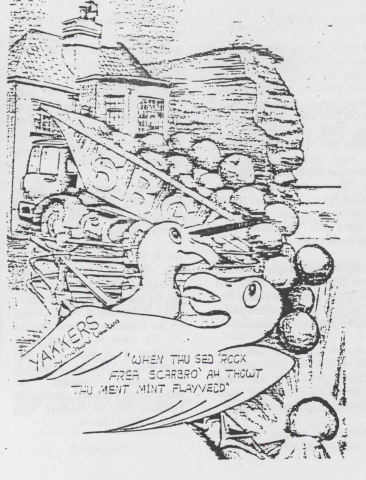
Dialect: "Squawkin', yappin', carryin' on!"

The dialect feature, written by Ringer, is headed "SQUAWKIN', YAPPIN', CARRYIN' ON!"
It is a humorous piece about the gulls around Staithes, written in the local dialect.
The article begins by describing the village's gulls as a noisy breed, particularly at that time of year, when they are nesting and bringing up their young.
The writer makes a joke about the noise made by the birds, comparing it with the complaints of a mother whose own children have been particularly troublesome.
It is full of local expressions and spellings, and is a lovely example of the magazine making space for the language and humour of the village.
Staithes Carnival: memories of the village in the 1950s
One of the most interesting historical articles in the first issue is "Now Then!", written by Gloria Wilson.
She recalls the Staithes Carnival, particularly the celebrations of the 1950s and 1960s.
For people who remembered the events, the carnival was still spoken about warmly.
It had clearly been an important part of village life.
The decorated boats and fireworks
One of the events she remembers was the Decorated Boats Procession.
Local boats were dressed with strings of coloured lights and sailed around the harbour and out into the bay.
A firework display followed.
One particular incident sounds rather alarming.
The first firework fell back into the box containing the rest of the display and set the whole lot off at once.
The fireworks shot horizontally up the beach, sending sparks past people's ears and causing everyone to run for cover.
Another rocket set fire to the grass on Penny Nab, and the fire brigade had to be called.
It sounds as though it was a memorable evening for all the wrong reasons!
The 1951 Festival of Britain exhibition
The article then goes further back, to 1951, when Staithes contributed an exhibition to the Festival of Britain celebrations.
The village's exhibition was staged in the old school, and brought together a remarkable collection of objects borrowed from almost every household.
There were antiques, curiosities and decorative and domestic objects, as well as exhibits relating to the geology of the area, fishing, shipbuilding, the alum industry, folklore, traditions, the lifeboat service and the Staithes Group of artists.
The collection included:
Christening robes used in 1884.
A child's school exercise book dated 1812.
A sixteenth-century Bible.
Gold and silver lustre vases.
Glass walking sticks and rolling pins.
Clipped mats.
Staithes bonnets and ganseys.
Musical boxes.
Embroideries.
Numerous old photographs.
There were also souvenirs brought home by sailors, including shawls from Malta and Shanghai, trays made from butterflies' wings, and objects made from jet and marcasite.
One particularly interesting item was an inkstand used at the Boulby Alum Works, said to be two hundred years old.
The Whitby Gazette apparently praised the exhibition, commenting:
"It is difficult to believe that the standard of the exhibition could be surpassed by any similar village festival event in the country."
What a wonderful collection that must have been, particularly given that so much of it had been borrowed from individual households.
Dancing on the Staith in the moonlight
The 1951 celebrations also included open-air dancing on the Staith in the moonlight, aquatic sports and a fancy-dress procession.
Gloria recalls that nearly every household in Staithes was represented, with many people wearing beautiful period dresses handed down through generations.
As time went on, the carnival developed into a much larger programme of entertainment.
There were concerts, barn dances, whist drives, produce and handicraft shows, comic water sports and torchlight processions.
There were also historical pageants, sometimes involving around two hundred people.
This is a particularly valuable article because it gives us a first-hand recollection of a village event that might otherwise survive only in scattered photographs and family memories.
It also gives us a glimpse of how residents understood their own heritage in 1951, when the village brought together its history, traditions, crafts and collections in a celebration of local identity.
A Day at Clark Hall: a school visit in 1994
This article is a report by Paul Fawcett about a visit by the top class at Seton School to a place called Clark Hall. Paul remembers how they were taken around the house and given the opportunity to experience aspects of historical domestic life.
The children practised writing with quill pens and were asked to write the alphabet. They also learned about soldiers' equipment, including helmets, leather jerkins, pikes and swords.
They learned to load a musket, and Paul remembers that a musketeer could load a musket three times in a minute. There were activities in the kitchen, where they learned about cooking and food, and ate their lunch while a boars head with an orange in its mouth watched on.
The children also encountered a rather dramatic story after lunch involving a letter, a coin, and a gun. Master David gave James a coin and a letter. James ran out of the room, but Mistress Glynis and Lieutenant Cahill stopped him and read the letter. It was passed to Rosemary, who gave it to Priscilla. Priscilla read it, pulled out a gun and announced:
"nobody move"
Lieutenant Cahill then produced a gun of his own, apparently considerably larger than hers.
The children found the whole episode extremely funny.
There was also a story about Rosemary being suspected of witchcraft. She was said to have hidden in a priest's hole in Priscilla's house while people came looking for her. The visitors searched the house but failed to find her. Then, one night, Rosemary disappeared, and so did her house.
The report is a particularly charming example of how a school visit could be made memorable through participation, storytelling and imaginative historical activities.
The names appearing in the children's account include Priscilla, Benjamin, Claire, Jane, Master David, James, Jack, Paul, Alan, Rosemary, Mistress Glynis, Mistress Ruth and Lieutenant Cahill.
School news: Seton School in May 1994

There is quite a lot of school-related news in the first issue.
Thirty children attended the 1994 Eskdale Festival of Arts on Wednesday 4 May. They took part in the under-11 choral-speaking competition and won their section.
On Friday 6 May, six children aged between eight and eleven took part in an inter-school Home Safety Competition. They were also overall winners.
There was a colouring competition for children under eight on the same subject, won by Christopher Taylor of Staithes.
On Saturday 7 May, Staithes School hosted a netball tournament involving a number of schools from the surrounding area.
The children also took part in the Education Sunday service at Staithes Methodist Chapel on Sunday 8 May.
The school calendar included:
17–23 May: School Book Fair at Seton County Primary School, Seaton Crescent.
27 May: Coffee afternoon and cake stall from 2.30pm, followed by a toy stall from 3.15pm.
These little announcements are useful for anyone researching Seton School, school activities and village events in the 1990s.
Pigeons, races and the Staithes Homing Society
The magazine also includes a detailed report from the Staithes Homing Society, recording the first four races of the 1994 season.
For anyone unfamiliar with pigeon racing, the reports give a fascinating amount of information: the numbers of members taking part, the number of birds entered, the distances flown, weather conditions, release times and the speeds achieved.
The first race took place from Selby on Saturday 2 April.
Thirteen members sent 136 birds, which were released at 11am in a west-to-north-west wind and fine weather.
The winner was recorded as J Marsay and son, with a velocity of 1502.21 yards per minute.
Other leading positions included K Breckon, J Cole and Mr and Mrs Bowman.
The second race, on 16 April, was from Mansfield, a distance of 86 miles. Again, thirteen members participated, this time sending 191 birds.
The winning position went to Mr and Mrs Bowman, followed by J Marsay and son.
On 23 April the birds travelled from Grantham, a distance of 119 miles. Nine members sent 202 birds.
The final race recorded was from Peterborough on Saturday 30 April.
This was a longer race, covering 141 miles, with eighteen members sending 249 birds.
J Marsay and son took first and second positions, followed by K Breckon, Mr and Mrs Hugill, J Cole and K Breckon again.
The names recorded in the race results include:
J Marsay and son
K Breckon
J Cole
Mr and Mrs Bowman
Mr and Mrs Hugill
Mr and Mrs Dix
W Porritt
The society was also advertising a Coffee Morning and Prize Bingo at Staithes Athletic Club on 30 May, between 10am and noon.
This is exactly the sort of material that can be particularly useful to family historians. A name that seems like a minor detail in a newsletter might be an important clue for someone researching a relative's interests or activities.
Aline Price writes to the editor
The Letters page includes a contribution from Aline Price of Cowbar.
Her letter concerns a road sign reading "Markings Erased".
She questions whether the wording was a way of avoiding the need to reinstate road markings, suggesting that if the white lines had disappeared, they ought simply to be painted again.
Her letter is a small example of the magazine's original intention: to provide a place where local residents could comment on everyday matters and challenge decisions they thought were unsatisfactory.
It also demonstrates how the newsletter could be used to record things that might never appear in an official local history. Will the 1-year anniversary of the Staithes traffic lights go into the history books?
The everyday details: what was going on in Staithes?

The unnumbered local information page at the beginning of the magazine is an interesting historical document in its own right.
It includes a list of useful telephone numbers, doctors, local churches, library services, swimming baths and community facilities.
The doctors listed for the Seaton Crescent surgery were Dr Stewart Brew, Dr Graham Croft and Dr Sharon Greaves.
The surgery was in Seaton Crescent, Staithes, with a branch surgery at 18 Moor View, Hinderwell.
Church services were listed for:
St Hilda's, Hinderwell.
St Peter's, Staithes.
St Nicholas', Roxby.
The Roman Catholic Church of Our Lady, Star of the Sea.
Staithes Methodist Church.
Bethel Church.
The named clergy included Rev David Demott, Father D Cahill and Rev Platten.
There was also a timetable for the mobile libraries.
The NYCC mobile library was scheduled to visit Staithes on 12 May, with stops including:
Staithes Car Park.
Cliff Road.
Seaton Close.
Seaton Crescent.
Captain Cook's Close.
Captain Cook's Old People's Bungalows.
A separate Cleveland County Council mobile library was due to visit Cowbar and the Cod and Lobster.
The swimming information listed Whitby Indoor Pool and Loftus Leisure Centre, with public swimming sessions at various times during the week.
The village's regular activities at the Memorial Hall also featured prominently, including Whist Drive, Keep Fit, Craft Class, the Senior Citizens' Club, Bingo, Mother and Toddlers, Country Dancing, Domino Drive and Evangelical Church services.
It is an interesting picture of a village with a very active network of clubs, services and community facilities.
One business opens... and another closes

This article records two changes to the commercial life of Staithes in 1994.
Marvic Gallery opens on the High Street
The new arrival was Marvic Gallery, which had opened on 21 March 1994.
Owned and run by Shirley Lester, the gallery was described as an Aladdin's Cave of art and individually handcrafted pieces.
Many of the items had been worked by Staithes residents, and the article emphasised the quality of local craftsmanship.
The gallery sold an unusually wide variety of things, including:
Paintings.
Photographs and prints.
Staithes bonnets.
Miniature lobster pots.
Hatpins.
Handcrafted jet jewellery.
Knitwear.
Pottery.
Handmade wooden and marbled books.
Handmade lead clocks and mirrors.
Rugs.
Many of the objects were made from local materials or inspired by local scenery.
Shirley had studied fine art at Kingston and printmaking at Wimbledon. She specialised in stained glass and exhibited her own mobiles, mirrors and lampshades. She also undertook larger stained-glass commissions, including windows.
The gallery was at Marvic House, High Street, Staithes, and was being advertised in the magazine as one of the village's latest business ventures.
There is also a separate advertisement earlier in the issue:
MARVIC GALLERY – Individually designed arts and crafts
Proprietor: Miss Shirley Lester.
Marvic House, High Street, Staithes, TS13 5BH.
The end of the sorting office at Lane End Post Office
The business closing was not the post office itself, but its sorting office.
After years of debate, a decision had been taken to close the sorting office at Staithes Lane End Post Office.
Royal Mail intended that, from 1 August 1994, all mail for Staithes would be sorted at a purpose-built modern delivery office at Skelton.
The intended benefit was an earlier mail delivery in Staithes, potentially by up to thirty minutes.
However, the article records the concerns of Mrs Dorothy Day, the postmistress at Staithes Lane End Post Office.
Although the office would continue to receive returned mail and packages that could not be delivered, Mrs Day was concerned about the effect on the service.
She also explained that she would no longer be able to release certain items, such as parcels requiring a signature, outside normal post office hours.
It is a small but significant record of changes to the way local services were organised.
The Lane End Post Office advertisement elsewhere in the issue also tells us more about the business. It was being run by B & D Day and advertised itself as a newsagent, grocer and off-licence, selling Danish bacon, home-cooked hams, real cheeses, cards and toys.
A whole village of businesses: the advertisements of May 1994

One of the most valuable things about the first issue is the collection of advertisements.
They provide a snapshot of the businesses, services and attractions available to residents and visitors in Staithes and the surrounding area.
They also preserve addresses, telephone numbers, proprietors' names and descriptions that may be difficult to find elsewhere.
Here is the full range of identifiable business advertisements in this issue.
Bulmans Coaches
32 Cliff Road, Saltburn-by-the-Sea
A local family-run business, established for forty years, offering 53-seater coaches.
The advert promised:
"PRICES TO SUIT ALL POCKETS"
It also advertised a full 24-hour service.
Marvic Gallery
Marvic House, High Street, Staithes
Owned by Shirley Lester, selling individually designed arts and crafts, including stained glass, pottery, jewellery, handmade items and objects inspired by the local area.

The Yellow House Tea Garden
Cowbar Bank
Advertising hot and cold drinks, hot snacks, sandwiches and homemade scones, with:
"SUPERB VIEWS OVER THE VILLAGE"
Seadrift Sweet Shop
Staithes
An advertisement by Ted and Sheila Howell.
The shop promised good confectionery and excellent coffee.
Leo Designs
Advertising beautiful interior decorating at competitive rates.
Black Lion Hotel
High Street, Staithes
A restaurant and bar offering meals and en-suite accommodation.
The advertisement specifically welcomed dogs, children, walkers and their boots.
The advert also contains a handwritten-style message from Mike and Steve, inviting loyal customers to celebrate the hotel's first anniversary on 30 May.
It ends with a playful suggestion:
"For a warm and friendly welcome, visit the Black Lion - the pub that doesn't live up to its reputation. You might be pleasantly surprised..."
Fryer Tuck's – Lane End Fisheries
53 Staithes Lane, Staithes
Advertising its summer season opening and inviting customers to sample its fine fish and chips.
Lunch was served from 11.30am to 1.30pm, and evening service ran from 4pm to 9pm, with the last fry.
The advert's slogan was:
"We ENDEAVOUR to please & COOK to Order"
And:
"GO ON, TRY THE FRY"
Lane End Post Office
Staithes Lane, Staithes
Run by B & D Day.
The business combined a post office with a newsagent, grocer and off-licence, and advertised Danish bacon, home-cooked hams, real cheeses, cards and toys.
The Captain Cook
Staithes Lane, Staithes
Offering a Thursday quiz night with free supper and a three-course Sunday lunch advertised at £4.50.
Aquarius Travel
20 Station Street, Saltburn
A local booking agent for British Rail and National Express, as well as an agent for major tour operators.
Its slogan was:
"You don't have to travel far to travel the world."
Richard Lawton Joinery
Unit 2A, Hinderwell Industrial Estate
The advertisement covered a huge range of woodworking services, including doors, floors, bookcases, staircases, sash windows, dormer windows, picnic tables, kitchen tables, garden benches, gates, fences, greenhouses, dolls' houses, rocking horses, clothes horses, cupboards and fitted kitchens.
It also offered signwriting and nameplates.
The advert promised:
"MAKING, FITTING, REPLACING, REPAIRING, GLAZING AND PAINTING. ANY KIND, ANY FINISH, ANYTHING IN WOOD!"
The cover illustration for the magazine is also signed Richard Lawton, making him an interesting figure in the production of the first issue as well as in the local business directory.
The Gift Shop
High Street, Staithes
The Gift Shop advertised a remarkable mixture of goods:
Gifts for all ages.
Sunday newspapers, including home delivery.
Tools, hardware and ironmongery.
Confectionery.
China and pottery.
Electrical and household goods.
Indian skirts and dresses.
Staithes bonnets.
Original postcards.
Whitby kippers.
Books and stationery.
It was open all year round.
The advertisement ended with a particularly memorable promise:
"If we haven't got it in stock - we will have on Friday, mate"

Trig Point 49
80 Staithes Lane, Staithes, Whitby, North Yorkshire, TS13 3AH
An Outdoor Educational Resources Centre, advertising its Summer Camp '94.
The programme offered seven-, five- and three-day holidays, fully qualified instructors and a wide range of activities and challenges.
It promised at least one leader for every five children.
The advertisement included a handwritten-style message about the beginning of the summer holidays:
"The kids are driving me crazy, and it's only the first day of the summer holidays..."
A few things for sale...
The classified advertisements are also worth recording.
The first issue included:
Bird boxes and bird tables, priced at £1.50 and £3.
Cockatiels, advertised as 94 young, at £8 each.
A pair of riding boots, size 2, hardly worn, for £10.
An upright spinning wheel, described as fully working and supplied with accessories, for £100.
Babysitting and dog walking offered by a reliable fourteen-year-old.
These little notices give us a glimpse of the everyday buying, selling and small services that formed part of village life.
They also show that the magazine was intended to be useful as well as entertaining.
What was on in May and June 1994?
The issue contains several announcements that give us a calendar of village events.
Here is what readers were being invited to attend.
Date | Event |
2 May | Staithes Ladies Lifeboat Guild Coffee Day at the Lifeboat House |
17–23 May | Seton School Book Fair |
27 May | School coffee afternoon, cake stall and toy stall |
30 May | Staithes Homing Society Coffee Morning and Prize Bingo at Staithes Athletic Club |
30 May | First anniversary celebrations at the Black Lion Hotel |
31 May | Black Lion Hotel Pizza Party, 5.30pm–7.30pm |
6 June | D-Day 50th Anniversary Coffee Morning at the Black Lion Hotel |
21 June–3 July | Nancy Miller's landscape painting exhibition at Montague Studio Gallery, Castleton |
The D-Day anniversary coffee morning was advertised for 6 June, between 10am and noon, with a tombola stall.
All proceeds were to go to Dalewood House, SHARE and the RNLI.
The magazine also gave details of the various school events, art activities and community groups taking place during the month.
The Last Word: how the magazine hoped to continue
The final article in the main magazine is appropriately called "THE LAST WORD".
It explains the practical arrangements behind the publication and what the team hoped to achieve in future.
The editors thanked everyone who had given their time, talents and telephone calls free of charge.
The main expenses had been photocopying and paper, and the advertising revenue did not yet cover those costs.
The team hoped that eventually there would be enough advertising income to produce more pages while keeping the magazine free.
They were also keen to receive more material from residents, apologising to those they had not yet managed to contact.
There was no intention to make a financial gain. Any revenue was to remain in the Black Lion bank account and go towards local projects.
The advertising rates were also published:
Classified advertisements: 15 words for 50p.
Display advertising, 5cm double column: £2.50.
Display advertising, 10cm double column: £5.00.
Half inside back page: £10.
The deadline for advertising and copy was the fourth of each month.
The first issue ended with a simple request for support.
People named in the first issue
One of the reasons we are making these magazines accessible is to help people researching local families and individuals.
The May 1994 issue includes many names, some appearing as contributors and others in stories, advertisements, school reports and community notices.
The following is an index of the identifiable people and contributor names appearing in the issue. Some are given only by initials, titles or pseudonyms, exactly as printed.
Editorial and contributors
Liz Hinchley
Bill Hinchley
Eileen Wright
Jackie Hampson
Richard Lawton
Celia Grant
Brian Morton – author of Steers
Dave Moffat – Garden of Eden
Alastair Grant – Paws and Claws
Terry Lawson – Poetry Corner
Gloria Wilson – Now Then!
Paul Fawcett – school visit report
Nancy Miller – local artist
Aline Price – letter to the editor
Ringer – dialect feature
J – Rockerama
Yakkers – cartoon feature
Wrecker Roe's Lass – Wrecker's Relations
People mentioned in stories and reports
George Hanson – skipper of the Frank and Elizabeth, remembered for his attempted rescue in 1957.
Mr Chapman – retired fisherman and neighbour of Brian Morton, who gave him a driftwood coble.
Shirley Lester – proprietor of Marvic Gallery.
Ted Howell and Sheila Howell – Seadrift Sweet Shop.
Dorothy Day – postmistress at Staithes Lane End Post Office.
Mike and Steve – Black Lion Hotel.
Christopher Taylor – winner of the school colouring competition.
Rachel – mentioned in the birthday announcements.
HRH the Prince of Wales – included in the list of supporters approached by SCAR.
Staithes Homing Society
The race results record:
J Marsay and son.
K Breckon.
J Cole.
Mr and Mrs Bowman.
Mr and Mrs Hugill.
Mr and Mrs Dix.
W Porritt.
School visit to Clark Hall
Names appearing in the children's report include:
Paul Fawcett.
Priscilla.
Benjamin.
Claire.
Jane.
Master David.
James.
Jack.
Alan.
Rosemary.
Mistress Glynis.
Mistress Ruth.
Lieutenant Cahill.
Some of these names appear as characters or roles in the activities described by the children, rather than necessarily as real local individuals.
Medical and church contacts
The local information page lists:
Dr Stewart Brew.
Dr Graham Croft.
Dr Sharon Greaves.
Rev David Demott.
Father D Cahill.
Rev Platten.
There are also numerous references to unnamed residents, fishermen, teachers, children, volunteers and members of the various village organisations.
A little snapshot of Staithes in 1994
Looking back through the first issue of The Steeaze Bellman, what is striking is how much of village life is contained in just sixteen pages.
We find a village concerned about the future of its harbour, debating coastal protection and demanding repairs to the Cod Wall.
We find children exploring the village, sailing toy boats, searching rock pools and remembering the danger of the sea.
We find the memory of a tragic rescue in 1957, and the courage of George Hanson and the unnamed teacher who lost their lives trying to save a boy.
We find a history of the village carnival, with decorated boats, fireworks, dancing on the Staith and an extraordinary Festival of Britain exhibition assembled from objects borrowed from local households.
We find a school full of activities, local artists preparing exhibitions, the Ladies Lifeboat Guild fundraising, pigeon fanciers competing across the region and people writing letters about road signs.
We find shops, cafes, a hotel, a gallery, a post office, a joinery business, a travel agent and an outdoor education centre.
And we find the small details: the price of a Sunday lunch, the mobile library timetable, a second-hand spinning wheel, homemade scones, a recipe involving Mars Bars and Rice Krispies, and a dog who spent three weeks trying to herd a tube of breast cream.
None of these things would necessarily have seemed remarkable to the people reading the magazine in May 1994.
That is precisely why they are so interesting now.
The first issue of The Steeaze Bellman was intended to help the village communicate with itself. In doing so, its contributors created an unexpected record of ordinary life: the things people remembered, the things they worried about, the things they enjoyed and the things they wanted to preserve.
Thirty years later, we are delighted to be able to share those pages again.
Explore the original magazine
The Steeaze Bellman – Issue 1, May 1994
The complete original sixteen-page issue is available to read below. Browse the original pages to discover the articles, advertisements, illustrations and local information for yourself.
Source: The Steeaze Bellman, Issue 1, May 1994. Original magazine held in the Staithes Museum archive. Archive Reference: TEMP.38


Comments