
The Mysterious Mrs K, the Case of the Exploding Cheese and Other Tales from Wartime Staithes


From a brick of wartime cake to a honeymoon derailed by bombing, two remarkable archive documents preserve the humour, heartache and everyday ingenuity of people who lived through the First and Second World Wars around Staithes and East Cleveland.
“I remember hitting it on a wooden topped dresser with my fists and you couldn't tell the difference in sound.”
The offending object was a cake. Or, at least, it was supposed to be one. Flour was rationed, the ingredients were precious, and the baker had forgotten to put the yeast in. The result, according to Ron Scarth of Kateridden, was “hard as bell metal!”
It's the sort of story that might be told across a kitchen table, accompanied by a laugh and a shake of the head. Yet it has survived for decades, preserved in a typewritten document in the Staithes Museum archive.
Ron was recalling life during the Second World War. His story appears alongside memories of air raids, lost fishing crews, ration books, mysterious strangers and the extraordinary kindness of people who had very little to spare.
These aren't official histories written after the event. They are people's own recollections, with all the quirks, humour, sadness and unexpected details that make oral history so compelling.
Two documents in the museum archive bring together these remarkable accounts: World War One, reference SSESM.2019.RED.612.20, and World War Two, reference SSESM.2019.RED.612.27. Both were compiled by Monica Williams for the East Cleveland Heritage Project in 1987. The First World War volume credits illustrations by Sara J Taylor; the Second World War volume credits Janette Rose and S. C. Mitchell.
These typed excerpts helped lay the foundations for the Voices project, which published books of local memories. They are fascinating objects in their own right: a surviving record of the process through which people's conversations and recollections became part of the area's written history.
And what shines through most strongly is the people themselves.
The First World War: A submarine, a silver watch and an unexpectedly generous enemy

One of the most extraordinary stories in the First World War transcript comes from Eva Hanson of Staithes, born in 1906. She remembered what her father told her about being out herring fishing when a German submarine appeared.
Her account is full of the particular details that make a family memory feel immediate:
“I remember me father an' them was torpedoed by a German Submarine an' they were herringin' at the time, herring cobles you know — an' there'd be about six or seven of them and this submarine came up.”
The submarine crew took the fishermen aboard and offered them water. Eva's father had bought a silver watch the week before, which he always wore beneath his jersey. Before going aboard, he slipped the watch from its chain and hid it down his sea boot.
The Germans ordered the men to sink their boats. Yet the coble carrying Eva's father stayed afloat, and the men were eventually put aboard it and sent home.
Eva remembered her father's verdict on the German sailors:
“He was good to them. Me father allus used to say ‘There's as many good Germans as there are English’.”
It's a remarkable sentiment to have survived a wartime experience, and an equally remarkable example of how a family's recollection can complicate the simple distinction between friend and enemy.
Eva appears in both the First and Second World War transcripts. In the later volume, her memories turn to rationing, the restrictions placed on fishing and the losses suffered by the Merchant Navy. Read together, her accounts show how war could reach into almost every aspect of life in a coastal community.
Zeppelins, tunnels and a rather unpleasant shelter
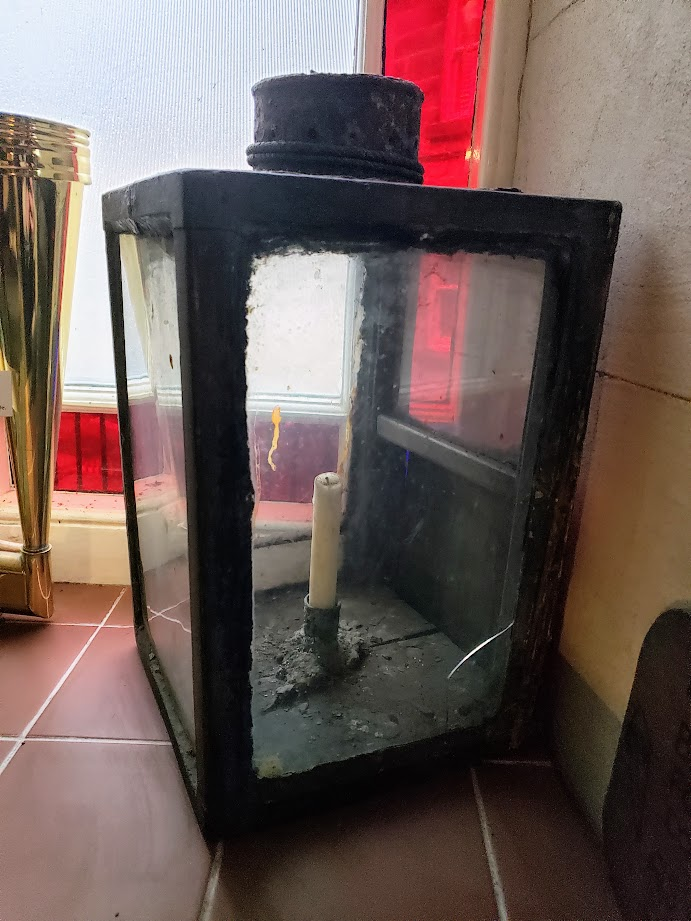
The First World War brought danger to the industrial communities around Staithes, too. The threat of Zeppelin raids meant that people had to find shelter wherever they could.
Doris Ward of Staithes recalled her family's stories of the raids. Her father was working at the mine when news came that the Zeppelins were approaching. Her mother took the children towards a drift tunnel, where people could shelter.
When they arrived, they realised that candles were needed to see in the darkness. It was the sort of practical problem that becomes obvious only when you imagine yourself there: the danger overhead, the rush to safety, and then the need to work out how everyone was going to sit in a dark tunnel.
Jim Lane of Skelton, born in 1907, remembered a dugout made from large tree trunks. He described it as “a horrible place”, with the supports called “baulks” and water dripping from the timbers.
His memory of the air raid itself was spectacular:
“I watched it — and there was a Zeppelin come over and the anti-aircraft guns had shot it. It all burst into flames, it was like a big red sausage, all blazing like mad.”
It's an extraordinary image: a child's description of an enormous burning airship, remembered decades later in exactly the sort of language that makes you see it.
George Nicholson, associated with Loftus and Staithes and born in 1910, recalled bombs falling near Street Houses when he was at school. One caused a fire in a stable, badly injuring two horses. Another fell into a man's kitchen, trapping him, his wife and daughter inside until they escaped through a little back window.
The transcript gives us not only the frightening events, but also the details of how people got themselves to safety. George remembered a trench dug in a field, with a haystack built over it to provide shelter in winter. In summer, people went to a smugglers' cave beneath a great pile of rock.
“We had no bread, never saw a bit of bread”
The First World War memories also bring us close to the lives of the soldiers.
Robert Billam of Hinderwell, born in 1898, described serving in France and being severely wounded at Ypres in October 1917. His testimony includes the kind of detail that makes a general account of military hardship feel real:
“We were paddling about in five or six inches of snow, we were on biscuits and cheese, we had no bread, never saw a bit of bread.”
Around Christmas, he received a parcel from his cousin in Jarrow, who worked in a cake shop.
It's a small detail, but one that stays with you. In the middle of a war, a parcel from home could mean more than a meal. It was a reminder that someone was thinking about you.
Harry Burgess of Skelton, born in 1899, had a rougher recollection of life in the trenches. He was wounded twice within twelve months and described spending fourteen days at a time in the trenches.
“You hadn't to take your uniform, you hadn't to take your equipment off, not even when you went to the toilet, you still had your boots and everything on.”
At night, he explained, soldiers wrapped themselves in a groundsheet and a piece of blanket.
Meanwhile, Frank Bennison of Lingdale, born in 1909, recalled the homecoming of one of his brothers around 1919. His mother had to burn the returned soldier's clothes because they were crawling with lice:
“Me mother had to burn all his clothes, he was lousy with bugs, then he went to bed, till she went an' bought him some clothes.”
It isn't a grand military story. It's a mother trying to get her son clean and clothed again. And perhaps that is exactly why it deserves to be remembered.
The end of the war: “Everybody one happy family”

Not all the First World War recollections are frightening. The transcript also records moments of solidarity and celebration.
May Jones of Skelton Green remembered queues for food, sometimes with nothing to show for hours of waiting. Evelyn and Tim Healey, from Middlesbrough, recalled taking turns to queue for meat, and the excitement of finally getting a large jar of raspberry and apple jam from the Co-op.
Frank Bennison also remembered travelling from Lingdale to give a concert for wounded soldiers at Wharton Hall, Skelton, which had become a military hospital. He was still in the infants' class at school. The children sang a song called “Click, click, it's a monkey on a stick”.
And then there was Armistice Day.
Herbert Harker of Brotton recalled a street party in 1918, with people bringing tables and tablecloths out of their houses.
“‘Have you got a tablecloth?’ ‘Yes, go in, you'll see it, it's in the bottom drawer....’ You know everybody one happy family...”
The image is lovely: people rummaging through their drawers, finding what they could contribute and turning the street into a shared celebration.
After years of loss and uncertainty, it was a moment when a community could simply be glad to be together.
The Second World War: Sally Fawcett's sunbathing and the end of ordinary life

The Second World War transcript begins some of its most vivid stories with Sally Fawcett of Hinderwell, born in 1907. When war was declared, Sally was manageress of the café at Runswick Bay.
Her opening memory is almost disarmingly ordinary:
“I was sunbathing on the beach at Runswick that Sunday afternoon when war was declared... I was Manageress of the cafe there, you see... I have some photos... there are about five or six of us... sat on deckchairs in our overalls, and bathing hut attendant lads was there as well... yes, I can remember that.”
The photograph she described isn't included in the transcript, but the scene is easy to imagine: a group of café workers sitting on deckchairs, enjoying a Sunday afternoon, not yet knowing how much their lives were about to change.
Sally soon became involved in fire watching, first aid and home nursing. She remembered tackling a fire in a large building full of straw:
“I used to go out every night because I had a horror of a bomb dropping and covering me ‘up in bed... and when I heard the siren... If I'd gone to bed I used to get up again...”
Her words reveal how fear could reshape even the simplest routines. Going to bed was no longer necessarily the safest or most comfortable thing to do.

Yet it is also the ordinary details that make her memories so engaging. Sally later worked in a grocery shop, where she became thoroughly familiar with the business of rationing.
“I could do rations up with me eyes shut,” she said.
She remembered weighing small portions of bacon, butter, lard, sugar and cheese, wrapping everything up and accounting for every coupon. It was a job that demanded precision, patience and a good memory.
There were customers who gave her their unwanted sweet coupons, and others who expected goods to be kept aside for them. Bananas appeared only occasionally, and the shop had to be careful about how they were distributed.
Sally's employer, Mr Featherstone, was eventually forced to give up the business. But she remembered him warmly as “a lovely chap”, and the shop as “the fairest shop in Hinderwell”.
Her account is full of practical details, but it also preserves the relationships that made a local shop more than somewhere to buy groceries.
The cake you could hardly chisel off the dresser
Now back to Ron Scarth, and that unfortunate yeast cake.
Ron Scarth of Kateridden, born in 1910, remembered food shortages and the effort involved in making ingredients stretch. His account of the failed cake is one of the funniest passages in the archive:
“When she took it out of the oven it looked lovely — It was hard as bell metal! — she'd not put the yeast in... I remember hitting it on... a wooden topped dresser with my fists and you couldn't tell the difference in sound.”
The family tried to salvage it rather than throw it away.
“I nearly had to chisel it off, we daren't throw it away — we chiselled bits off to eat it...”
It's funny because Ron tells it so matter-of-factly. There is no grand punchline, just a cake that went badly wrong and a family that couldn't afford to waste it.
His wife, Mrs Scarth, remembered the same determination to make something out of very little:
“It's surprising... what you can do and what you can make... out of nothing... because you really had to be careful with your coupons and buy necessities.”
People made coats out of blankets. Mrs Scarth herself was given a beautiful blanket, which she was expected to cut up and turn into a coat.
Pauline Wilkinson-Armistead of Middlesbrough, born in 1938, remembered another ingenious use for an unlikely material:
“I remember we had a nightdress made out of flour sacks, boiled and boiled until the sign came off the back…”
The flour sacks became fabric; the blanket became a coat; and the failed cake, somehow, still became food. The stories are a testament to a kind of “make-do” that was less about craft for its own sake than about getting through the week.
Five evacuees and a very unusual bedtime

Ron Scarth also remembered being required to take five evacuees into his home. “They were canny kids but... they'd been brought up a little rougher than we'd been used to,” he explained.
One day, the children's parents came to visit, bringing a cake. The table was already set with buttered bread, but the visiting mother promptly dumped the cake on top of it.
Then there was bedtime.
Ron and his family went to check on the children and found them lying underneath the bed.
“They said ‘Oh, Mummy and Daddy sleep on top and we sleep underneath’!”
The children didn't stay for very long. Ron recalled that they were eventually sent away again, but not before local people had helped get them nicely clothed. “Everybody gave us what they could,” he remembered.
It's a funny story, but it also tells us something about the disruption of evacuation. Children arrived in unfamiliar homes, carrying with them their own habits and experiences. Hosts had to adjust, and children had to learn new ways of living.
The story's humour doesn't erase that difficulty. Instead, it makes the people involved feel real.
A honeymoon on a hay bench
Ron had another story about making do when plans went wrong — this time on his honeymoon.
He and his wife were married on 21 December 1940 and set off for Buxton. But bombing around Manchester disrupted their journey, and they became stranded at Stalybridge.
Eventually, a railway worker offered them a place to stay for the night.
Ron recalled the warmth of the house and the hospitality of the man who took them in:
“There was a most gorgeous, great big fire... it was absolutely out of this world, and it was something to be warm…”
Their sleeping arrangements were less luxurious.
“We slept on a hay bench, yes, slept on a hay bench with some old sacks on top of us...”
The man offered them a cup of tea in what Ron remembered as “the muckiest mug I think I've ever seen in my life”. He even shared a sandwich with them, cutting it in half with his penknife.
They washed in the morning using an enamel bowl with a hole in the bottom and a pipe leading into a bucket. Then the host began sweeping up the confetti that had been scattered around the room, stirring up the coal dust.
“Oh we felt like sweeps when we came out!”
Despite the discomfort, Ron remembered his rescuer with great affection:
“But he was a real sport...”
There is something wonderful about a story in which the most memorable part of a honeymoon is not the hotel or the destination, but the stranger who provided a fire, half a sandwich and a place to sleep.
The mysterious Mrs K: Spy, author or simply a stranger?

The Second World War transcript contains one of its most intriguing stories under the heading “The Mysterious Mrs K”.
Sally Fawcett remembered a woman who arrived in Hinderwell alone, carrying a case. She was well educated, elegant and distinctive in her dress, and she lived in a cottage at West End. Sally described her as:
“She wasn't somebody just ordinary and she had all styles, she always wore black, real short skirts with a split up, even then, and fancy shoes and her hair shingled.”
The woman walked alone along the cliff tops and did not tend to speak unless spoken to. During wartime, when people were alert to the possibility of spies, this was enough to make her an object of suspicion.
Sally, however, became friendly with her. Mrs K told Sally that she came from Epping Forest and was writing a book about Hinderwell, including Sally and her family. She promised to send a copy once it was finished.
But she disappeared, and Sally never heard from her again.
The story ends with Sally's own assessment:
“You see, when she lived down there and aeroplanes coming every night, folks... put two and two together, but I still don't think there was anything. She was no more a spy than we were.”
It's a wonderful little mystery. Who was Mrs K? Was she really writing a book? Did she ever finish it? The transcript gives us no answers. All it preserves is Sally's affection for a woman who had become, briefly, part of her life.
Sometimes oral history leaves us with an unanswered question rather than a neat conclusion. That is part of its charm.
The Casamance: A shipwreck, a rescue and a very peculiar lump of “cheese”

One of the longest pieces in the Second World War document is an account by George Cox of Loftus, born in 1907, about the loss of the Casamance on 17 February 1941.
George was on coastguard duty at Skinningrove with his colleague Teddy Breckon when a north-easterly gale was blowing and the sea was rough.
Just after midnight, he heard a strange noise.
“It sounded like a fox howling.”
Looking towards Staithes, he saw coloured flares being fired into the sky and realised that the noise was a ship's foghorn. A vessel had gone onto the rocks.
George's account describes the coastguards' attempts to help the crew, including men wading into the sea and trying to reach people in freezing water. The night had already been spent on watch, and the work was physically exhausting.
Later, the beaches were covered with the wreck's cargo: logs of mahogany, sacks of cocoa beans, clothing and other goods. The logs had to be recovered, and local boats were put to work towing them ashore.
George's account gives us a wonderfully detailed picture of the practical aftermath of a shipwreck: who did what, which boats were used, how the cargo was moved, and the arrangements made for salvaging the logs.
But the document contains another story involving George and Teddy that is almost too good to leave out.
During the war, the two coastguards had heard that a large block of cheese had washed up on the beach. Cheese was scarce, and they thought the soldiers billeted nearby would appreciate some.
They took a piece down to the soldiers' hut. A short time later, there was a commotion.
“What the devil's this you've sent us?”
George's mate answered, “It's cheese”.
“Cheese be damned”, the soldiers shouted back, “Cheese doesn't smoke like this”.
Black smoke was belching out of the door and windows. The supposed cheese burned for half an hour before it finally went out.
George later learned that it was beeswax used for sealing joints in boatbuilding. The mystery was solved, though not before the unwitting soldiers had been treated to a rather unusual supper.
It is one of those stories that feels almost tailor-made for oral history: a little misunderstanding, an unexpected twist, and a group of people trying to make the best of wartime shortages.
“There was like a cloud over Staithes that day”

The archive is full of humour, but it also preserves the terrible losses that affected local families.
Margaret Nicholson of Staithes remembered the young men who served and the merchant ships that failed to return. She described the loss of nine men from one ship:
“When you take nine out of a little village, when you get news on one Saturday to say that it had gone down, captain and crew, and in a little village, you can imagine what it was like.”
She summed up the feeling in Staithes that day:
“There was like a cloud over Staithes that day. Terrible...”
Alfred Pearson of Skelton, born in 1926, similarly reflected on the number of seamen lost from Staithes during the war. His recollection puts these losses in the context of a village with a population of about 1,200.
Mary Laverick of Staithes remembered a bomb falling near Greystones, narrowly missing houses. She also recalled the deaths of three members of her extended family when their room in Middlesbrough was bombed. They were buried together at Hinderwell Cemetery.
These are memories that don't need embellishment. Their power lies in the speakers' own words, and in the way they connect national events to the lives of particular families and communities.
From the voices of local people to the museum archive

The two documents are now part of Staithes Museum's archive, but they began with people talking about their lives.
The First World War transcript records interviews gathered between 1983 and 1987. Monica Williams compiled the selections for the East Cleveland Heritage Project, which produced both volumes in 1987. The later Voices project brought local memories into published books, allowing these recollections to reach readers beyond the people who first shared them.
The surviving typescripts offer a glimpse of how such history is made. A person remembers an event; an interviewer records it; someone selects and types an extract; a publication gives the story a wider audience; and eventually, the transcript itself becomes an archival object.

What makes these documents so precious is not simply the information they contain. It is the way the people speaking still seem to be present.
Sally Fawcett is there, explaining how she could weigh rations with her eyes shut. Ron Scarth is there, trying to eat a cake that could withstand a beating. Eva Hanson remembers her father's encounter with a German submarine. George Cox recounts the apparent miracle of cheese washing up on the beach, only for it to turn out to be beeswax.
And somewhere in Hinderwell, in Sally's memory, the mysterious Mrs K is still walking along the cliff tops, carrying her case and promising to write a book.
These are the voices that turn local history into something more than a list of events and dates. They remind us that people lived through the wars not as characters in a textbook, but as neighbours, parents, children, shopkeepers, fishermen, soldiers and strangers who helped one another along the way.
The two typed documents preserve those voices for us to encounter decades later. We can laugh at the cake, admire the ingenuity, feel the sadness of the losses and wonder about Mrs K.
And we can still hear, in the words of the people who were there, what life was really like.


Comments