
Staithes Museum Newsletter September 2026

Hello everyone,
September has been a busy one at Staithes Museum, with a record-breaking Arts Festival, a special premiere of our new museum film, and plenty of fascinating discoveries in the archives!
Our latest newsletter is below, with all the news from behind the scenes, stories from the Eileen Huby collection, our poetry competition winners, six new blog posts, and a few mysteries we could do with your help solving.
Thank you, as always, for your continued interest and support. There’s lots happening at the museum, and we look forward to sharing more with you over the coming months.
Happy reading!
Best wishes,
Rosie
Below is a version of the newsletter without its pictures and layout stuff:
Hello!
Hello! I’m writing to you on the 3rd of October - at the start of the quiet season after a manic month of festival action, missed emails, and important meetings. It’s time to revamp the website and hoover the windowsills - but while I can still remember - here’s what we got up to in September!
A Record-Breaking Arts Festival!
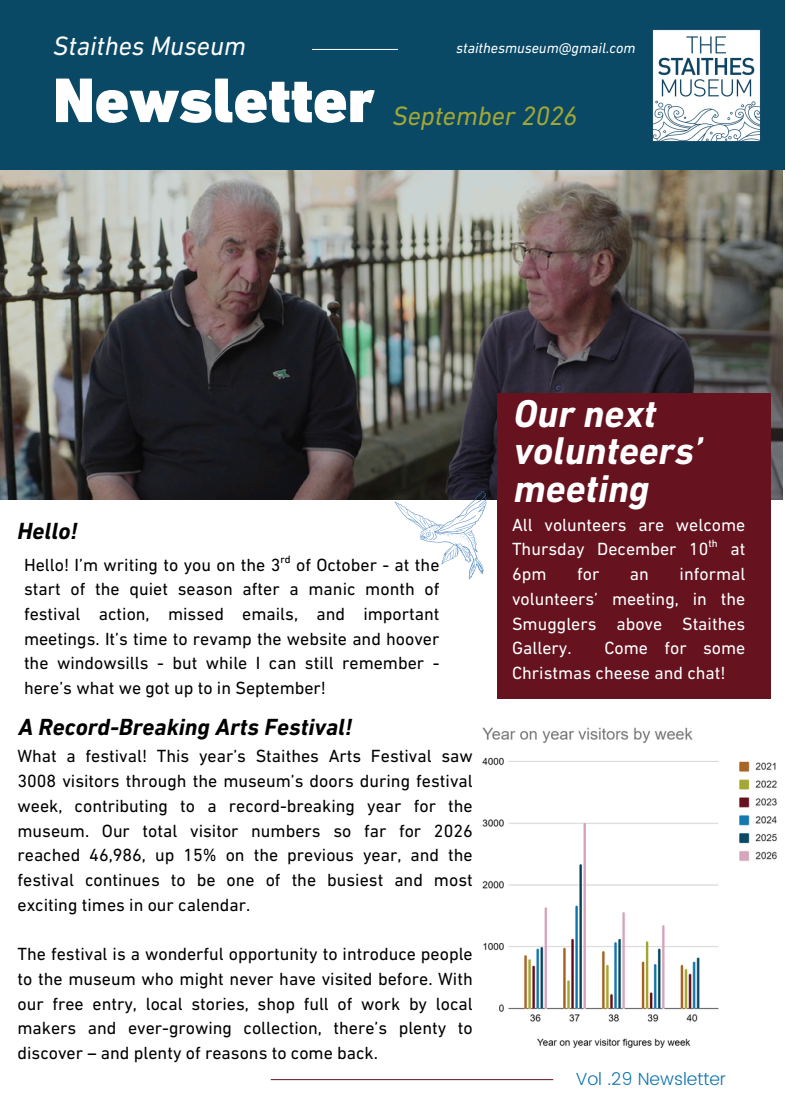
What a festival! This year’s Staithes Arts Festival saw 3008 visitors through the museum’s doors during festival week, contributing to a record-breaking year for the museum. Our total visitor numbers so far for 2026 reached 46,986, up 15% on the previous year, and the festival continues to be one of the busiest and most exciting times in our calendar.
The festival is a wonderful opportunity to introduce people to the museum who might never have visited before. With our free entry, local stories, shop full of work by local makers and ever-growing collection, there’s plenty to discover – and plenty of reasons to come back.
A Premiere at the Museum: The Stories of Staithes
Our volunteers' meeting was a special premiere our new film, The Stories of Staithes Museum, bringing together local voices to explore the history of the museum and the stories behind its collections.
We gathered in the museum to watch the film together, hearing memories of Reg and Anne Firth, stories of Staithes fishing families, traditional bonnets, local dialect, artists, miners – and, of course, the rather surprising tale of the ships bringing barrels of urine into Staithes for the alum industry!
It was a lovely opportunity to reflect on how much history is held in our little museum, and how much of it depends on local people sharing their memories and knowledge. The screening also prompted some discussion about the museum's own beginnings, with archival material upstairs adding to the conversation.
The film has an important practical purpose, too. As so much of our collection is upstairs in our historic chapel, we wanted to find a way for visitors who cannot manage the steps to experience some of those stories. The film is now available to watch on our big screen in the museum, bringing the upstairs galleries to a wider audience.
A huge thank you to BYT Films for doing such a brilliant job of bringing these stories together, and to the North York Moors National Park Authority for funding the project. And thank you to everyone who contributed their voices, memories and knowledge.
The film is now available on YouTube, too – so even if you can't visit us in person, you can still discover the stories of Staithes Museum!
What I’ve Discovered While Scanning the Huby Collection
I’ve recently been spending quite a lot of time with the Eileen Huby family-history collection, carefully turning pages, putting them down on the scanner glass, saving the images, turning the next page… and occasionally getting completely distracted by what I’ve just read.
The collection is packed with family trees, handwritten research, newspaper cuttings, photographs and notes about families from Staithes, Hinderwell and the surrounding area. We’re working our way through it so that this fascinating material can eventually be properly catalogued and made much easier to access.
But digitising historical documents has a slight occupational hazard: you keep discovering things.Here are just a few of the stories that have stopped me mid-scan so far.
A mother who knew her son had drowned
One of the most extraordinary stories concerns John Richard Verrill Tyerman, known as “Dick Tyers”, from Pond Farm, Hinderwell. He was Second Officer aboard the SS Gaboon when he accidentally drowned at Millwall Docks in London in January 1919.
According to the family story recorded in Eileen Huby’s research, Dick’s mother, Polly, was said to have experienced “second sight”. At the moment her son fell into the icy dock, she reportedly saw him drowning – just before local police arrived at her door with the news.
There was another remarkable twist to the story. Because of errors in the wartime docklands records, Dick’s surname was recorded incorrectly as “Teyerman”, and his age was also wrong on his death certificate. His family eventually managed to have the historical records officially amended – 84 years later, in 2003.
(Huby 14)
Three generations lost at sea
Sea drownings appear repeatedly in the family histories, and one memorial in St Hilda’s Churchyard, Hinderwell, records an especially grim sequence.
George Verrill drowned in 1830, aged 28. His son John drowned ten years later, in 1840, aged just 15. Then, in 1872, George’s grandson Isaac also drowned – again aged 28.
Three generations of one family, all lost at sea.
(Huby 13)
A rescue attempt that ended in tragedy
Another story takes us much further afield.
In May 1926, sailor Richard Verrill fell between his ship and the quay at Bilbao in Spain. The ship’s bosun, Daniel Cole, climbed down with a boat hook in an attempt to rescue him.
The hook snapped.Cole hit his head against the quay and both men were swept into the tide and drowned.
This is the story behind the grim photo label upstairs “Richard Verrill, died in Bilbao, Spain.”
(Huby 14)
“Yon painter has trampled the corn agin!”
The collection also gives us wonderful glimpses of much less tragic village life.
The farmers around Hinderwell and Staithes had to put up with the arrival of the Staithes Group of Artists, who would roam across the countryside looking for the perfect view.
Joseph Henry Tyerman, a local farmer, apparently allowed artists free access to his coastal land – although he was not always delighted when they trampled through his crops in pursuit of a particularly good painting position.
One artist, Rowland Hill, apparently had a distinctive appearance, wearing a deerstalker hat and pom-pom and plus-fours. He also liked to include local farm children in his landscapes. The collection records the wonderfully exasperated local reaction: “Yon painter has trampled the corn agin!”
(Huby 14)
How a Hinderwell housekeeper helped bring Laura Knight to Staithes
The collection also reveals some fascinating connections between people who might otherwise appear in completely separate chapters of Staithes history.
Ruth Harrison, from the local area, left Staithes to work as a housekeeper in Nottingham for artist Thomas Barrett, one of the founders of the Staithes Group.
Barrett tutored the young Laura Johnson and Harold Knight, encouraging them to come to Staithes to paint. They eventually moved here, married, and Laura went on to become the celebrated artist Dame Laura Knight.
So tucked away in a family-history collection is another little thread connecting an ordinary local life with one of the most famous artistic stories associated with Staithes.
(Huby 13)
Footballers, rugby players and a French prison camp
And then there are the stories that simply make you realise how much history is hiding in these pages.
Thomas Verrill, a Staithes fisherman and shipowner, died in 1841 while being held in a French prisoner-of-war camp at Longwy – a reminder that the Napoleonic Wars reached right into the lives of local fishing families.
(Huby 16)
A few generations later, the Verrill family produced some rather different sorts of sporting heroes. George Verrill played professional football for Middlesbrough, Gainsborough Trinity and Hibernian, while his brother Edward – known as Ted – also played for Middlesbrough.
And Hubert Lockwood played rugby for Halifax at Wembley in 1933 and later became President of the Rugby Football League.
(Huby 15)
And, of course, the nicknames…
When several families shared the same names, nicknames became essential. The Huby collection records Richard Verrill as “Fiddler Dick”, Ernest Johnson Dunn as “Shot”, and coalman John Robinson as “John Dolls”. These little names can sometimes be just as useful to a family historian as a formal name on a certificate – and they give us a wonderfully vivid glimpse of how people knew one another in the village.
(Huby 1, Huby 15, Huby 35)
There’s much more to come
These are only a handful of the stories I’ve encountered so far. The collection is still sitting on the scanner, and there are plenty more pages to turn.
That’s one of the joys of this sort of work. You start with the rather unglamorous task of digitising a handwritten family tree and, a few minutes later, you’re reading about a drowned sailor, a royal horse, or a family trying to correct a death certificate 84 years after the event.
The aim is that, once the collection has been catalogued and digitised, these stories will be much easier for researchers and local families to discover for themselves.
For now, though, I’ll get back to the scanner. There are still rather a lot of pages to turn…
Presenting the poetry competition winners!
This summer, we invited budding poets of all ages to choose an object in the museum and write a poem inspired by it. We were delighted by the response – and our judge, poet and author Andy Blackford, had the rather difficult job of choosing the winners.
Huge congratulations to: Frieda Lennox,Charlotte M, Elizabeth, Judith Jackson, Annette Burrow, Jenna Taylor, Cathy Ross, Ellen Gruenbaum, Eliza Fellows, and Sarah Porteus.Your poems are all wonderfully different - different voices, subjects, styles and ways of looking at Staithes - and we’re delighted to have them next to some of our objects at the museum.
The winning poems are currently on display alongside the very objects that inspired them, so you can read the poems and then look at the things that sparked them. It’s a lovely way of seeing some of the museum’s collection through somebody else’s eyes – and a reminder that an object can tell a rather different story depending on who is looking at it.
This week is your last chance to see the poems in the museum. After that, they’ll be taken down and added to our archive, where they’ll become part of the museum’s record of how people have responded to the collection.
Can't make it in this week? Don't worry! Keep an eye on our blog this month, where we’ll be publishing all ten poems so that you can read them from home.
And a huge thank you to everyone who entered. We had poems inspired by all sorts of objects, and it was wonderful to see the museum’s collections prompting new stories, ideas and imaginations.
Taking Staithes’ Stories on the Road
Just a few days before the Staithes Festival of Arts and Heritage, I headed down to Ingleby Arncliffe to give a talk to their WI about the museum and some of the people and stories behind our collections.
It was a lovely opportunity to introduce people to the museum who might not have visited before. I talked about the rather extraordinary story of how the museum came to be, from the old Primitive Methodist chapel and Reg and Anne Firth’s beginnings in the 1990s, through to the museum we have today. I also shared some stories about the famous – and occasionally rather eccentric – characters who have lived in or passed through Staithes, and some of the objects in our collection that help tell their stories.
Of course, the best thing about talking about museum objects is eventually getting to see the real thing. So I finished by inviting everyone to come and visit us in Staithes and see some of these objects for themselves. There’s only so much justice you can do to an intriguing object with a PowerPoint slide!
Whoops! This article hasn’t got a photo of me actually talking. My mum very kindly drove me – and the projector – all the way to Ingleby Arncliffe, but she was also frantically finishing some of her handmade cards to sell at the Festival of Arts and Heritage. Taking photographs of the speaker rather slipped her mind!
So you’ll just have to imagine me standing in front of a projector screen, talking enthusiastically about Staithes. If you were at the talk, thank you for coming – and if you weren't, perhaps the next best thing is to come and see the museum for yourself!
Trustee Meeting News: What’s been happening behind the scenes?
The trustees met on the 24th of September to talk about the museum’s future, and there are some interesting plans taking shape behind the scenes.
We’re looking at how to make better use of the village’s heritage with a film of John Cole’s heritage fishing techniques, and the possibility of a series of museum talks between March and July next year. Jackie is exploring speakers and funding, with the hope of bringing some of them back for the Arts Festival in September. We’re also investigating whether we can help improve the welcome visitors receive at the top of the village, where clear information about the museum, parking and what to explore is currently rather lacking.
There’s plenty to think about on the building front, too. Replacing the cobblestones with paving slabs could make access easier, and we’re investigating what support might be available for this and other improvements. The trustees are also keeping the longer-term ambition of securing ownership of the museum building firmly on the agenda. Just imagine what a little more space could mean for talks, workshops and winter activities!
We’re also reviewing the skills we need around the trustees’ table, particularly in finance, fundraising and HR, and thinking about our priorities for the year ahead. The next meeting will focus on our Forward Plan: deciding what matters most and how we can make it happen.
And finally… about that wine!
A small apology to everyone who came to our volunteers’ meeting: we’re very sorry there wasn’t any wine! We realise this was a serious oversight. Rest assured, we’ve been promised double the wine at Christmas to make up for it.
Put Thursday 10 December in your diaries! Our next get-together will be at the Smuggler’s, with the trustees meeting beforehand to plan the museum’s priorities for the year ahead. We look forward to seeing you there – and raising a glass or two! 🍷
Can anyone help us hear Staithes on the BBC in 1935?
A little piece of Staithes history may be waiting to be heard – and we need your help to find it!
While chatting to visitors during the Arts Festival, I discovered that the British Library Sound Archive holds surviving recordings from a BBC programme broadcast on 22 October 1935, called Harry Hopeful in Yorkshire: Saltersgate to Staithes – a Yorkshire Itinerary.
The programme featured interviews with local people talking about Staithes history, including, apparently, a bit about smuggling. And here at the museum, we already have a copy of the original programme script! Being able to hear the recordings would let us discover which local voices and stories survive on the original discs, more than 90 years later.
There is a particularly intriguing story attached to the programme. One of the men interviewed was apparently planning to tell a detailed tale about the smuggling that went on in the village. At the last minute, somebody reportedly decided that broadcasting his revelations might cause him rather too much trouble with his neighbours, and the story was cut. Did it make it onto the surviving recording after all? We would love to find out!
Here’s where you might be able to help. The British Library currently requires a Reader Pass to request these recordings, and obtaining one means travelling to London or Boston Spa. That’s quite a journey just to get started on a bit of archive research!
We’re looking for someone who already has a British Library Reader Pass and might be willing to visit the Sound Archive, help us establish which recordings are available to listen to, and, if possible, hear them on our behalf. We’d be delighted to hear from anyone who has a pass themselves, knows a researcher who does, or might be travelling to the British Library anyway.
We’ve already been in touch with Rob Williams, the archivist at Whitby Museum, who is kindly making enquiries with the British Library to see whether there’s another way for us to access the recordings.
If we can track them down, these recordings could bring the voices of 1930s Staithes back to life, preserving a little more of the village’s history for everyone to enjoy.
Can you help us listen in to Staithes in 1935? Please get in touch with the museum if you have a lead. We’d be very grateful!
Object of the Month: A Coconut from Kealakekua Bay, Hawaiʻi 2019.Red.722
At first glance, this is a rather modest object: half a coconut shell, carefully polished, with a little pincushion made inside it.
Look a little closer, though, and it takes us halfway around the world.
This coconut was collected at Kealakekua Bay, Hawaiʻi, in 1874 by Royal Navy sailor Henry Grange, who was serving aboard HMS Scout. It was not an ordinary posting. Scout had travelled to Hawaiʻi as part of a major British scientific expedition to observe the Transit of Venus, a rare astronomical event which astronomers hoped would help them calculate the distance between the Earth and the Sun.
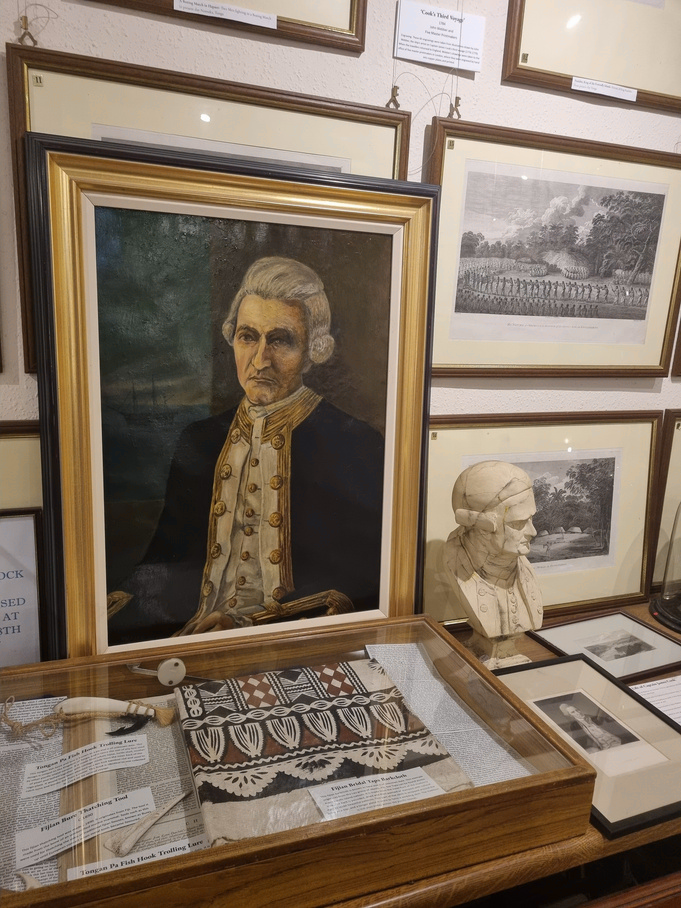
While Scout was in Hawaiʻi, her captain, Ralph Cator, helped transport the people and materials needed to build a new memorial to Captain James Cook at Kealakekua Bay. The 27-foot white obelisk was unveiled on 14 November 1874.
There had been a much humbler memorial there before. When Mark Twain visited the site in 1866, Cook's death was marked by an old coconut-palm stump covered in pieces of copper taken from visiting ships. Officers had scratched their names and dates into the copper, leaving behind a rather extraordinary record of generations of Royal Navy visitors.
It was from one of the palms growing at this historic site that Henry Grange collected our coconut.
Grange had already had an extraordinary escape. Four years earlier he had been aboard HMS Captain when the ship capsized in the Bay of Biscay. More than 500 people were aboard and only 18 survived. Grange was one of them.
After bringing the coconut home, he cut it in half and polished the shell. One half was turned into a pincushion by his wife, and it passed through the family until his granddaughter, Ethel Hine, decided that its story deserved to be preserved. Eventually it crossed the country — and the Atlantic in spirit, at least — one more time, finding its home here at Staithes.
Collected in 1874, the coconut has now been with us for around 152 years. It is a small object, but it carries an extraordinary chain of stories: a Hawaiian landscape, the commemoration of Cook, Victorian naval expeditions, astronomical science, a shipwreck, one sailor's survival, and a family's determination to keep hold of a treasured souvenir.
And, perhaps most wonderfully of all, after all those adventures it is still a pincushion.
Six new stories from Staithes Museum
There’s been a bit of a blog explosion over the last few weeks, with six new posts now waiting to be explored on the Staithes Museum website.
You can find out how Staithes Museum came to be, hear Anne King’s memories of growing up in the village, and follow one family historian’s four-year investigation into a great-grandfather, a gamekeeper, a shooting and a rather troublesome family mystery.
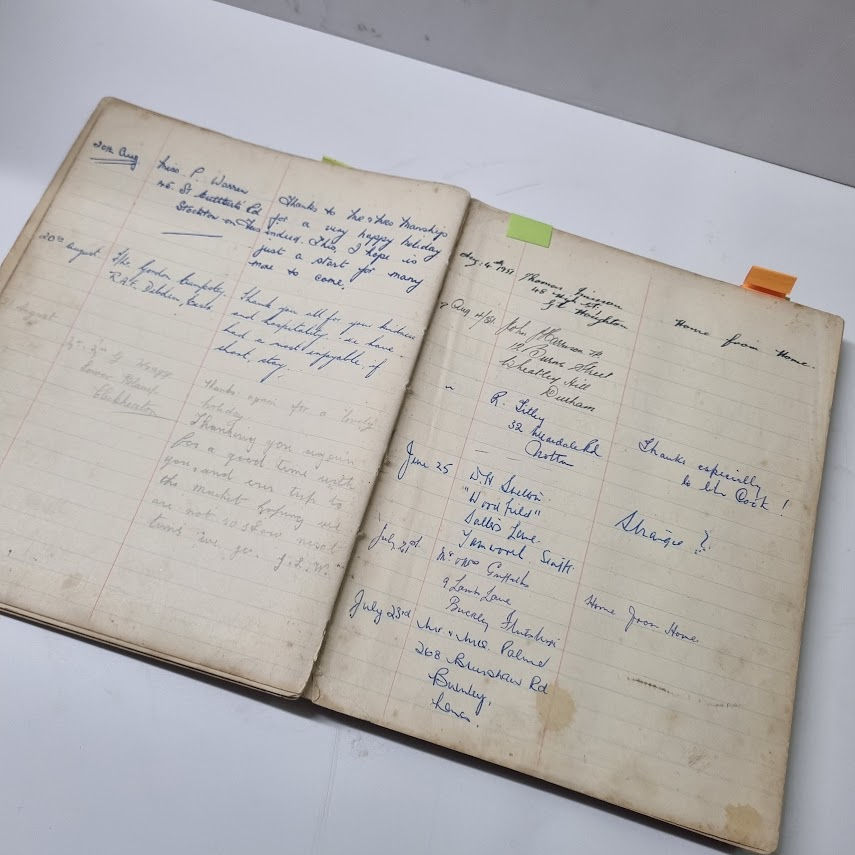
You can also explore Staithes with the late Bill Hinchley, whose walking tour brings the village’s streets, buildings and stories to life, discover the remarkable life of Marie Lowden, Staithes’ famous “Toffee Crackle Lady”, and take a trip back to 1927, when a group of schoolchildren from Huddersfield came to Staithes for their holiday.
So whether you’re interested in local history, family history, village characters, old photographs, or simply the stories behind the places you think you know, there’s plenty to get stuck into.
Have a browse — and you may find that one story leads you straight into another.
Thank You, Seton School!
A big thank you to Seton School for visiting us at the museum last week!
We hope you enjoyed having a good look around the collection, hearing some of the stories behind the objects, and finding out a little more about Staithes’ history.
And, of course, we hope you enjoyed getting to touch the original wooden shutter from Captain Cook’s shop – we hope your journey takes you wherever you dream of going, yourself!
It was lovely to have you with us, and we hope to see you again!

Comments